 Skip to content
When a Semi-Truck Hits You in Atlanta, Every Second Counts
If you need an Atlanta commercial truck attorney in Atlanta, here’s what matters most right now:
Quick answers for truck accident victims in Atlanta:
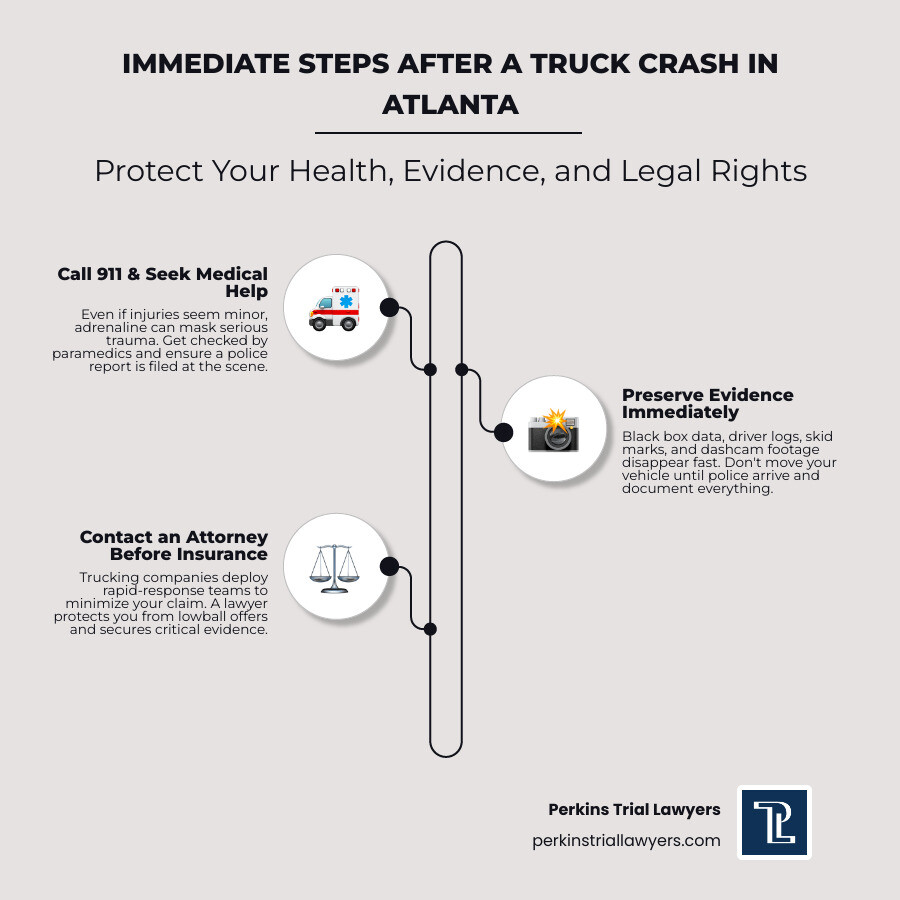
- Get medical help first — call 911 immediately, even if you feel “okay”
- Don’t talk to the trucking company’s insurance without a lawyer
- Evidence disappears fast — black box data, driver logs, and skid marks don’t last long
- You have 2 years to file a personal injury claim in Georgia (O.C.G.A. § 9-3-33)
- Multiple parties can owe you money — not just the driver, but the trucking company, cargo loaders, and more
The numbers from Fulton County in 2024 tell a hard story. There were 13,389 crashes involving large trucks, leaving 4,306 people injured and 37 dead. That’s not a statistical blip — it’s a crisis on Atlanta’s roads, and it’s getting worse. Truck accidents have jumped 49% over the last decade.
When a fully loaded semi weighing up to 80,000 pounds hits your car, the results are almost never minor. The injuries are severe. The medical bills pile up fast. And within hours of the crash, the trucking company’s defense team is already working against you.
This guide explains what to do, what to expect, and what makes truck accident claims so different — and so much harder — than a typical car accident case.
Basic Atlanta commercial truck attorney Atlanta glossary:
- Atlanta trucking accident attorney
- Tractor trailer accident lawyer Atlanta
- Atlanta big rig accident attorney
Why Truck Accidents in Georgia Require an Atlanta Commercial Truck Attorney Atlanta

A common mistake many accident victims make is assuming that a commercial truck crash is just a “bigger” car accident. In reality, the legal, regulatory, and physical dynamics of a semi-truck collision belong to an entirely different world. If you attempt to resolve a commercial truck claim using the same approach as a standard passenger vehicle claim, you will quickly find yourself outmatched by corporate legal teams.
First, consider the physics of the collision itself. An average passenger vehicle weighs about 3,000 to 4,000 pounds. A fully loaded commercial tractor-trailer can weigh up to 80,000 pounds. This massive size disparity means that commercial trucks carry an unbelievable amount of kinetic energy. When a collision occurs, this energy is transferred directly to the smaller vehicle, often resulting in catastrophic structural damage and life-altering injuries.
Furthermore, the stopping distance required for these giant rigs is immense. Under ideal road conditions, a fully loaded 18-wheeler traveling at highway speeds requires up to 525 feet to come to a complete stop—which is nearly the length of two entire football fields. When roads are wet or slick, or if the truck’s brakes are poorly maintained, that distance increases significantly. This is why rear-end collisions involving semis on our local interstates are so frequently fatal.
To navigate these complex physical and legal realities, you need an experienced Atlanta truck collision lawyer who understands how to build a case from the ground up. Commercial trucking is governed by a dense web of rules, primarily established by the Federal Motor Carrier Safety Administration (FMCSA). These regulations dictate everything from how many hours a driver can spend behind the wheel to how often the vehicle’s brake pads must be inspected. Proving negligence in a truck accident case requires demonstrating how the driver or the motor carrier violated these strict standards. For more information on these federal guidelines, you can review the FMCSA safety regulations and resources.
How an Atlanta Commercial Truck Attorney Atlanta Uncovers FMCSA Violations
When we investigate a commercial vehicle crash, our primary goal is to determine whether the trucking company or the driver violated federal safety laws. One of the most common violations we see involves the FMCSA’s Hours of Service (HOS) regulations. These rules are explicitly designed to prevent fatigued driving by limiting a commercial driver to a maximum of 11 hours of driving after 10 consecutive hours off duty.
Despite these clear rules, driver fatigue remains a contributing factor in approximately 13% of all commercial truck crashes. Trucking companies often operate on razor-thin profit margins and tight delivery schedules, which can create immense pressure on drivers to cut corners, falsify paper logs, and push past their physical limits.
This is where advanced technology becomes our most valuable asset. Modern commercial trucks are equipped with Electronic Logging Devices (ELDs) and electronic “black boxes” (specifically, Electronic Control Modules or ECMs). These devices automatically record critical operational data, including:
- Exact driving hours and rest breaks
- Vehicle speed immediately prior to impact
- Brake application timing and force
- Sudden acceleration or deceleration events
- GPS location history
Because trucking companies are only legally required to preserve this data for a limited time under federal law, we must act immediately to prevent this evidence from being overwritten or destroyed. Working with an attorney who knows how to draft and serve an immediate spoliation letter is the most critical step in protecting your claim. You can read more about this investigative process in our ultimate guide to hiring an Atlanta semi-truck accident lawyer.
Proving Liability with an Atlanta Commercial Truck Attorney Atlanta
In a typical passenger car accident, liability is usually straightforward: one driver made a mistake, and their insurance company is responsible. In a commercial truck accident, however, liability is rarely limited to the person sitting in the driver’s seat. Because the trucking industry relies on a complex network of independent contractors, corporate carriers, third-party logistics brokers, and maintenance providers, multiple parties may share responsibility for your injuries.
When we build an 18 wheeler lawsuit Atlanta attorney navigating the road to a settlement strategy, we thoroughly investigate every entity involved in the truck’s operation:
- The Trucking Company (Carrier): Under the legal doctrine of respondeat superior, employers are generally liable for the negligent actions of their employees. Additionally, carriers can be held directly liable for negligent hiring, failing to perform required background and drug checks, or failing to properly train their drivers.
- Cargo Loading Companies: If a flatbed truck carries unsecured cargo, or if a closed trailer is loaded unevenly, the freight can shift during transit. This shift can cause the driver to lose control, leading to devastating rollover or jackknife accidents.
- Maintenance Contractors: Many trucking companies outsource their fleet maintenance to third-party mechanics. If a contractor signs off on a vehicle with worn brake pads, bald tires, or defective steering components, they can be held liable for a mechanical failure on the highway.
- Parts Manufacturers: If a catastrophic tire blowout or brake failure was caused by a design or manufacturing defect, we can pursue a product liability claim against the manufacturer of that specific component.
Common Causes and Dangerous Corridors for Atlanta Truck Wrecks
Atlanta is the logistical hub of the Southeast, which means our local highways are constantly flooded with massive commercial rigs. Some of our local corridors are so congested and poorly designed for heavy truck traffic that they have gained national notoriety. According to the American Transportation Research Institute, Georgia is home to 9 of the nation’s 100 worst trucking bottlenecks.
If you commute in the metro area, you are likely familiar with these high-risk zones:
- The I-285 Perimeter: Especially the northern arc near I-75 and I-85, where rapid lane changes and heavy merging lead to frequent side-swipe and jackknife wrecks.
- Spaghetti Junction (I-285 at I-85 North): A dizzying maze of flyover ramps and tight curves that can easily cause top-heavy commercial trucks to lose balance.
- The Downtown Connector (I-75/I-85 through downtown): Constant stop-and-go traffic combined with limited shoulder space makes this corridor prime territory for catastrophic rear-end collisions.
- The I-20 Corridor: A major east-west freight route where driver fatigue often peaks as long-haul truckers approach the city limits.
These corridors are particularly hazardous because of how commercial trucks behave compared to standard passenger cars. To help visualize these differences, we have broken down the contrasting dynamics below:
| Feature / Dynamic | Passenger Car | Commercial Semi-Truck |
|---|---|---|
| Average Weight | 3,000 – 4,000 lbs | Up to 80,000 lbs (fully loaded) |
| Braking Distance (60 mph) | ~130 – 140 feet | Up to 525 feet (length of ~2 football fields) |
| Turning Radius | Small (~35 feet); easily maneuvers tight city corners | Extremely wide; requires swinging left to turn right |
| Blind Spots (“No-Zones”) | Minimal; easily managed with side and rearview mirrors | Massive blind spots directly behind, in front, and along both sides |
| Rollover Risk | Low; low center of gravity | High; top-heavy cargo easily shifts on curves or ramps |
When a commercial driver fails to account for these physical limitations—especially on congested stretches like the Perimeter—the results are often fatal. If you or a loved one has survived a rollover collision, we encourage you to read the 18-wheeler rollover Atlanta lawyer survival guide to understand your legal options.
Understanding Damages and Georgia’s Modified Comparative Fault Rule
Because the physical impact of a semi-truck crash is so severe, the financial toll on victims is often astronomical. Under Georgia law, injured victims have the right to pursue full compensation for both their economic and non-economic losses.
Economic damages are the quantifiable financial costs resulting from the accident. These include:
- Immediate emergency room bills and hospital stays
- Ongoing physical therapy and specialized rehabilitation
- Future medical treatments, surgeries, and medical equipment
- Lost wages from missed work during recovery
- Loss of future earning capacity if you suffer a permanent disability
Non-economic damages are designed to compensate you for the intangible, human cost of the accident. These include physical pain and suffering, emotional distress, loss of enjoyment of life, and loss of consortium (the impact of your injuries on your relationship with your spouse).
In rare cases where the trucking company or driver acted with conscious indifference to safety—such as driving under the influence of drugs or alcohol, or forcing a driver to violate HOS rules—we may also pursue punitive damages. These are not meant to compensate the victim, but rather to punish the negligent party and deter similar reckless behavior in the future.
Navigating these claims requires a deep understanding of Georgia’s modified comparative fault rule under O.C.G.A. § 51-12-33. Under this system, you can still recover compensation even if you were partially at fault for the accident, provided your percentage of fault is less than 50%. However, your total recovery will be reduced by your percentage of blame. For example, if a jury determines your total damages are $1,000,000, but finds you were 10% at fault for changing lanes too quickly, your final award will be reduced to $900,000.
Because insurance defense lawyers will do everything in their power to shift the blame onto you to minimize their payout, having a skilled advocate build a clear, evidence-backed case is essential. You can learn more about how these financial recoveries are calculated by reading our guide on securing a truck accident settlement Atlanta lawyer.
Frequently Asked Questions About Atlanta Truck Accidents
What is the statute of limitations for a truck accident in Georgia?
In Georgia, the timeline to take legal action is strict. Under O.C.G.A. § 9-3-33, you generally have two years from the date of the accident to file a personal injury lawsuit. If you are filing a wrongful death claim on behalf of a loved one who passed away in a collision, the timeline is governed by O.C.G.A. § 51-4-2, which allows two years from the date of death to file.
While two years may sound like a long time, in the context of a commercial truck accident, it passes incredibly quickly. Building an airtight case requires obtaining black box data, interviewing witnesses, conducting accident reconstructions, and reviewing thousands of pages of corporate safety logs. If you wait too long to consult an attorney, critical physical evidence may be lost, and witnesses’ memories will fade. If you have lost a family member to a negligent trucking operation, please review our compassionate resource on navigating a fatal truck crash Atlanta lawyer claim.
Why are heavy trucks restricted inside the I-285 perimeter?
To combat extreme traffic congestion and reduce the risk of catastrophic highway accidents, Atlanta enforces strict local ordinances that prohibit heavy commercial trucks (specifically those with 6 wheels or more) from traveling inside the I-285 perimeter.
There are only two exceptions to this rule:
- The truck is actively making a local pickup or delivery inside the city.
- The truck’s terminal or maintenance facility is located inside the perimeter.
If a long-haul truck driver was simply using the Downtown Connector as a shortcut to travel through Georgia and caused an accident, their violation of this local perimeter restriction can serve as powerful evidence of negligence. If you were struck by a semi-truck operating inside the Perimeter, we recommend reading our specific guide on semi-truck rollover Atlanta lawyer claims to see how these local rules apply to your case.
How do insurance companies try to minimize truck accident claims?
The commercial trucking industry is backed by massive, multi-million-dollar insurance policies. Because the financial stakes are so high, these insurance providers do not play fair. Within hours of a serious crash, the insurance company will dispatch a “rapid-response” defense team—including corporate investigators, reconstruction experts, and defense attorneys—directly to the scene of the accident to gather evidence that protects their bottom line.
Some of the most common tactics they use to minimize or deny your claim include:
- Offering quick, lowball settlements: They will contact you while you are still recovering in the hospital, offering a fast cash payout in exchange for signing a liability waiver. This initial offer is almost always a fraction of what your case is actually worth.
- Requesting recorded statements: Adjusters will call you under the guise of “helping process your claim,” but their actual goal is to get you to say something that can be twisted to sound like you are admitting fault.
- Searching your medical history: They will demand access to your entire medical history, searching for pre-existing injuries or conditions they can blame for your current pain.
To protect yourself from these predatory corporate tactics, you should never sign any documents or speak to an insurance adjuster without legal representation. For a deeper look at how to protect your rights, read our breakdown on why you need an Atlanta trucking accident attorney.
Standing Up to Corporate Giants for Atlanta Families
When you are recovering from a catastrophic truck crash, the last thing you should have to worry about is fighting a multi-billion-dollar trucking corporation and their army of insurance adjusters. At Perkins Trial Lawyers, we provide tireless, aggressive advocacy against insurance companies to secure the maximum compensation you need to rebuild your life.
We do not believe in quick, easy settlements that leave our clients shortchanged. We prepare every single case as if it is going to trial, ensuring that the insurance companies know we are ready to fight for you in court if they refuse to offer a fair settlement.
If you or a loved one has been injured on an Atlanta highway, do not go through this difficult journey alone. Contact us today for a free, no-obligation case evaluation. We will review the details of your crash, explain your legal options under Georgia law, and help you take the first step toward securing the justice and recovery you deserve. To learn more about our practice and how we can help, visit our dedicated page for a Truck accident lawyer in Atlanta GA.
