 Skip to content
What You Need to Know About Filing an Atlanta Tractor Trailer Claim
An Atlanta tractor trailer claim is one of the most complex personal injury cases you can face — and what you do in the first hours after a crash can make or break your recovery.
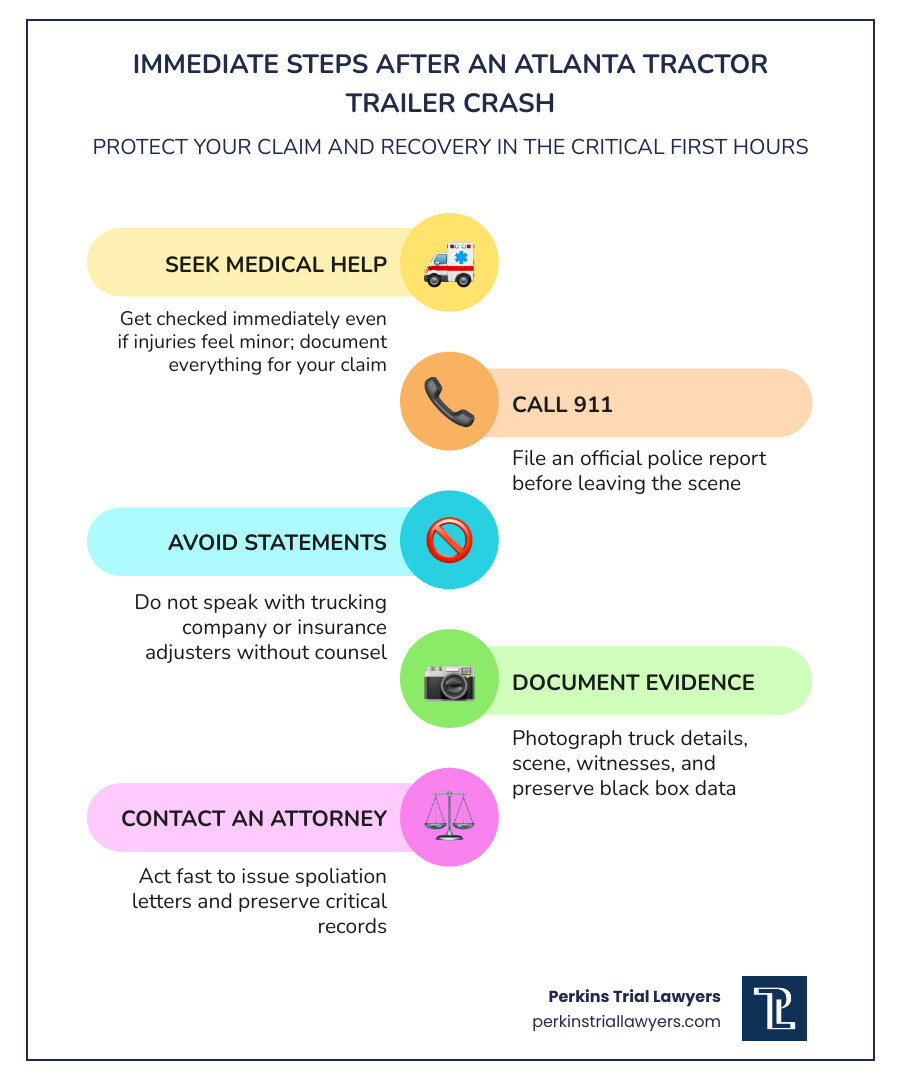
If you were hurt in a crash involving a commercial truck in Atlanta, here is what matters most:
- Seek medical attention immediately, even if you feel fine
- Call 911 and get an official police report filed
- Do not give statements to the trucking company or their insurance adjusters
- Document everything — photos, witness names, truck markings, and driver details
- Contact a truck accident attorney as soon as possible to preserve critical evidence
- Do not accept any settlement offer before speaking with a lawyer
Why does speed matter so much? Because in 2023, 188 people died in large-truck crashes in Georgia alone — and trucking companies deploy rapid-response teams to crash scenes within hours to protect their own interests.
More than 27,000 trucks move through the Atlanta metro every single day. Highways like I-285, I-75, and I-20 are among the busiest freight corridors in the Southeast. When a tractor-trailer — which can weigh up to 80,000 pounds — collides with a passenger car, the results are almost always catastrophic.
These cases are not like standard car accident claims. They involve federal regulations, multiple potentially liable parties, and insurance companies with aggressive legal teams. Knowing your rights from the start is critical.
Similar topics to Atlanta tractor trailer claim:
- 18 wheeler fatality Atlanta lawyer
- Atlanta truck collision lawyer
- Truck accident settlement Atlanta lawyer
Common Causes of Commercial Truck Wrecks in Georgia
When we look at the sheer volume of commercial vehicle traffic on Georgia highways, it becomes clear that accidents are rarely simple flukes. They are often the direct result of systemic pressures, safety shortcuts, and clear violations of federal law. According to the Federal Motor Carrier Safety Administration (FMCSA) Large Truck Crash Causation Study, driver actions are the critical factor in 87% of serious commercial vehicle crashes.
To build a strong Atlanta tractor trailer claim, we must first identify exactly what went wrong. The most common causes of commercial truck wrecks in Georgia include:
- Driver Fatigue: Trucking companies operate on incredibly tight delivery schedules. Although federal Hours-of-Service (HOS) regulations dictate how long a driver can be behind the wheel, many drivers face immense pressure to ignore these rules. A fatigued driver has slower reaction times, impaired judgment, and may even fall asleep at the wheel of an 80,000-pound vehicle.
- Distracted Driving: Just like passenger vehicle drivers, truck drivers are susceptible to distractions. Looking at a phone, adjusting a GPS device, or eating while driving can have deadly consequences. When a massive truck travels at highway speeds, a driver looking away for just a few seconds means the vehicle covers the length of a football field completely blind.
- Improper Cargo Loading: If cargo is unbalanced, overloaded, or poorly secured, it can shift during transit. This shift can cause the driver to lose control of the vehicle, leading to rollovers or cargo spilling directly onto busy highways like the Downtown Connector or I-285.
- Mechanical Failure: Commercial trucks require constant, rigorous maintenance. When trucking companies or third-party maintenance providers cut corners to save money, critical systems fail. Brake failures, tire blowouts, steering defects, and faulty trailer couplings are leading causes of equipment-related wrecks.
Understanding these root causes is the first step in holding negligent parties accountable. For a deeper dive into how these factors play out on our local roads, you can read our comprehensive Atlanta Truck Wrecks Guide.
How Jackknife Accidents Impact an Atlanta Tractor Trailer Claim
Among the most terrifying occurrences on metro highways is the jackknife accident. A jackknife occurs when a tractor-trailer’s drive wheels lock up, causing the trailer to slide outward and swing forward, forming a sharp angle resembling a folding pocketknife.
This mechanical and physical phenomenon is incredibly dangerous because the swinging trailer can sweep across multiple lanes of traffic, collecting any passenger vehicles in its path and triggering massive, multi-vehicle pileups.
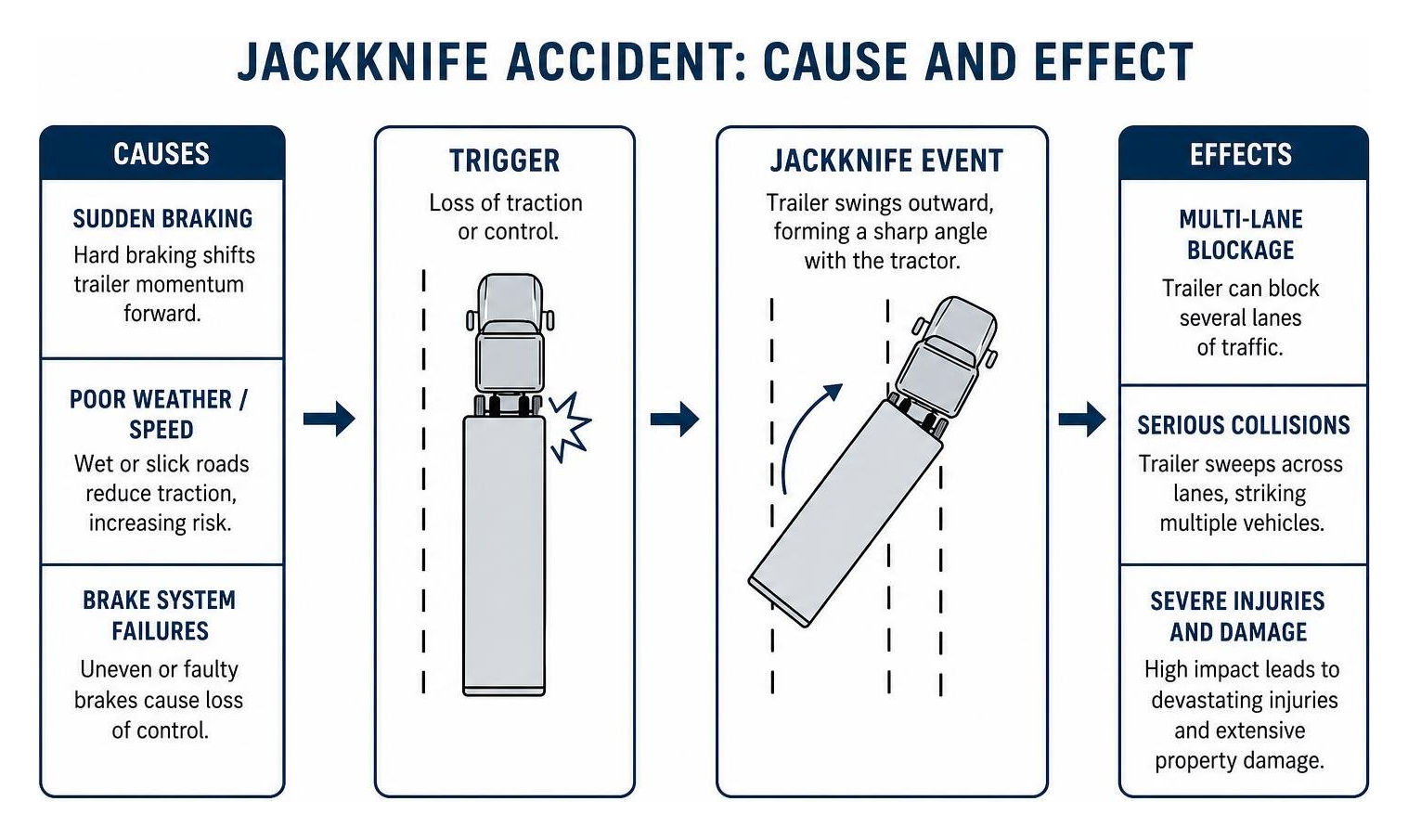
Jackknife accidents are typically triggered by:
- Sudden Braking: If a truck driver slams on the brakes too quickly on a slick highway, the momentum of the heavy trailer can push it past the cab.
- Improper Speed for Weather Conditions: Rain and wet roads reduce tire traction, making it much easier for a trailer to swing out of control.
- Brake System Failures: Poorly adjusted brakes can cause uneven braking force, locking up one side of the vehicle while the other keeps moving.
Determining liability in a jackknife crash requires a detailed forensic analysis of the truck’s braking systems, speed records, and road conditions. If you have been injured in one of these devastating events, consulting an experienced Atlanta Semi Truck Accident Lawyer is vital to securing the evidence needed to prove fault.
Determining Liability in an Atlanta Tractor Trailer Claim
Unlike a standard car accident where you generally seek damages from the other driver, a commercial truck crash involves a web of potentially liable parties. To recover maximum compensation, we must look beyond the driver’s seat.
| Liable Party | Basis of Liability | Key Evidence Used |
|---|---|---|
| Truck Driver | Active negligence (speeding, distracted driving, driving under the influence, hours-of-service violations). | Driver logs, toxicology reports, phone records, dashcam footage. |
| Trucking Company | Vicarious liability, negligent hiring, training, and retention; failure to maintain vehicles. | Driver qualification files, company safety records, maintenance logs. |
| Cargo Loading Company | Improperly securing, balancing, or overloading the freight inside the trailer. | Bills of lading, post-crash cargo photos, weight station records. |
| Parts Manufacturer | Defective truck components (brakes, tires, steering linkages, underride guards). | Physical parts analysis, manufacturing records, recall histories. |
Under the legal doctrine of respondeat superior (vicarious liability), a trucking company is legally responsible for the negligent actions of its employees while they are on the clock. However, trucking companies frequently try to shield themselves from liability by classifying their drivers as independent contractors.
We know how to break through this defense. Federal regulations often classify these drivers as statutory employees regardless of what their contract says, meaning the trucking company cannot escape responsibility. Furthermore, we can pursue direct claims against the company for negligent hiring and retention if they hired a driver with a history of safety violations or failed to conduct proper background checks.
To learn more about how we establish liability and build these complex cases, explore our dedicated page for an Atlanta Truck Accident Lawyer.
Federal Regulations and Georgia Trucking Laws
Commercial trucking is heavily regulated to protect the public. These rules are established by the FMCSA under Title 49 of the Code of Federal Regulations (CFR) and are officially incorporated into Georgia state law under O.C.G.A. § 40-1-8. When a driver or company violates these rules, it serves as powerful evidence of negligence in your claim.
Key regulations include:
- Hours-of-Service limits: Drivers are generally limited to 11 hours of driving after 10 consecutive hours off duty.
- Pre-Trip Inspections: Drivers must inspect their vehicles daily to ensure brakes, lights, and tires are in safe working order.
- Alcohol and Drug Testing: Commercial drivers are held to a strict 0.04% blood alcohol concentration (BAC) limit and are subject to mandatory post-crash drug testing.
Additionally, Georgia provides a unique legal advantage to victims through the Georgia Direct Action Statute (O.C.G.A. § 40-2-140 and O.C.G.A. § 40-1-112). In a standard personal injury case, you cannot sue the defendant’s insurance company directly. However, under Georgia’s direct action laws, you can name the commercial truck’s insurance carrier directly in your lawsuit. This prevents the insurance company from hiding in the shadows and ensures that the jury is fully aware that a major insurance policy is on the line. You can view an example of how these direct action claims are structured in this Georgia Direct Action Statute legal document.
Critical Evidence to Preserve After a Metro Atlanta Crash
The moments following a tractor-trailer collision are a legal battleground. While you are recovering in the hospital, the trucking company’s defense team is already working to minimize their financial exposure. To protect your Atlanta tractor trailer claim, we must act quickly to preserve physical and digital evidence before it is lost, altered, or destroyed.
Critical evidence we must secure includes:
- The Black Box (Electronic Control Module – ECM): Commercial trucks are equipped with ECMs that record vital data in the seconds leading up to a crash. This includes the truck’s speed, brake application, throttle position, and steering angles. If we do not act quickly, this data can be overwritten or cleared during vehicle repairs.
- Electronic Logging Devices (ELD): Modern trucks use ELDs to automatically record driving hours. This digital record is crucial for proving whether a driver was fatigued and violating federal hours-of-service rules.
- Driver Qualification Files (DQF): These files contain the driver’s employment history, medical certifications, road test results, and drug testing records.
- Spoliation Letters: Under Georgia law, we can send a formal spoliation letter to the trucking company and their insurer. This letter legally compels them to preserve all physical evidence, driver logs, maintenance records, and electronic data related to the crash. If they destroy evidence after receiving this letter, the court can penalize them severely, even instructing a jury to assume the destroyed evidence proved the company’s guilt.
Working with an experienced Atlanta Tractor Trailer Accident Lawyer ensures that these critical preservation steps are executed flawlessly within the first 48 hours of the accident.
Understanding Georgia’s Modified Comparative Negligence Rules
A common tactic used by commercial insurance adjusters is to point the finger back at you. They will claim that you cut off the truck, slammed on your brakes, or were distracted. They do this because of Georgia’s modified comparative negligence rules under O.C.G.A. § 51-12-33.
Under Georgia’s 50% bar rule, your ability to recover compensation depends on your percentage of fault:
- If you are 0% to 49% at fault: You can still recover compensation, but your total payout will be reduced by your percentage of blame. For example, if a jury determines your total damages are $1,000,000, but finds you were 10% at fault for speeding, your final recovery will be $900,000.
- If you are 50% or more at fault: You are completely barred from recovering any compensation under Georgia law.
Because the financial stakes are so high, insurance companies will fight tooth and nail to push your percentage of fault over that 50% threshold. We utilize accident reconstructionists, highway safety professionals, and forensic evidence to counter these arguments and prove the truck driver was the primary negligent party. For more information on how fault percentages impact your final payout, read our Atlanta Truck Accident Settlement Guide.
Compensation and Damages in Georgia Trucking Cases
The physical, emotional, and financial toll of a tractor-trailer accident can be overwhelming. Under Georgia law, victims have the right to pursue full compensation for all losses stemming from the crash.
In a typical trucking injury claim, we pursue three main types of damages:
1. Economic Damages
These are the tangible, measurable financial losses you have incurred or will incur in the future. They include:
- Medical Expenses: Emergency room visits, surgeries, hospital stays, doctor appointments, prescription medications, and physical therapy.
- Future Medical Care: Long-term rehabilitation, assistive devices, home modifications, and ongoing medical treatments.
- Lost Wages: Income lost while you are recovering and unable to work.
- Lost Earning Capacity: If your injuries result in permanent disability that prevents you from returning to your career, we calculate your lifetime lost earning potential.
2. Non-Economic Damages
These represent the intangible, personal impact of the accident on your life. They include:
- Pain and Suffering: The physical pain and discomfort caused by your injuries.
- Mental Anguish: Anxiety, depression, PTSD, and sleep disturbances following the traumatic event.
- Loss of Enjoyment of Life: The inability to participate in hobbies, sports, and daily activities you enjoyed before the crash.
- Loss of Consortium: The negative impact of the injuries on your relationship with your spouse.
3. Punitive Damages
Unlike compensatory damages, punitive damages are not meant to compensate you for a loss. Instead, they are designed to punish the defendant for active, egregious misconduct and deter others from acting similarly. Under Georgia law, punitive damages may be awarded if we can prove the trucking company or driver acted with “willful misconduct, malice, fraud, wantonness, oppression, or that entire want of care which would raise the presumption of conscious indifference to consequences.” Examples include driving under the influence of drugs or alcohol, or a trucking company knowingly putting a truck with completely failed brakes on the road.
To understand the full value of your claim and how we calculate these damages, reference our Atlanta 18 Wheeler Injury Lawyer Guide.
Frequently Asked Questions About Atlanta Truck Accidents
Dealing with the consequences of a major truck wreck brings up many pressing questions. Here are the answers to the most common questions we receive from victims in the metro Atlanta area.
What is the statute of limitations for an Atlanta tractor trailer claim?
In Georgia, the statute of limitations for a personal injury or wrongful death claim is generally two years from the date of the accident under O.C.G.A. § 9-3-33.
While two years may seem like a long time, waiting to file is a critical mistake. Evidence disappears quickly, witnesses move away, and physical road conditions change. Additionally, if the tractor-trailer is owned by a government entity, much shorter administrative notification deadlines (known as ante-litem notices) may apply. If you have tragically lost a family member in a crash, consult our Atlanta Fatal Truck Crash Lawyer to understand the specific legal timelines for wrongful death claims.
What immediate steps should I take after a tractor-trailer crash in Atlanta?
Your actions immediately following a crash are vital to your physical recovery and your legal claim:
- Prioritize Safety: If possible, move your vehicle to the shoulder of the road to avoid secondary collisions on busy highways.
- Call 911: Request both police and emergency medical services. Ensure the responding officer files an official accident report.
- Seek Medical Care: Go to the emergency room or see a doctor immediately. Some severe injuries, like internal bleeding or traumatic brain injuries, may not show symptoms right away.
- Gather Evidence: Take photos of the vehicle damage, road conditions, skid marks, and the truck’s license plates and company logos. Collect contact information from any eyewitnesses.
- Do Not Speak to Insurance Adjusters: The trucking company’s insurance adjusters may call you asking for a recorded statement. Politely decline and refer them to your attorney.
For more detailed guidance on post-crash protocols, see our Atlanta Car Accident Lawyer resource page.
Why is it critical to hire legal representation quickly?
Trucking companies do not wait to build their defense. They deploy rapid-response teams — consisting of investigators, reconstructionists, and corporate lawyers — to the scene of a crash within hours of the collision. Their goal is to control the narrative, gather evidence that favors their driver, and find ways to minimize your injuries.
By hiring a dedicated legal advocate immediately, you level the playing field. We can launch our own independent investigation, send out spoliation letters to protect electronic data, and handle all communications with the insurance carriers so you can focus entirely on healing. Learn more about how we counter these corporate defense tactics by reading our guide on hiring an Atlanta Big Rig Accident Attorney.
Secure Your Recovery with Dedicated Atlanta Legal Advocacy
When you are facing the devastating aftermath of a commercial truck crash, you should not have to fight the insurance companies alone. At Perkins Trial Lawyers, we provide tireless advocacy to help you secure the maximum compensation you deserve.
We understand the complex state and federal regulations that govern the trucking industry, and we prepare every case as if it is heading to trial. This aggressive preparation shows the insurance companies that we will not settle for lowball offers.
If you or a loved one has been injured in a tractor-trailer collision in metro Atlanta, contact our Atlanta Truck Accident Lawyer team today for a free, no-pressure consultation to discuss your legal options.
