 Skip to content
When an Unsafe Property Changes Your Life in an Instant
If you’ve been hurt on someone else’s property, an unsafe premises lawyer can help you understand whether the property owner is legally responsible — and what you can recover.
Here’s what you need to know right away:
- Property owners in Georgia have a legal duty to keep their premises reasonably safe for visitors.
- If a dangerous condition caused your injury and the owner knew (or should have known) about it, you may have a valid premises liability claim.
- Georgia’s statute of limitations gives you two years from the date of injury to file a lawsuit.
- You can recover compensation for medical bills, lost wages, pain and suffering, and more.
- A premises liability attorney can investigate, gather evidence, and handle insurance companies on your behalf.
One moment you’re walking into a store, apartment building, or parking lot. The next, a wet floor, broken stair, or dark hallway has turned your life upside down. Medical bills pile up. You miss work. And the property owner’s insurance company is already working to minimize — or deny — your claim.
You don’t have to face that alone.
Georgia law holds negligent property owners accountable. But proving a claim requires more than showing you were hurt. You need to show the owner failed their legal duty — and that failure caused your injury.
That’s exactly what a premises liability claim is built around.
What Counts as an Unsafe Property Under Premises Liability Law?
At its core, premises liability law is about accountability. When you step onto someone else’s property in Georgia—whether it is a grocery store in Midtown, an apartment complex in Buckhead, or a neighbor’s home in Decatur—you have a right to expect that you won’t be sent to the emergency room by a hidden hazard.
An “unsafe property” is not just a place that looks run-down. Under Georgia law, a property is legally unsafe when it features a hazardous condition that poses an unreasonable risk of harm to visitors, and the person responsible for the property has failed to address it. This concept is closely tied to property maintenance and building codes.
Municipalities establish strict building codes to ensure structures are physically sound, stairwells are stable, and fire exits are clear. When a commercial or residential owner ignores these codes, they are not just cutting corners—they are actively creating a dangerous environment.
If you have been injured due to a property owner’s failure to maintain their building, consulting an experienced Premises Liability Lawyer Atlanta is the first step toward understanding your legal options and holding the negligent party accountable.
Common Examples of Dangerous Property Conditions
Unsafe conditions can take many shapes. While some hazards are glaringly obvious, others are subtle traps waiting to cause a severe injury. Here are the most common examples we see in Atlanta:
- Slip and Fall Hazards: This is the most common category of premises claims. It includes wet floors from spilled liquids, freshly mopped surfaces left without warning signs, loose rugs, slick transitions between flooring types, and rainwater tracked into a store entryway.
- Poor Lighting: Dark parking lots, unlit stairwells, and dim apartment corridors are breeding grounds for injuries. Poor lighting makes it impossible to see structural hazards and invites criminal activity.
- Broken Handrails and Defective Stairs: Missing railings, loose steps, rotting wood on decks, and uneven risers frequently cause catastrophic fall injuries.
- Elevator and Escalator Malfunctions: Sudden drops, misaligned stops (where the elevator cabin does not align perfectly with the floor), and sudden stops can throw passengers to the ground, causing severe joint and spinal injuries.
- Negligent Security: When property owners fail to provide adequate security measures—such as working gates, security guards, or security cameras—in areas with a history of crime, they can be held responsible if a visitor is assaulted.
Whether you tripped over an unexpected obstacle in a retail aisle or fell down a dark stairwell, a dedicated Slip and Fall Attorney in Atlanta can help you establish that the property owner’s neglect directly caused your suffering.
The Legal Elements of a Property Negligence Claim
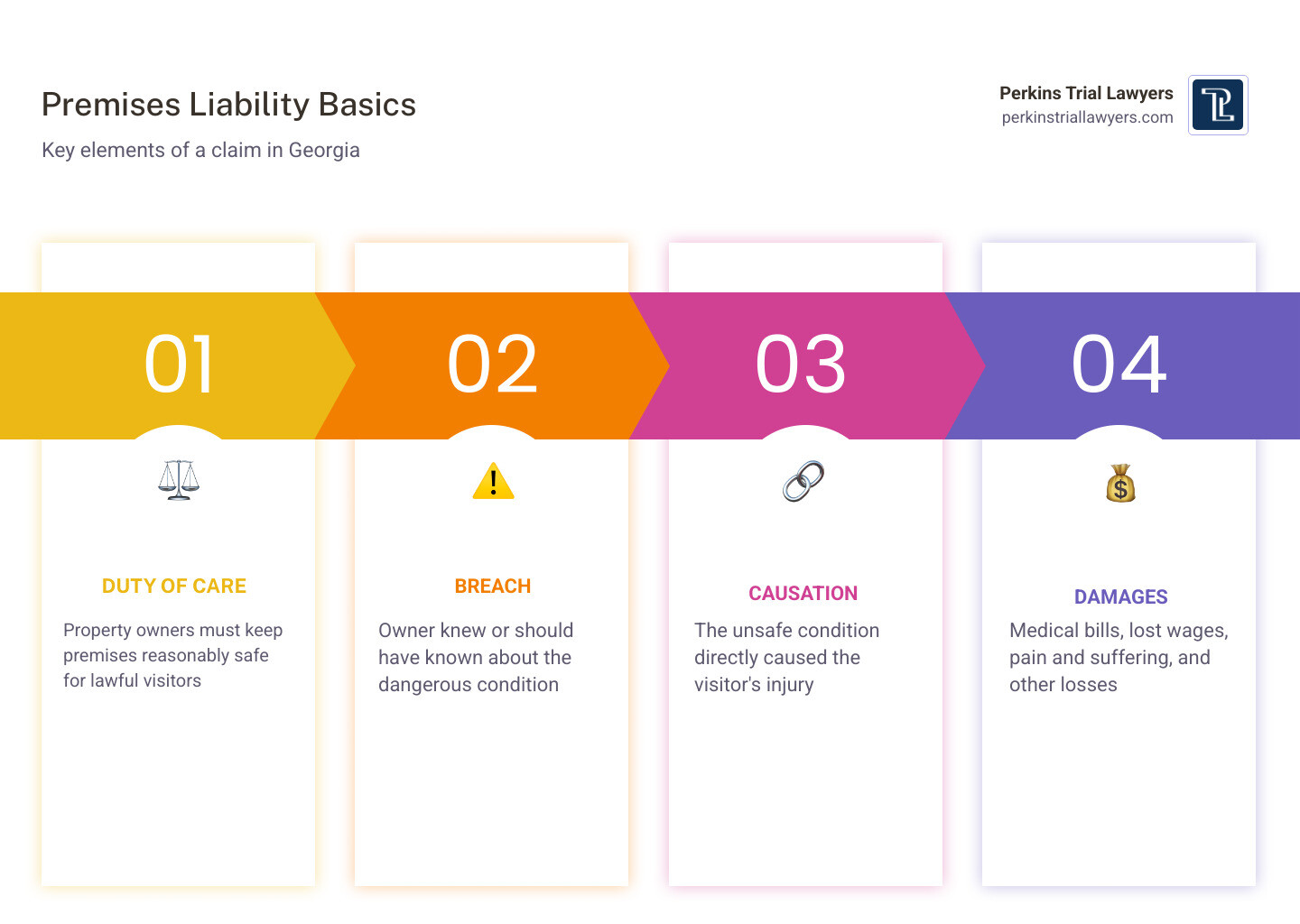
You cannot secure compensation simply by proving that you were injured on someone else’s property. To win a premises liability lawsuit in Georgia, your legal team must establish four core elements of negligence:
- Duty of Care: You must prove that the property owner or occupier owed you a legal duty to keep the premises safe. This duty depends heavily on why you were on the property.
- Breach of Duty: You must show that the owner breached that duty by allowing a dangerous condition to exist on the premises.
- Causation: You must directly link the property owner’s breach of duty to your injuries. In other words, you must prove that the hazardous condition—and not something else—caused your accident.
- Damages: You must have suffered actual losses, such as medical bills, lost income, or physical pain and suffering.
A major battleground in these cases is proving notice. Under Georgia law, a property owner is generally only liable if they had notice of the hazard. Notice comes in two forms:
- Actual Notice: The owner or their employees knew about the hazard. For example, a customer told a manager about a spill, or an employee wrote a maintenance request for a broken step but failed to fix it.
- Constructive Notice: The hazard existed for such a length of time that the owner should have discovered and corrected it if they were exercising reasonable care. For instance, if a grocery store floor goes uninspected for several hours and a leak pools into a massive puddle, the store has constructive notice.
Proving these elements requires deep legal knowledge. Working with a skilled Georgia Premises Liability Attorney ensures that your case is built on solid evidence rather than assumptions.
Duty of Care Owed to Invitees, Licensees, and Trespassers
In Georgia, the level of care a property owner owes you is determined by your legal status as a visitor. Georgia law divides visitors into three distinct categories:
| Visitor Classification | Definition | Owner’s Duty of Care |
|---|---|---|
| Invitee | A person invited onto the property for the mutual benefit of both parties (e.g., customers in a retail store, restaurant patrons, hotel guests, or hired contractors). | Highest Duty: Must keep the premises safe through regular inspections, prompt repairs, and clear warnings of hidden hazards (OCGA § 51-3-1). |
| Licensee | A person who enters the property for their own convenience, pleasure, or purposes, with the owner’s implied or express consent (e.g., social guests, family members visiting, or door-to-door salespeople). | Moderate Duty: Owner cannot willfully or wantonly expose the visitor to hidden perils. They must warn of known, non-obvious dangers (OCGA § 51-3-2). |
| Trespasser | A person who enters the property without permission, authority, or consent. | Lowest Duty: Owner generally owes no duty to keep the property safe, but they cannot set traps or intentionally harm the trespasser once their presence is known. |
The Attractive Nuisance Doctrine and Child Trespassers
While property owners generally owe a very low duty of care to adult trespassers, the law changes dramatically when children are involved. Children do not possess the same capacity as adults to understand risks and recognize dangers.
Under the legal doctrine of attractive nuisance, a property owner can be held liable if a child trespasses on their land and is injured by a dangerous, artificial condition that was highly likely to attract children.
Common examples of attractive nuisances include:
- Unsecured swimming pools without proper fencing or self-latching gates.
- Trampolines left open to the public.
- Abandoned machinery, construction equipment, or deep excavations.
- Unsecured playground equipment.
Nationwide, falls are the leading cause of hospitalizations for children up to age 14, with roughly 19% of falls for children ages 1 to 9 occurring on playgrounds. If a property owner maintains a dangerous feature that draws children in, they must take reasonable precautions—like installing secure fences and locks—to prevent foreseeable tragedies. If your child was hurt under these circumstances, an Atlanta Premises Liability Lawyer can help you pursue justice.
How An Unsafe Premises Lawyer Proves Property Owner Negligence
Property owners and their insurance companies rarely admit fault. When you file a claim, they will likely clean up the hazard immediately, claim they had no idea the danger existed, or argue that you were simply clumsy. To beat these tactics, you need an unsafe premises lawyer who knows how to preserve and analyze evidence before it disappears.
Proving negligence requires a prompt, methodical investigation. Our legal team uses several strategies to build an airtight case:
- Securing Surveillance Footage: Many commercial properties have security cameras that capture the exact moment of an accident, as well as the hours leading up to it. This footage can prove how long a hazard was left unaddressed, establishing constructive notice.
- Obtaining Maintenance Logs: We review internal inspection records, cleaning schedules, and sweep logs. If a store’s policy says aisles must be inspected every 30 minutes, but the logs show no one checked the area for four hours, we have clear evidence of neglect.
- Analyzing Building and Safety Records: We look for past code violations, previous complaints about the property, and histories of similar accidents in the same location.
- Preserving Physical Evidence: This includes photographing the hazard from multiple angles, measuring the slip-resistance of the floor, and preserving the footwear you wore during the fall.
If your injury occurred due to criminal activity on a property with a history of violence, a Security Negligence Attorney can subpoena police dispatch logs and internal security reports to prove the owner failed to protect you.
What an Unsafe Premises Lawyer Does to Build Your Case
Navigating a legal claim while recovering from a serious injury is overwhelming. When you hire our firm, we handle the heavy lifting so you can focus on healing.
Our comprehensive approach to building your case includes:
- Immediate Investigation: We dispatch investigators to photograph the scene, interview eyewitnesses, and send formal spoliation letters to the property owner demanding they preserve all video footage and records.
- Consulting Professional Witnesses: We work with structural engineers, retail safety professionals, and medical professionals who can explain exactly how the hazard formed, why it violated safety standards, and how it caused your specific injuries.
- Handling All Insurance Communications: Insurance adjusters are trained to twist your words. We manage all phone calls, emails, and negotiations on your behalf, protecting you from lowball settlement offers.
- Trial Preparation: We prepare every case as if it is going to trial. If the insurance company refuses to offer a fair settlement, we will not hesitate to present your case to an Atlanta jury.
For a deeper dive into how this process works, read The Ultimate Guide to Slip and Fall Lawyers in Atlanta.
Common Defenses Used by Property Owners and Insurers
Insurance companies use a predictable set of defenses to avoid paying premises liability claims. Understanding these tactics helps us anticipate and defeat them:
- The “Open and Obvious” Doctrine: The defense will argue that the hazard was so visible and obvious that any reasonable person would have seen and avoided it. However, under Georgia law, this is not a automatic bar to recovery; it is a factor evaluated by a jury.
- Comparative Negligence: The insurance company will try to shift the blame to you. They might claim you were distracted by your phone, wearing inappropriate shoes, or running.
- Lack of Notice: The owner will swear they had no idea the hazard existed and that it occurred so quickly they had no reasonable opportunity to clean it up.
- Delay Tactics: Insurers often drag out the claims process, hoping you will grow desperate as medical bills pile up and accept a fraction of what your case is actually worth.
We know these tricks inside and out. To learn more about how we counter these corporate strategies, check out our guide on Top Slip Fall Attorneys Atlanta Fighting Insurers.
Steps to Take Immediately After an Injury on Unsafe Property
What you do in the minutes and days following an injury can make or break your legal claim. If you are hurt on someone else’s property, take these steps to protect your health and your legal rights:
- Seek Medical Attention Immediately: Your health is the top priority. Even if you think your injuries are minor, see a doctor. Adrenaline can mask severe injuries, such as internal bleeding or traumatic brain trauma. Prompt medical care also creates an official, unbiased link between the accident and your injuries.
- Report the Incident: Notify the property owner, manager, or landlord immediately. Ask them to write an official incident report and request a physical copy before you leave. Do not sign any statements admitting fault or downplaying your injuries.
- Document the Hazard: Use your smartphone to take clear photos and videos of the dangerous condition that caused your fall. Capture close-ups of the hazard (e.g., the puddle of water, the broken stair, the missing warning sign) as well as wider shots of the surrounding area to show the lack of warnings or poor lighting.
- Gather Witness Contact Information: If anyone saw you fall or noticed the hazard before your accident, ask for their names, phone numbers, and email addresses. Their independent testimony is incredibly valuable.
- Preserve Your Clothing and Shoes: Place the clothes and shoes you were wearing during the accident in a secure bag. Do not wash them or wear them again, as they may contain physical evidence of the hazard.
When to Contact an Unsafe Premises Lawyer After an Injury
Do not wait to seek legal help. You should contact an unsafe premises lawyer as soon as possible after your medical condition is stabilized.
Early consultation is critical because property owners often fix hazards immediately after an accident occurs. While repairs prevent others from getting hurt, they also destroy the physical evidence of your accident.
An attorney can step in immediately to demand the preservation of security footage, identify liable parties, and shield you from aggressive insurance adjusters who want to take a recorded statement before you have legal representation.
Statute of Limitations for Premises Liability in Georgia
In Georgia, you do not have unlimited time to seek justice. Under Georgia law (OCGA § 9-3-33), the statute of limitations for personal injury claims is two years from the date of the accident.
If you fail to file a formal lawsuit before this two-year window closes, you will permanently lose your right to seek compensation, no matter how severe your injuries or how clear the owner’s negligence.
Furthermore, if your injury occurred on public property—such as an Atlanta city sidewalk, a public park, or a government building—the deadlines are much shorter. You must file a formal “ante-litem” notice with the government entity within six months (for municipalities) or twelve months (for county or state entities) of the incident. Acting quickly is essential to protect your rights.
Recovering Damages in a Premises Liability Lawsuit
A successful premises liability claim can secure financial compensation for both your tangible and intangible losses. These damages are divided into three main categories:
Economic Damages (Tangible Financial Losses)
These are objective, quantifiable financial losses that you can prove with receipts, bills, and pay stubs:
- Medical Bills: Covers emergency room visits, hospital stays, surgeries, physical therapy, prescription medications, and any anticipated future medical care.
- Lost Wages: Compensates you for the income you lost because you had to miss work while recovering.
- Loss of Earning Capacity: If your injuries result in a permanent disability that prevents you from returning to your career, you can recover compensation for the lifetime income you would have earned.
Non-Economic Damages (Intangible Personal Losses)
These compensate you for the physical and emotional toll of the accident, which do not have a set price tag:
- Pain and Suffering: Compensation for the physical pain caused by your injuries.
- Emotional Distress: Covers anxiety, depression, PTSD, and sleep disturbances caused by the trauma of the accident.
- Loss of Enjoyment of Life: Compensates you for the inability to participate in hobbies, sports, and daily activities you enjoyed before the injury.
Punitive Damages
In rare cases where the property owner’s conduct showed willful misconduct, malice, fraud, or an entire want of care, Georgia courts may award punitive damages. These are not meant to compensate you, but rather to punish the wrongdoer and deter others from similar reckless behavior.
Frequently Asked Questions About Unsafe Properties
Can I sue if I was injured as a social guest in someone’s home?
Yes. If you are visiting a friend, family member, or neighbor for a social gathering, you are legally classified as a licensee. Under Georgia law (OCGA § 51-3-2), the homeowner has a duty to warn you of any hidden, dangerous conditions they are aware of that you are unlikely to discover on your own.
If they knew about a loose deck railing or a aggressive dog and failed to warn you, they can be held liable. Rest assured, these claims are almost always paid out by the homeowner’s insurance policy, meaning you do not have to worry about taking money directly from a loved one’s pocket. If the injury was caused by a dog, a skilled Dog Bite Attorney in Atlanta GA can help you understand the specific legal requirements for animal liability.
What if I was partially at fault for my slip and fall accident?
Georgia follows a modified comparative negligence system. This means you can still recover compensation even if you were partially to blame for your fall, as long as your share of the fault is less than 50 percent.
If you are found to be 10%, 20%, or 40% at fault, your total compensation will be reduced by that exact percentage. For example, if a jury awards you $100,000 in damages but finds you 20% responsible because you were looking at your phone, you will receive $80,000. However, if you are found to be 50% or more at fault, you are barred from recovering any compensation under Georgia’s “50 percent bar” rule.
How do I file a premises liability claim against a government entity?
Filing a claim against a public entity—such as the City of Atlanta, MARTA, or a state university—is highly complex. Government bodies are protected by sovereign immunity, which limits when and how they can be sued.
To proceed, you must file a highly specific written notice called an ante-litem notice within a very short timeframe (six months for cities, twelve months for counties and the state). This notice must detail the time, place, circumstances, and extent of your injuries. Because the procedural rules are incredibly strict and a single mistake can result in the immediate dismissal of your case, you should consult an attorney immediately if you are injured on public property.
Demand Justice: Partner with Atlanta’s Dedicated Injury Advocates
When an unsafe property leaves you injured, the physical pain is only the beginning. Dealing with aggressive insurance adjusters, confusing legal deadlines, and mounting medical bills can make you feel entirely powerless.
At Perkins Trial Lawyers, we provide tireless advocacy for personal injury victims throughout the Atlanta metro area. We believe that property owners should be held accountable when their neglect hurts innocent people. Our legal team knows the tactics insurance companies use to undervalue claims, and we fight aggressively to secure the maximum compensation you deserve.
If you or a loved one has been hurt by a dangerous property condition, do not navigate this difficult time alone. Contact a dedicated premises liability lawyer in Atlanta today to schedule a free, no-obligation consultation. We work on a contingency fee basis, meaning you pay nothing upfront, and we only get paid if we win your case. Let us fight for the justice and recovery you deserve.
Para obtener asistencia en español, visite nuestra página sobre Abogado de Responsabilidad por Propiedades en Atlanta.
