 Skip to content
Atlanta’s Pedestrian Crisis: What Injured Walkers Need to Know Right Now
If you’re searching for a pedestrian accidents lawyer in Atlanta, here is what you need to know right away:
Quick answers for injured pedestrians in Atlanta:
- See a doctor immediately — even if you feel okay. Some injuries show up days later.
- Call 911 and get a police report filed at the scene.
- Don’t give a recorded statement to any insurance company before talking to a lawyer.
- You have 2 years to file a personal injury lawsuit in Georgia (O.C.G.A. § 9-3-33).
- You can still recover compensation even if you were partly at fault — as long as you were less than 50% responsible.
- Hit-and-run victims may still recover through their own uninsured motorist (UM) coverage.
- Consultations are free and most attorneys work on contingency — no fee unless you win.
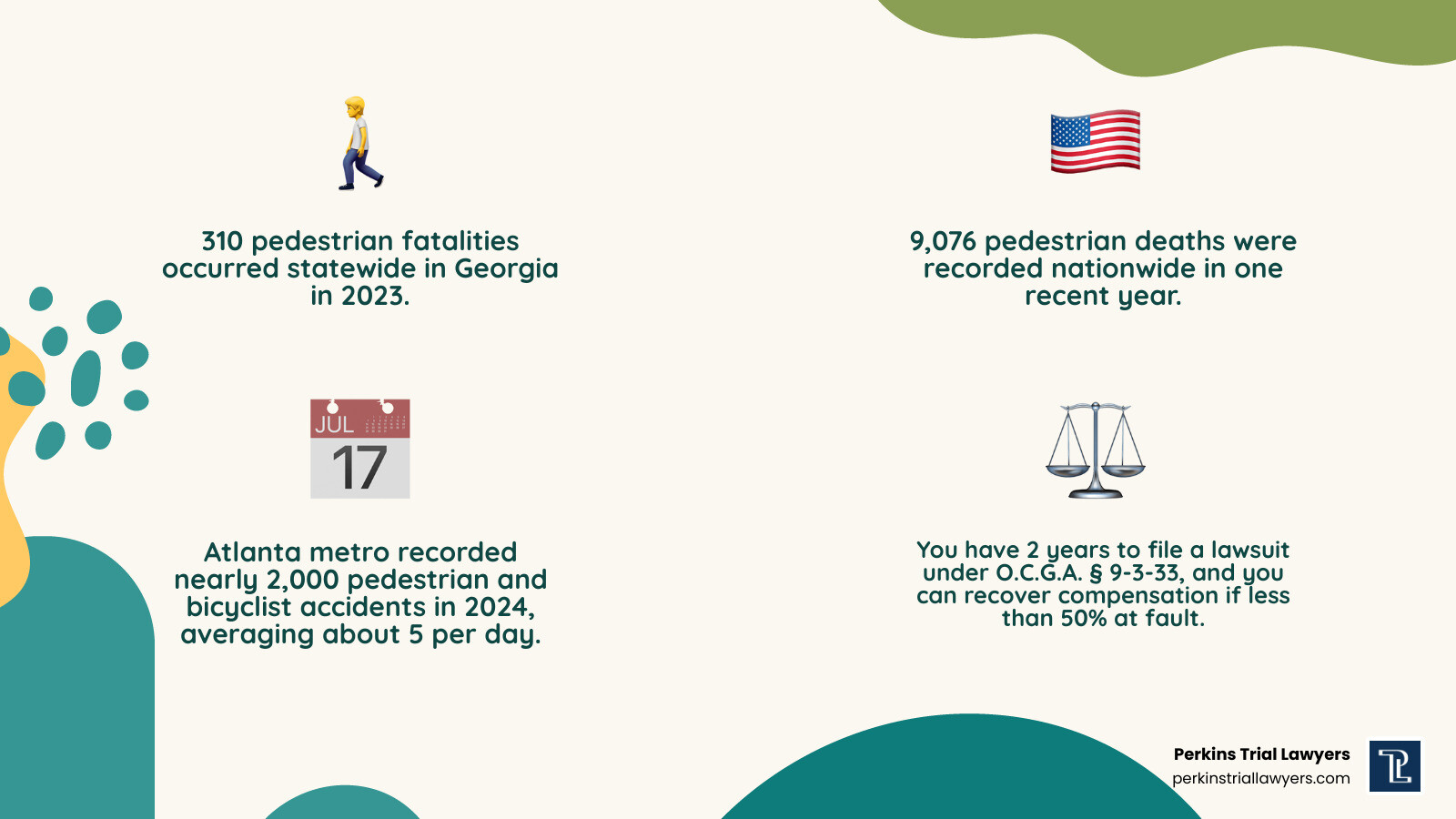
Atlanta has a serious pedestrian safety problem. The Georgia Governor’s Office of Highway Safety recorded 310 pedestrian fatalities statewide in 2023. Nationwide, the National Safety Council tallied 9,076 pedestrian deaths in a single year. In the Atlanta metro area alone, nearly 2,000 pedestrian and bicyclist accidents were recorded in 2024 — roughly 5 per day.
Being hit by a car as a pedestrian is terrifying. The injuries are often catastrophic. Medical bills pile up fast. And insurance companies — even your own — are not on your side.
That’s why what you do in the days immediately following the crash can make or break your case.
Understanding Atlanta’s Dangerous Roads and Common Accident Causes
Atlanta’s rapid growth has transformed it into a bustling economic hub, but our road infrastructure hasn’t always kept pace with the safety needs of people on foot. The city’s “High-Injury Network”—a small percentage of streets where the vast majority of severe traffic crashes occur—highlights how dangerous walking in certain parts of town can be.
Some of the most dangerous roads and corridors for pedestrians in Atlanta include:
- Buford Highway: Known for wide lanes, high speed limits, and long distances between marked crosswalks, making it incredibly hazardous for foot traffic.
- Memorial Drive: A heavily traveled corridor where rapid development meets fast-moving commuter traffic.
- Ponce de Leon Avenue: A high-traffic roadway with frequent pedestrian crossings near popular retail and dining spots.
- Peachtree Street: Running straight through the heart of Midtown and Downtown, this street experiences heavy foot traffic alongside distracted drivers, rideshare drop-offs, and delivery trucks.
When we investigate these crashes, we find that driver behavior is almost always the root cause. Under Georgia law (O.C.G.A. § 40-6-93), motorists have a heightened “due care” duty to avoid colliding with pedestrians. Yet, we regularly see serious injuries caused by:
- Distracted Driving: Drivers looking at smartphones, GPS screens, or entertainment systems instead of watching the crosswalks.
- Speeding: Higher speeds dramatically reduce a driver’s reaction time and exponentially increase the severity of a pedestrian’s injuries.
- Driving Under the Influence (DUI): Alcohol and drugs impair judgment, slow reaction times, and lead to devastating, high-impact collisions.
- Failure to Yield: Drivers turning left or right at intersections often look for oncoming vehicular traffic while completely ignoring pedestrians who have a green walk signal.
If you have been hurt in one of these corridors, working with dedicated Atlanta Pedestrian Accident Lawyers is the best way to ensure your rights are protected while you focus on recovering.
What to Do Immediately After Being Hit by a Car in Atlanta
The moments following a pedestrian crash are chaotic and overwhelming. However, taking a few systematic steps can protect both your physical health and your future legal claim. If you are physically able, follow this checklist:
- Call 911 Immediately: Request both police and emergency medical services. The arriving officer will document the crash and generate an official Georgia Uniform Accident Report (which is later uploaded to the GEARS database). This report is a cornerstone of your injury claim.
- Seek Medical Care: Even if you think your injuries are minor, go to the emergency room or an urgent care clinic. Adrenaline can mask severe internal injuries, traumatic brain trauma, or soft-tissue damage. Medical records created on the day of the accident directly link your injuries to the crash.
- Document the Scene: If you or a companion can do so safely, take photos and videos of the vehicle that hit you, its license plate, the surrounding intersection, any visible traffic signals, skid marks, and your injuries.
- Gather Witness Contacts: Police officers do not always gather statements from every witness. Collect names, phone numbers, and email addresses of anyone who saw what happened.
- Avoid Giving Insurance Statements: The driver’s insurance adjuster may call you within 24 hours, acting friendly and asking for a “recorded statement to help speed up your claim.” Politely decline. These statements are designed to lock you into early, incomplete descriptions of your injuries that can be used to minimize your payout later.
- Contact Legal Representation: Before you sign any medical releases or settlement offers, speak with an experienced Pedestrian Accident Attorney Near Me to understand the true value of your claim.
Proving Liability and Recovering Compensation Under Georgia Law
To win a pedestrian accident lawsuit in Georgia, you must establish the four core elements of negligence:
- Duty of Care: The driver owed you a legal duty to operate their vehicle safely.
- Breach of Duty: The driver violated that duty (e.g., ran a red light, texted while driving, or failed to yield).
- Causation: The driver’s breach directly caused the collision.
- Damages: You suffered actual physical, financial, and emotional harm as a result.
When negligence is proven, you are entitled to pursue comprehensive compensation. This compensation is divided into economic and non-economic damages. In rare cases involving egregious behavior—such as drunk driving or hit-and-run—you may also be awarded punitive damages to punish the driver and deter similar conduct.
Economic vs. Non-Economic Damages
| Economic Damages (Tangible Financial Losses) | Non-Economic Damages (Intangible Personal Losses) |
|---|---|
| Emergency room and hospital bills | Physical pain and suffering |
| Future medical treatment and rehabilitation | Emotional distress and mental anguish |
| Lost wages from missed work | Loss of enjoyment of life |
| Diminished future earning capacity | Permanent impairment or disfigurement |
| Out-of-pocket medical supplies and prescriptions | Loss of consortium (impact on family relationships) |
How a Pedestrian Accidents Lawyer in Atlanta Proves Negligence
Insurance companies rarely admit full liability voluntarily. They will look for any excuse to deny or devalue your claim. To build an ironclad case, we immediately launch a comprehensive investigation to secure critical evidence before it disappears:
- Spoliation Letters: We send formal legal notices to vehicle owners, rideshare companies, or businesses near the accident scene to legally preserve evidence. For example, commercial surveillance video is often overwritten every 7 to 30 days; a spoliation letter prevents this destruction.
- Traffic and Surveillance Camera Footage: We locate and secure footage from city traffic cameras, commercial security systems, and dashboard cameras.
- Witness Interviews: We obtain detailed statements from neutral eyewitnesses while the event is fresh in their minds.
- Cell Phone Records: If we suspect distracted driving, we can subpoena the driver’s mobile carrier records to see if they were texting or using data at the exact moment of impact.
- Event Data Recorders (EDR): Modern vehicles contain “black boxes” that record speed, braking, and steering inputs immediately before a crash.
- Accident Reconstruction: We work with engineering professionals to reconstruct the crash dynamics, proving the driver’s speed and path of travel.
How Georgia’s Comparative Negligence Laws Affect Your Claim
Under O.C.G.A. § 51-12-33, Georgia follows a modified comparative negligence rule. This means you can still recover compensation even if you were partially at fault for the accident, provided your percentage of fault is less than 50 percent.
If you are found partially responsible, your financial recovery will be reduced by your percentage of fault. For example:
- If a jury determines your total damages are $100,000, but finds you were 20% at fault (perhaps for crossing slightly outside a marked crosswalk), your final recovery will be reduced by 20%, leaving you with $80,000.
- If you are found to be 50% or more at fault, you are legally barred from recovering any compensation at all.
Because of this “50 percent rule,” insurance adjusters aggressively use victim-blaming tactics. They will argue you were distracted by your phone, wearing dark clothing at night, or jaywalking. We know how to counter these bad-faith arguments, utilizing physical evidence and eyewitness testimony to minimize any fault attributed to you.
Why You Need an Experienced Pedestrian Accidents Lawyer in Atlanta
Trying to handle a serious pedestrian injury claim on your own is incredibly risky. Insurance companies are multi-billion-dollar corporations focused on protecting their bottom lines. They employ experienced adjusters and defense lawyers whose entire job is to pay you as little as possible.
An experienced pedestrian accidents lawyer in Atlanta levels the playing field by:
- Accurately calculating the lifetime cost of your medical care and lost wages.
- Handling all aggressive phone calls, negotiations, and paperwork.
- Filing a lawsuit and preparing your case for trial if the insurance company refuses to offer a fair settlement.
- Navigating complex state and local laws, including critical filing deadlines.
Under O.C.G.A. § 9-3-33, the statute of limitations for personal injury and wrongful death claims in Georgia is generally two years from the date of the accident. If you miss this deadline, you lose your right to sue forever.
Furthermore, if your accident involved a government entity—such as a MARTA bus or a poorly designed city road—you must file a formal ante litem notice much sooner. For claims against a municipality, this notice must be filed within six months of the incident.
To learn more about how we protect your rights and fight for maximum recovery, check out our dedicated Pedestrian Accident Lawyer Atlanta practice page.
When to Contact a Pedestrian Accidents Lawyer in Atlanta
You should contact an attorney as soon as possible after a crash. Early representation prevents critical mistakes, ensures evidence is preserved, and helps coordinate insurance coverage. This is especially vital in complex accident scenarios:
- Hit-and-Run Accidents: If the driver fled the scene, we work alongside law enforcement to identify them. If they cannot be found, we can help you recover compensation through the Uninsured Motorist (UM) coverage on your own auto policy (or a household family member’s policy). In Georgia, UM coverage protects you even when you are hit as a pedestrian.
- UM Stacking: If you have multiple auto policies in your household, we can often “stack” these coverages to maximize the insurance funds available for your medical bills.
- Rideshare Accidents (Uber/Lyft): If you were hit by a rideshare driver, the available insurance coverage depends on the driver’s app status. If they were actively transporting a passenger or en route to a pickup, corporate liability policies of up to $1 million may apply.
- MARTA Bus Claims: Accidents involving public transit require immediate Open Records Requests (ORRs) to secure onboard camera footage before it is deleted, alongside strict adherence to government claim deadlines.
Frequently Asked Questions About Atlanta Pedestrian Accidents
Can I still recover compensation if I was partially at fault for the accident?
Yes. Under Georgia’s modified comparative negligence law, you can recover compensation as long as you are less than 50% responsible for the crash. Your final compensation package will be reduced by your assigned percentage of fault. Having skilled legal representation is crucial to keeping this percentage as close to zero as possible.
How do hit-and-run pedestrian accidents work in terms of compensation in Georgia?
If a driver flees the scene, you can seek compensation through your own Uninsured Motorist (UM) auto insurance policy or a policy held by a household relative. UM coverage applies to policyholders even when they are walking. Additionally, you may be eligible for state-sponsored crime victim compensation programs.
How long do I have to file a pedestrian accident lawsuit in Georgia?
Generally, you have two years from the date of the accident under O.C.G.A. § 9-3-33. However, if your claim is against a government entity (like a city-owned vehicle or MARTA), you must file an ante litem notice within six months. It is always best to act quickly to preserve evidence.
Secure Your Recovery with a Dedicated Atlanta Legal Advocate
At Perkins Trial Lawyers, we understand that a pedestrian accident changes your life in an instant. You are facing physical pain, emotional trauma, and mounting financial stress. You shouldn’t have to fight aggressive insurance companies alone.
We provide tireless advocacy against insurance corporations to secure the maximum compensation you deserve. We prepare every case as if it is going to trial, which gives us maximum leverage at the negotiating table. If you or a loved one has been injured, we invite you to reach out to us today. We operate on a contingency fee basis, meaning you pay nothing upfront, and we only get paid if we win your case.
Contact the dedicated legal team at Perkins Trial Lawyers today to schedule your free, no-obligation consultation.
Para asistencia en español, visite nuestra página sobre Accidentes de Peatones o hable directamente con nuestro equipo hoy.
