
When a Crime on Someone Else’s Property Changes Everything
If you’re looking for a negligent security attorney in Atlanta, here’s what you need to know right away:
What is a Negligent Security Claim?
| Question | Answer |
|---|---|
| What is it? | A legal claim against a property owner who failed to provide reasonable security, allowing a crime to happen |
| Who can file? | Anyone lawfully on the property who was harmed by a third-party criminal act |
| What must you prove? | Duty, breach, foreseeability, causation, and damages |
| Time limit in Georgia? | 2 years from the date of the incident (O.C.G.A. § 9-3-33) |
| What can you recover? | Medical bills, lost wages, pain and suffering, and more |
| Does the attacker need to be caught? | No — the claim targets the property owner’s failure, not the criminal |
Every year in the U.S., violent crimes claim more than a million victims. In 2018 alone, the FBI recorded an estimated 1,206,836 violent crimes nationwide — with aggravated assault making up nearly 67% of those incidents.
Many of those crimes happen in places where they could have been stopped: apartment parking lots with broken lights, hotel stairwells with busted cameras, gas stations in high-crime areas with no security at all.
When a property owner knows about crime risks and does nothing, Georgia law may hold them responsible. That’s the core of a negligent security claim — and it falls under premises liability law.
If you or someone you love was assaulted, robbed, or harmed on someone else’s property in Atlanta, you may have more legal options than you realize. This guide walks you through exactly what negligent security means, how these cases work in Georgia, and what steps to take right now.
Understanding Negligent Security and Georgia Premises Liability Law
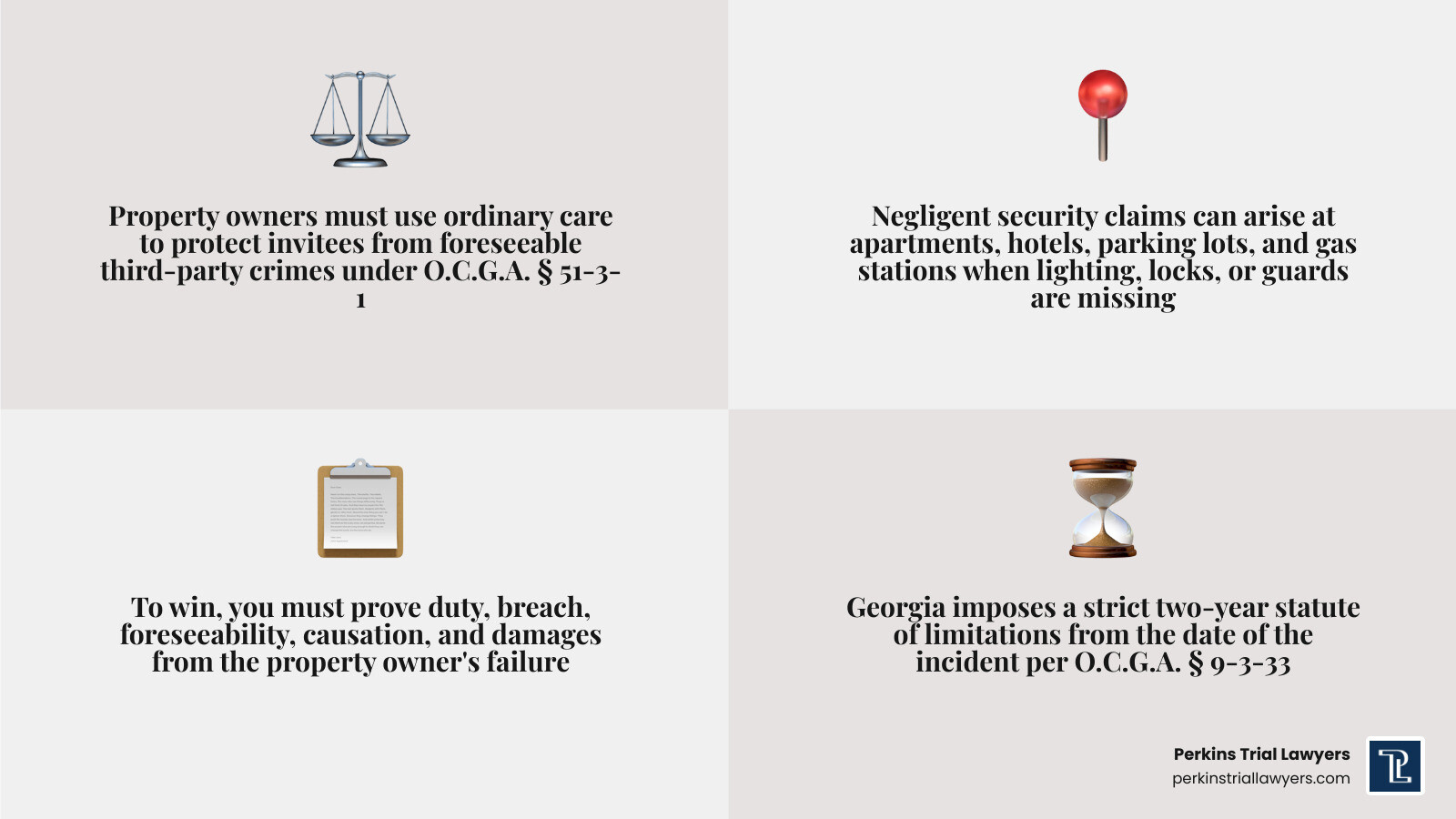
To understand negligent security, we have to look at the foundation of Georgia premises liability law. Under Georgia statute O.C.G.A. § 51-3-1, property owners and land occupiers have a strict legal duty to keep their premises safe for people they invite onto the property.
However, Georgia law does not treat everyone who steps onto a property the same way. Your legal status at the time of the crime dictates the level of protection the property owner owed you. Under state law, visitors are divided into three categories:
- Invitee: This is a person who is on the property for the financial benefit of the owner or by express/implied invitation. Examples include retail shoppers, hotel guests, restaurant patrons, and apartment tenants. Property owners owe invitees the highest duty of care—they must exercise ordinary care to keep the premises and approaches safe.
- Licensee: This is someone who is on the property for their own convenience or interest, such as a social guest or a door-to-door salesperson. Under O.C.G.A. § 51-3-2, the property owner is only liable for willful or wanton injuries.
- Trespasser: This is someone who enters the property without permission. Generally, property owners owe no duty to trespassers other than to refrain from intentionally harming them.
In a negligent security case, we almost always represent invitees. When you pay rent to live in an apartment, book a room at a hotel, or buy gas at a station, you are an invitee.
The core of a negligent security claim is foreseeability. Property owners are not automatically responsible for every crime that happens on their land. They are, however, responsible if a crime was foreseeable and they failed to take reasonable steps to prevent it. If a commercial property has a history of violent assaults, drug deals, or armed robberies, the owner cannot simply look the other way and pretend everything is fine. They must implement security measures to protect their invitees.
When property owners cut corners on safety to save a buck, innocent people pay the price. If you have been injured under these circumstances, working with a Premises Liability Lawyer Atlanta is the best way to hold them accountable.
Common Examples of Inadequate Security Failures at Atlanta Properties
Negligent security can happen anywhere, but we frequently see it in specific commercial spaces across Metro Atlanta. Different properties have different security needs, but the underlying failures are often remarkably similar.
Here are some of the most common examples of security failures:
- Apartment Complexes: Landlords frequently fail to maintain access control gates, leaving them stuck open for weeks or months. Other failures include broken locks on common area doors, missing window latches, unlit breezeways, and a total lack of security patrols despite known gang activity or drug transactions on the property.
- Hotels and Motels: Budget motels and luxury hotels alike can be hotbeds for crime if they lack proper security. Common issues include non-functioning room door locks, unmonitored stairwells, sliding doors that do not lock, and a failure to restrict access to guest floors from the lobby.
- Parking Decks and Lots: Dark, unpatrolled parking structures are prime targets for muggings, carjackings, and sexual assaults. Property owners often fail to repair burned-out lightbulbs, fail to install emergency call buttons, or fail to hire security guards to patrol the area.
- Gas Stations and Convenience Stores: 24-hour gas stations in high-crime areas have a known risk of robbery and violence. Negligence occurs when owners fail to install bulletproof glass partitions, fail to train staff on safety protocols, or refuse to hire security personnel during late-night shifts.
- Shopping Centers and Malls: Large retail spaces often fail to monitor their surveillance cameras, use “dummy” or fake cameras that do not record, or fail to deploy visible security guards to deter criminal behavior.
When these physical and operational safeguards break down, criminals take advantage of the vulnerabilities. If you were harmed because a business failed to secure its premises, consulting a Security Negligence Attorney in Atlanta can help you determine if the property owner’s negligence paved the way for the crime.
How a Negligent Security Attorney Atlanta Can Help Prove Your Case
Proving a negligent security claim is highly complex. Unlike a simple car accident where fault is often clear, a premises security case involves showing that a business owner should be held civilly liable for the intentional, criminal actions of a third party.
To build a winning case, a negligent security attorney Atlanta must establish five key legal elements:
- Duty: We must prove that the property owner owed you a legal duty of care (meaning you were a lawful invitee on the property).
- Breach: We must show that the property owner breached that duty by failing to provide reasonable security measures.
- Foreseeability: We must prove that the property owner knew, or should have known, that there was a substantial risk of criminal activity on the premises.
- Causation: We must demonstrate that the owner’s breach of duty (the inadequate security) directly enabled or caused the criminal attack.
- Damages: We must document the physical, financial, and emotional injuries you suffered as a result of the attack.
Establishing foreseeability is the most critical hurdle in these cases. To do this, we dive deep into local crime data. We obtain police reports, 911 call logs, and crime maps for the property and the immediately surrounding area.
If we can show a pattern of “substantially similar” crimes—such as prior armed robberies at a gas station or multiple break-ins at an apartment complex—the law dictates that the owner was on notice. They had a duty to act, and their failure to do so constitutes negligence. If you need assistance navigating these complex requirements, a Personal Injury Lawyer in Atlanta can guide you through the process.
Why You Need a Negligent Security Attorney Atlanta to Investigate
The moments and days following a violent crime are critical for gathering evidence. Unfortunately, commercial property owners and their insurance companies often move quickly to protect themselves. They may repair broken locks, fix lighting, or overwrite surveillance footage before you even have a chance to file a claim.
This is why immediate legal representation is vital. When you hire us, we immediately issue a spoliation of evidence letter. This is a formal legal notice that warns the property owner they will face severe legal penalties if they destroy, alter, or delete any evidence related to the incident.
Our investigation process is exhaustive. We will:
- Secure and preserve surveillance camera footage before it is automatically deleted.
- Obtain access control logs to see if gates or doors were bypassed.
- Interview eyewitnesses, neighbors, and former employees.
- Review internal maintenance logs, security contracts, and guard patrol records.
- File open records requests under O.C.G.A. § 50-18-70 to obtain municipal police files and 911 dispatch audio.
By working with certified security consultants and former law enforcement officers, we reconstruct the event to show exactly how the security breakdown occurred. For more insights on how we build these rock-solid cases, read about our approach as an Atlanta Proven Injury Lawyer.
How a Negligent Security Attorney Atlanta Maximizes Your Compensation
Insurance companies do not stay in business by handing out fair settlements willingly. When a violent crime occurs on a commercial property, the business’s Commercial General Liability (CGL) insurance carrier will immediately look for ways to deny or minimize your claim.
They will argue that the crime was completely unpredictable, that you were partially at fault, or that no amount of security could have stopped the attacker.
We don’t buy those excuses. We counter their tactics by preparing every case as if it is going to trial. We identify all potential sources of recovery, including CGL policies, umbrella/excess coverage, and additional insured endorsements.
By presenting a meticulously documented case file backed by crime statistics and security professional testimony, we make high-leverage policy-limits demands. Our tireless advocacy against insurance companies for maximum compensation ensures that you are not forced to accept a lowball settlement that fails to cover your long-term needs.
Compensation and Damages Available to Crime Victims in Georgia
Victims of violent crimes often face a long, painful, and expensive road to recovery. The physical injuries from gunshots, stabbings, or physical assaults can require lifelong medical care, while the psychological trauma can be just as debilitating.
In a Georgia negligent security lawsuit, you can pursue compensation for both economic and non-economic damages:
- Medical Bills: This includes emergency room visits, surgeries, hospital stays, physical therapy, prescription medications, and any anticipated future medical treatments.
- Lost Wages: If your injuries forced you to miss work, you can recover your lost income. If you can no longer return to your previous line of work, we will pursue compensation for your lost earning capacity.
- Pain and Suffering: This compensates you for the physical pain, emotional distress, anxiety, PTSD, and loss of enjoyment of life caused by the traumatic event.
- Punitive Damages: In rare cases where a property owner showed willful misconduct, malice, or an entire want of care, Georgia law (O.C.G.A. § 51-12-5.1) allows for punitive damages to punish the bad actor and deter others from similar conduct.
- Wrongful Death: If you lost a cherished family member to a fatal shooting or assault on an unsafe property, you can file a wrongful death claim to recover full financial compensation for the value of their life, as well as funeral and burial expenses.
Please keep in mind that the Georgia statute of limitations for filing a personal injury or negligent security lawsuit is typically two years from the date of the incident under O.C.G.A. § 9-3-33. If you miss this deadline, you lose your right to seek justice forever.
If you have questions about your timeline or need to discuss a potential claim, reaching out to a Slip and Fall Attorney in Atlanta or a premises liability professional is a critical first step.
Crucial Steps to Take Immediately After an Assault or Crime
If you are a victim of a crime on commercial property, your immediate actions can impact both your physical health and your future legal claim.
Here is what you should do as soon as possible:
- Call 911: Ensure that the Atlanta Police Department or local law enforcement dispatches officers and emergency medical services to the scene. This creates an official police report.
- Seek Medical Care: Go to the emergency room or see a doctor immediately. Some injuries, like internal bleeding or traumatic brain injuries, may not be obvious right away. Your medical records will serve as vital evidence linking your injuries to the crime.
- Photograph Everything: If it is safe to do so, take photos of your injuries, torn clothing, and the scene of the crime. Pay special attention to security conditions, such as broken locks, unlit areas, or damaged security gates.
- Document Witness Information: Collect the names, phone numbers, and addresses of anyone who saw the attack or helped you afterward.
- Avoid Speaking to Insurance Adjusters: The property owner’s insurance company may contact you shortly after the incident, asking for a recorded statement. Politely decline and tell them to speak with your attorney.
Frequently Asked Questions About Premises Security Claims
What is the statute of limitations for a negligent security claim in Georgia?
Under O.C.G.A. § 9-3-33, you generally have two years from the date of the criminal incident to file a negligent security lawsuit in Georgia. However, if the claim involves a public or governmental entity (such as a school, housing authority, or MARTA), you must file a formal ante litem notice much sooner—often within six months for cities and twelve months for counties.
Can I still sue if the criminal perpetrator was never caught?
Yes. A negligent security lawsuit is a civil action against the property owner, not a criminal case against the attacker. The civil standard of proof is a “preponderance of the evidence” (meaning it is more likely than not that the owner’s negligence caused your injuries). You do not need to identify, arrest, or convict the criminal to win your civil case against the negligent property owner.
How does Georgia’s SB 68 affect my negligent security case?
Passed as part of the state’s 2025 tort reform measures, SB 68 introduced a heightened foreseeability standard for negligent security claims. To establish foreseeability under the new rules, plaintiffs must show evidence of prior, substantially similar crimes occurring on the property or within 500 yards of the property lines. Additionally, SB 68 requires juries to apportion fault between the negligent property owner and the criminal perpetrator, which makes having a highly skilled attorney essential to maximize your financial recovery.
Take Control of Your Recovery with Perkins Trial Lawyers
You do not have to carry the heavy burden of a traumatic crime alone. At Perkins Trial Lawyers, we provide the tireless advocacy and personalized legal support you need to hold negligent property owners accountable.
We handle all negligent security cases on a contingency fee basis, meaning you pay absolutely nothing upfront, and we only get paid if we win your case. Let us stand up to the insurance companies while you focus on healing.
Contact our team today to schedule your free, confidential consultation with a dedicated Premises Liability Lawyer Atlanta.