 Skip to content
When an Accident in Atlanta Turns Your Life Upside Down
If you need an Atlanta injury lawyer, here’s what you should know right away:
Quick answers for accident victims in Atlanta:
- You have 2 years to file a personal injury lawsuit in Georgia (O.C.G.A. § 9-3-33) — shorter deadlines apply for government claims
- You pay nothing upfront — Atlanta injury lawyers work on contingency, meaning no fee unless you win
- Do not talk to insurance adjusters before speaking with a lawyer
- Your case may cover medical bills, lost wages, pain and suffering, and more
- Partial fault is not a bar to recovery — you can still collect if you are less than 50% at fault
One moment everything is fine. The next, you’re in an ambulance, staring at a pile of medical bills, missing work, and getting calls from an insurance adjuster who wants to settle fast — and cheap.
Atlanta’s roads are some of the busiest in the Southeast. Accidents happen every day on I-285, I-75, I-85, and in neighborhoods across Fulton, DeKalb, Cobb, and Gwinnett counties. When someone else’s negligence causes your injuries, the legal and financial pressure can feel overwhelming.
The insurance company already has lawyers working for them. You deserve someone fighting for you.
This guide walks you through everything you need to know about working with an Atlanta injury lawyer — from understanding your rights, to what your case may be worth, to how to choose the right attorney for your situation.
What Types of Cases Does an Atlanta Injury Lawyer Handle?
Personal injury law covers a wide range of situations where someone is harmed due to another party’s reckless, negligent, or intentional actions. When we represent injured individuals in the metro area, we handle a diverse spectrum of cases. No two accidents are identical, but they generally fall into several key categories:
- Car Accidents: From high-speed collisions on the Downtown Connector to rear-end fender benders in Midtown, motor vehicle wrecks are the most common source of personal injury claims in Georgia.
- Truck Accidents: Wrecks involving commercial semi-trucks, tractor-trailers, and delivery vehicles are incredibly complex. They often involve catastrophic injuries, multiple insurance policies, and strict federal safety regulations.
- Motorcycle Wrecks: Motorcyclists have virtually no protection in a crash. When negligent drivers fail to share the road, the resulting injuries are frequently life-altering.
- Premises Liability: Property owners in Georgia have a legal duty to maintain safe conditions for visitors. If you are injured due to hazardous conditions, we can help you hold the negligent owner accountable.
- Slip and Falls: A subset of premises liability, these cases often involve wet floors, uneven pavement, broken stairs, or poorly lit walkways in retail stores, apartment complexes, or parking garages.
- Wrongful Death: When a tragic accident results in the loss of a loved one, surviving family members can pursue a claim to recover compensation for the full value of the life lost, as well as medical and funeral expenses.
No matter how your injury occurred, having a dedicated Personal Injury Lawyer in Atlanta on your side ensures that your rights are protected from day one.
How an Atlanta Injury Lawyer Determines If You Have a Valid Claim
We hear this question daily: “Do I actually have a case?”
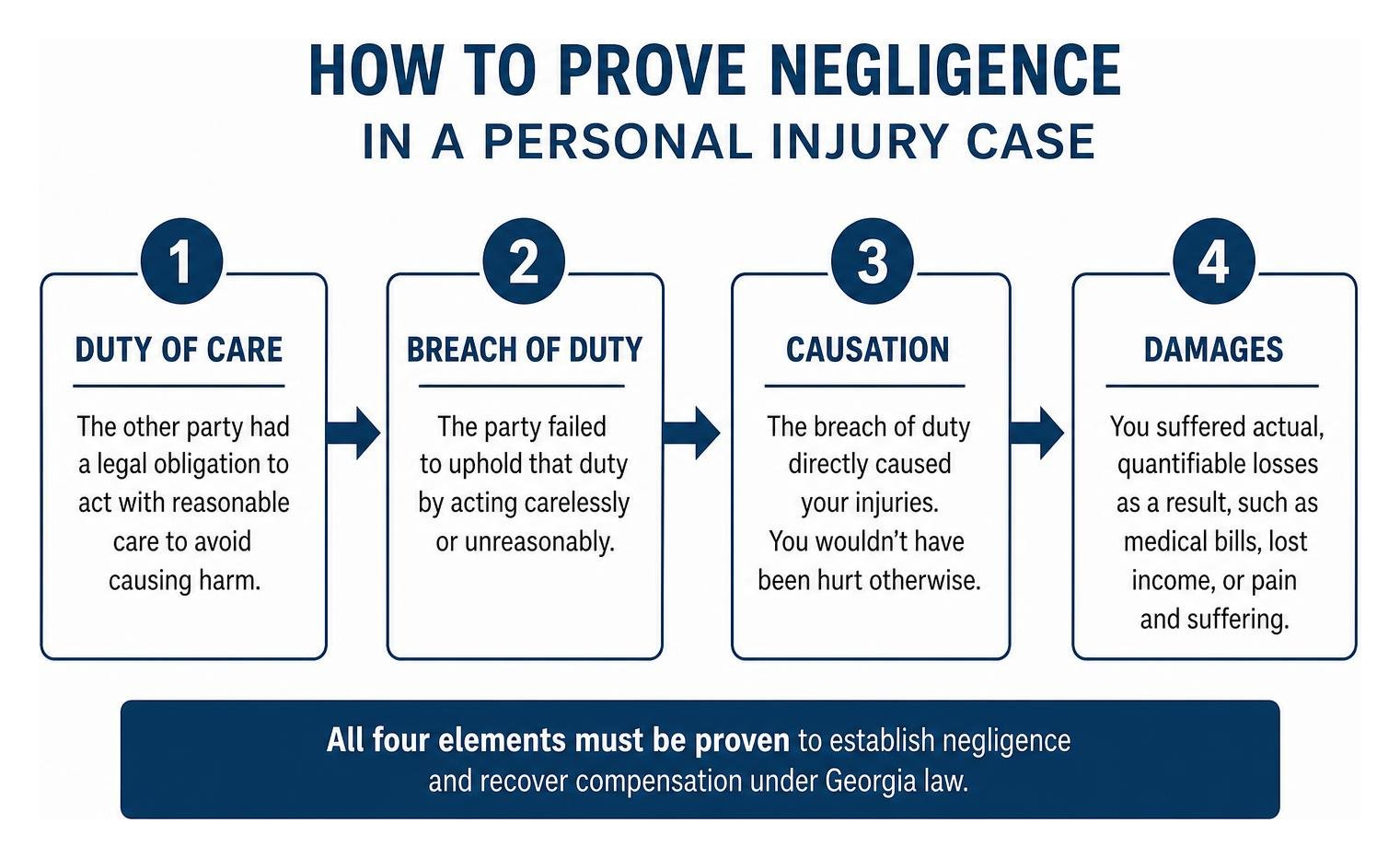
To determine if you have a valid personal injury claim, we look at the core legal concept of negligence. In Georgia, establishing negligence requires proving four distinct elements:
- Duty of Care: The other party had a legal obligation to act with reasonable care to avoid causing harm. For example, drivers have a duty to obey traffic laws, and property owners have a duty to keep their premises safe.
- Breach of Duty: The party failed to uphold that duty. This could mean speeding, driving under the influence, or ignoring a broken handrail on a staircase.
- Causation: The breach of duty directly caused your injuries. We must show that you wouldn’t have been hurt if the other party hadn’t acted negligently.
- Damages: You suffered actual, quantifiable losses as a result of your injuries, such as medical bills, lost income, or physical pain.
When you consult a seasoned Atlanta Injury Lawyer, we will thoroughly evaluate these elements. We also consider Georgia’s comparative negligence statute (O.C.G.A. § 51-12-33), which dictates how shared fault affects your right to recover compensation.
Proving Negligence Under Georgia Law
Building a rock-solid case requires gathering compelling evidence before it disappears. Insurance companies are notorious for trying to shift the blame to the victim or downplaying the severity of the injuries. To counter these tactics, we systematically compile the necessary proof:
- Police and Accident Reports: Official law enforcement reports provide an objective, immediate account of the incident and often indicate who was cited for the crash.
- Medical Records: Comprehensive medical documentation is the foundation of your damages claim. It proves the direct link between the accident and your physical injuries.
- Witness Statements: Eyewitness accounts can provide unbiased confirmation of how the accident unfolded.
- Spoliation Letters: In commercial trucking or premises liability cases, we immediately send formal spoliation letters. These legally compel the negligent party to preserve critical evidence, such as truck black box (ECM) data, driver logs, or security camera footage.
How an Atlanta Injury Lawyer Calculates Your Case Value
Calculating the true value of a personal injury case is far more complex than simply adding up your current hospital bills. We must project the lifelong impact of your injuries. In Georgia, compensation is divided into three main categories:
- Economic Damages: These are objective, financial losses that can be documented with receipts and invoices. They include current and future medical bills, rehabilitation costs, lost wages, diminished earning capacity, and property damage.
- Non-Economic Damages: These compensate you for subjective, non-monetary losses. This includes physical pain and suffering, emotional distress, loss of enjoyment of life, and loss of consortium.
- Punitive Damages: Under O.C.G.A. § 51-12-5.1, punitive damages are intended to punish the defendant for active malice or conscious indifference to safety (such as drunk driving). While Georgia generally caps punitive damages at $250,000, there are critical exceptions — such as cases involving active impairment from drugs or alcohol — where the cap is completely lifted.
Critical Deadlines and the Georgia Statute of Limitations
Time is your enemy after an accident. Under Georgia law (O.C.G.A. § 9-3-33), the standard statute of limitations for a personal injury claim is two years from the date of the injury. If you fail to file a lawsuit before this window closes, you lose your right to seek compensation forever.
However, certain circumstances demand even faster action. If your injury involves a government entity — such as a collision with a city bus, a slip and fall on municipal property, or a MARTA transit accident — you must file an ante litem notice to preserve your claim.
These government deadlines are incredibly brief:
- Municipal (City) claims: Must file notice within 6 months of the incident.
- County and State claims: Must file notice within 12 months of the incident.
Because these timelines are rigid, waiting to seek legal help can destroy an otherwise strong case. If you are dealing with delays or denials from an insurance provider, understanding Why Your Denied Claim Needs an Atlanta Injury Attorney Now can save your financial future.
What to Do Immediately After an Accident in Atlanta
The steps you take in the minutes, hours, and days following an accident will directly impact your physical recovery and your eventual legal claim.

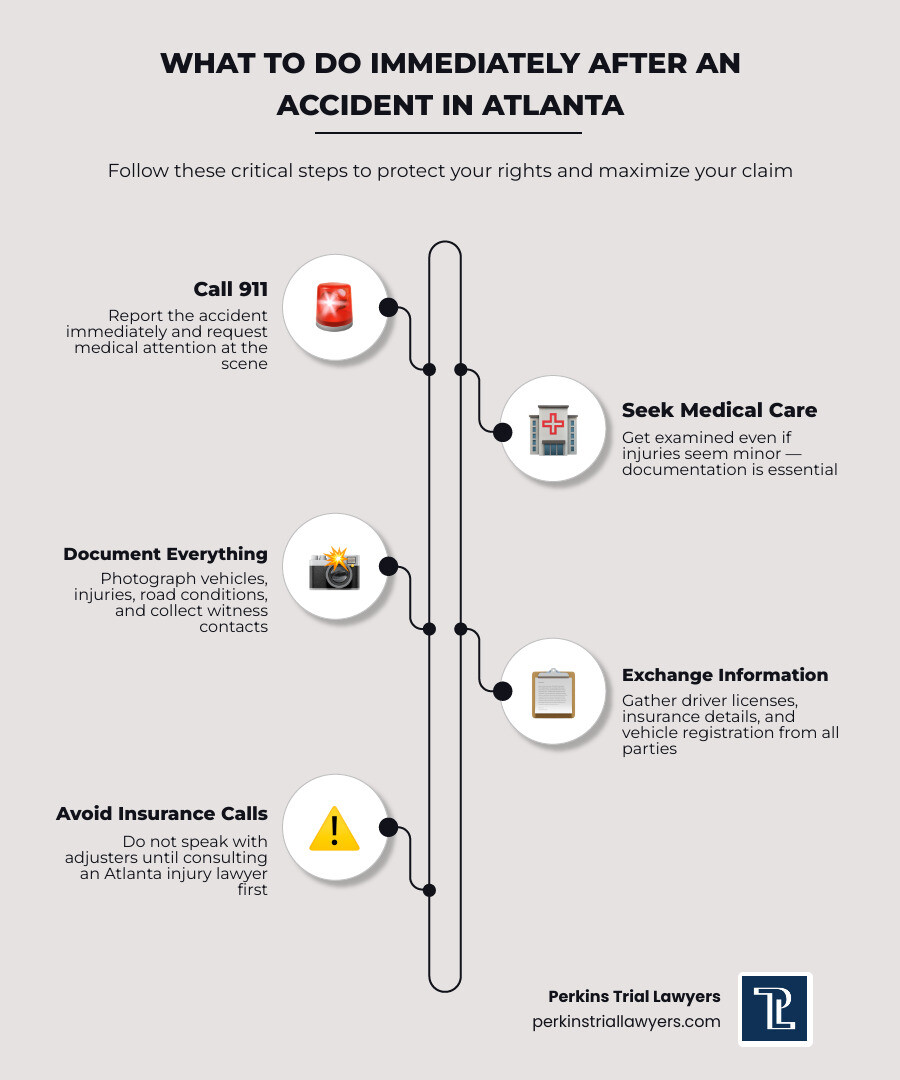
If you are involved in an accident, follow this protocol to protect yourself:
- Call 911 immediately: Ensure that law enforcement and medical personnel are dispatched to the scene. An official police report is vital.
- Seek medical attention: Even if you feel fine, adrenaline can mask severe injuries like whiplash, internal bleeding, or concussions. Go to an emergency room or urgent care right away.
- Document the scene: If you are physically able, take photos and videos of the vehicles, road conditions, skid marks, property hazards, and your visible injuries.
- Exchange information: Collect names, phone numbers, insurance details, and license plate numbers from everyone involved.
- Gather witness contacts: If anyone stopped to help, get their contact information before they leave.
- Avoid speaking with insurance adjusters: Do not give recorded statements or sign any medical releases until you have spoken with an attorney.
| What to Do (Best Practices) | What to Avoid (Common Mistakes) |
|---|---|
| Call law enforcement to create an official report | Do not apologize or admit fault at the scene |
| Seek immediate medical evaluation | Do not delay medical treatment or skip follow-up care |
| Take photos of all damages and hazards | Do not post about the accident on social media |
| Contact a qualified injury attorney | Do not sign quick settlement offers from insurers |
How Contingency Fees Work with an Atlanta Injury Lawyer
Many accident victims hesitate to contact an attorney because they worry about high hourly rates and legal retainers. Fortunately, personal injury representation is highly accessible because we work on a contingency fee basis.
Understanding the No-Win, No-Fee Agreement
A contingency fee agreement means that you pay zero upfront costs to hire us. We cover all the expenses of building your case — including filing fees, hiring medical experts, retrieving records, and conducting investigations.
We only get paid if we successfully resolve your case through a negotiated settlement or a court verdict. Our fee is calculated as a pre-agreed percentage of your final recovery (typically between 33% and 40%). If we do not win your case, you do not owe us a single dime in attorney fees. This aligns our interests directly with yours and removes the financial risk of pursuing justice.
How to Choose the Right Atlanta Injury Lawyer for Your Case
Not all law firms are created equal. When searching for the right representation, keep these factors in mind:
- Trial Readiness: Many high-volume “settlement mills” want to resolve cases quickly for whatever the insurance company offers. You want a firm that prepares every single case as if it is going to trial. This willingness to litigate forces insurance companies to take your claim seriously.
- Small Caseloads: When a firm handles thousands of cases simultaneously, clients get lost in the shuffle. Choose a firm that maintains a selective caseload so you receive direct, personalized attention.
- Direct Communication: You should be speaking with your actual attorney, not just paralegals or case managers.
- Strategic Negotiation: Your lawyer should understand the inner workings of insurance companies and have a proven strategy to counter their lowball offers.
Frequently Asked Questions About Atlanta Personal Injury Claims
What if I am partially at fault for my accident in Georgia?
Georgia operates under a modified comparative negligence system (O.C.G.A. § 51-12-33). This means you can still recover compensation as long as your share of the fault is less than 50 percent.
However, your financial recovery will be reduced by your percentage of blame. For example, if a jury determines that your total damages are $100,000 but finds you 10% at fault for speeding, your final award will be reduced by 10%, leaving you with $90,000. If you are found 50% or more at fault, you are barred from recovering any compensation.
How long does it take to resolve a personal injury lawsuit in Atlanta?
There is no universal timeline. A simple case with clear liability and minor injuries might settle in a few months. However, complex cases involving severe injuries can take a year or longer.
We generally advise waiting until you reach Maximum Medical Improvement (MMI) — the point at which your doctors believe your injuries have healed as much as they ever will. This ensures we know the exact cost of your past, present, and future medical needs before we agree to a settlement.
Do I have to go to court for my personal injury claim?
Probably not. The vast majority of personal injury claims are successfully resolved through pre-suit negotiations or structured mediation. However, if the insurance company refuses to offer a fair settlement that covers the full extent of your losses, we will not hesitate to file a formal lawsuit and present your case to an Atlanta jury.
Stand Up to the Insurance Companies with Perkins Trial Lawyers
When you are recovering from a serious injury, you shouldn’t have to battle multi-billion-dollar insurance companies on your own. They have teams of adjusters and corporate defense lawyers whose only job is to protect their bottom line by paying you as little as possible.
At Perkins Trial Lawyers, we level the playing field. We provide tireless advocacy, personalized attention, and the relentless representation you need to secure maximum compensation. From investigating the details of your crash to providing aggressive premises liability representation, we handle the complex legal heavy lifting so you can focus entirely on your physical recovery.
Do not leave your financial future to chance. Contact us today to schedule a free, no-obligation consultation to discuss your case.
