Hiring a premises liability attorney is often the single most important step you can take after being injured on someone else’s property in Atlanta.
Here’s a quick overview of what to do right now:
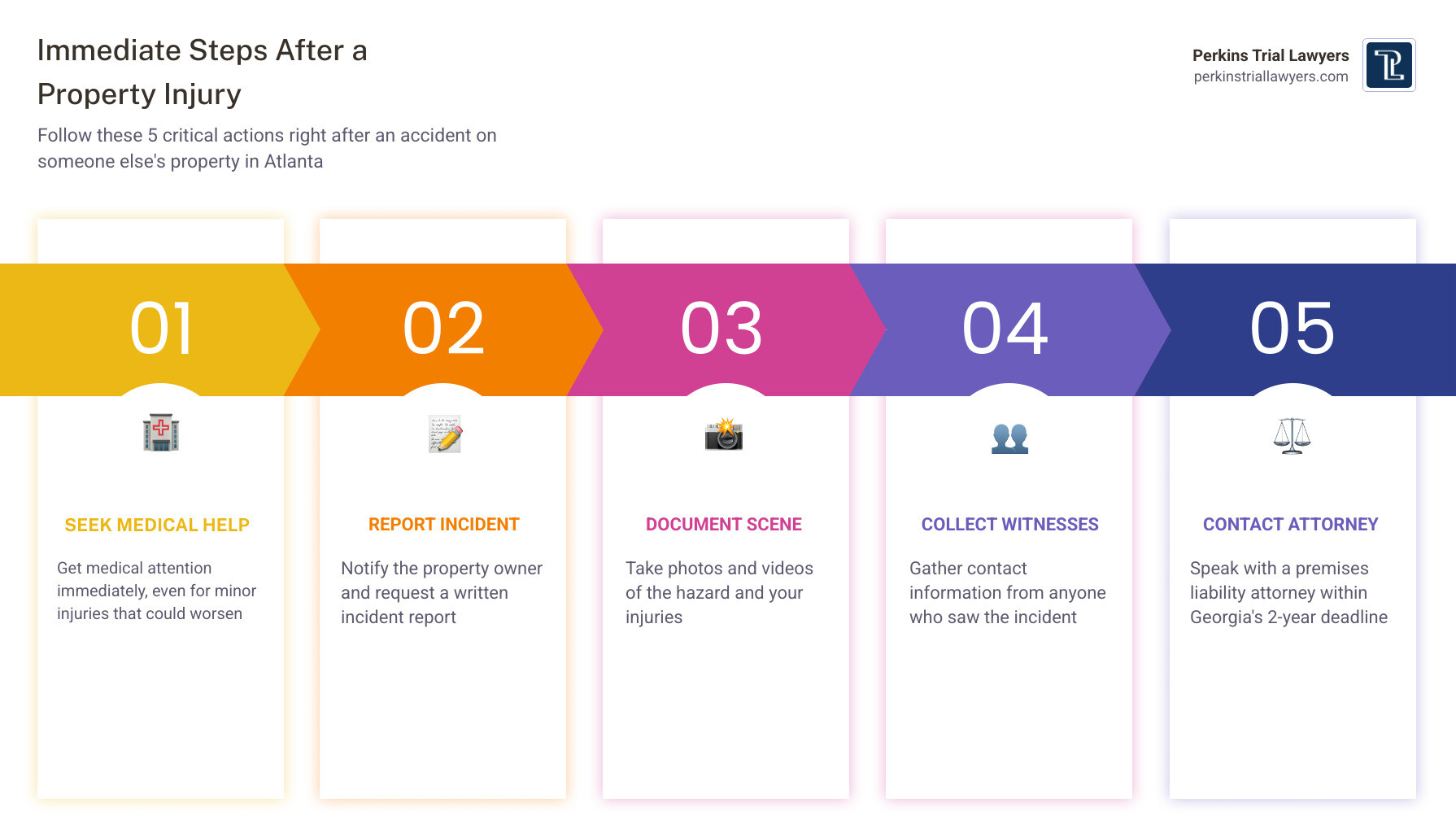
- Seek medical attention — even if injuries seem minor
- Report the incident to the property owner or manager and request a written incident report
- Document the scene with photos and videos of the hazard
- Collect witness contact information before leaving
- Preserve evidence — clothing, shoes, and any physical items involved
- Do not give a recorded statement to an insurance adjuster before speaking to an attorney
- Contact a premises liability attorney as soon as possible — Georgia’s statute of limitations gives you only two years from the date of injury to file a claim
Property owners in Georgia have a legal duty to keep their premises reasonably safe. When they ignore that duty — whether it’s a wet floor with no warning sign, a broken staircase, or a poorly lit parking lot — people get hurt.
And when you get hurt, the costs pile up fast. Medical bills. Missed work. Pain that doesn’t go away overnight.
The challenge is that proving a property owner was negligent isn’t always straightforward. Insurance companies push back hard. Evidence disappears. Deadlines pass.
That’s exactly why choosing the right premises liability attorney matters so much — and why this guide exists.
Understanding Property Owner Negligence and Your Legal Rights
When you step onto someone else’s property in Atlanta—whether it is a local grocery store, an apartment complex, or a neighbor’s home—you have a right to expect a reasonably safe environment. Under Georgia law, specifically Official Code of Georgia Annotated (OCGA) § 51-3-1, property owners and occupiers are required to exercise ordinary care to keep their premises and approaches safe for visitors.
However, the specific “duty of care” a property owner owes you depends entirely on your legal status as a visitor. Georgia premises liability laws divide visitors into three distinct categories. If you are injured, your status determines how hard we must work to prove the owner was negligent.
| Visitor Classification | Definition | Owner’s Duty of Care | Common Examples |
|---|---|---|---|
| Invitee | A person invited onto the property for the owner’s financial or mutual benefit. | Highest duty: Must actively inspect, maintain, and warn of known or hidden hazards. | Customers in retail stores, grocery shoppers, hotel guests, restaurant patrons. |
| Licensee | A person who enters the property for their own convenience, pleasure, or purposes. | Medium duty: Must not willfully or wantonly cause harm; must warn of known, hidden dangers. | Social guests visiting a friend’s house, door-to-door salespeople. |
| Trespasser | A person who enters the property without permission or legal right. | Lowest duty: Must only avoid causing intentional or wanton harm (no hidden traps). | Intruders, uninvited wanderers. |
Understanding these categories is vital because insurance companies will immediately try to downgrade your status to limit their financial exposure. If they can argue you were a licensee instead of an invitee, their legal obligations drop significantly.
What Owed Duties Apply to Your Visitor Status?
Let’s break down these roles further so you can see where your situation fits.
- Business Invitees: If you are shopping at a supermarket or dining at a restaurant, you are an invitee. The business owner has an active obligation to walk the aisles, inspect for spills, fix broken stairs, and place clear warning signs. If they fail to do this, they are liable for your injuries.
- Social Guests (Licensees): If you go to a friend’s house for a cookout, you are a licensee. The homeowner does not have to conduct a formal safety inspection before you arrive, but they absolutely must warn you if they know the back deck has a rotted, unstable plank.
- Trespassers: Generally, landowners do not owe trespassers a duty of care to keep the property safe. However, they cannot set “booby traps” or intentionally harm someone.
- Attractive Nuisance: There is a major exception to the trespasser rule when it comes to children. If a property owner has something on their land that naturally attracts children—like an unfenced swimming pool, a trampoline, or heavy machinery—and a child trespasses and gets hurt, the owner can still be held fully liable.
Common Types of Property Accidents and Injuries
Property negligence takes many forms, and we see the painful consequences every day. Some of the most common cases we handle in the Atlanta area include:
- Slip-and-fall and Trip-and-fall Accidents: These are the most frequent premises claims, often caused by spilled liquids, freshly mopped floors without signs, torn carpeting, or uneven pavement. If you’ve suffered a fall, working with a dedicated Slip and Fall Attorney in Atlanta is the best way to hold the business accountable.
- Negligent Security: When apartment complexes, parking garages, or retail centers fail to provide adequate lighting, working locks, or security patrols in high-crime areas, they pave the way for violent assaults and robberies. Property owners have a legal obligation to protect you from foreseeable criminal acts.
- Swimming Pool Accidents: Unfenced pools, missing lifesaver equipment, or defective drains can lead to catastrophic drowning or near-drowning incidents, particularly involving children.
- Dog Bites and Animal Attacks: Under Georgia’s dog bite laws, owners can be held liable if they knew their animal had vicious tendencies or failed to follow local leash laws.
- Elevator and Escalator Injuries: Sudden drops, misaligned doors, or abrupt stops due to skipped maintenance can cause severe joint, back, and head injuries.
No matter how your accident occurred, these events can result in broken bones, traumatic brain injuries (TBIs), spinal cord damage, and immense emotional trauma.
Key Elements to Prove in a Property Injury Claim
To secure compensation, simply showing that you were hurt on someone else’s property is not enough. You must establish negligence. For a deeper look at what this process looks like in our local courts, read The Ultimate Guide to Slip and Fall Lawyers in Atlanta.
In any premises liability lawsuit, we must prove four core elements:
- Duty of Care: The property owner owed you a legal duty based on your visitor status.
- Breach of Duty: The owner breached that duty by allowing a dangerous condition to exist.
- Causation: The dangerous condition directly caused your slip, trip, fall, or assault.
- Damages: You suffered real, documentable injuries and financial losses as a result.
Proving Notice and Causation in Court
The battleground of most premises liability cases is proving notice. We must show that the owner either had actual notice (they knew about the hazard because they saw it or someone reported it) or constructive notice (the hazard existed for so long that a reasonable owner should have discovered and fixed it during routine inspections).

To build a bulletproof case, we aggressively gather and analyze:
- Surveillance Footage: Store security cameras often capture the exact moment a spill occurred, proving how long it sat on the floor before you slipped.
- Maintenance Logs: We review these records to check if the staff was actually performing their scheduled safety sweeps.
- Witness Statements: Sworn testimony from bystanders or employees can dismantle a property owner’s claim that they “had no idea” a hazard existed.
How Comparative Negligence Affects Your Compensation
Insurance companies love to point the finger back at the victim. They will claim you weren’t looking where you were going, that you were distracted by your phone, or that you ignored a warning sign.
This is because Georgia operates under a modified comparative negligence system (specifically, a 50 percent bar rule). Under this rule:
- You can recover damages as long as you are less than 50% at fault for the accident.
- Your final financial recovery will be reduced by your percentage of fault. For example, if a jury awards you $100,000 but finds you 20% responsible because you were texting, you will receive $80,000.
- If you are found 50% or more at fault, you receive absolutely nothing.
A skilled premises liability attorney knows how to counter these victim-blaming tactics and keep the focus where it belongs: on the property owner’s negligence.
The Ultimate Checklist for Selecting Your Premises Liability Attorney
When you are facing medical debt and physical pain, you cannot afford to hire an attorney who treats your case like a file on an assembly line. You need a dedicated advocate.
Use this checklist when evaluating legal representation:
- [ ] Real Trial Experience: Do they actually take cases to court, or do they settle quickly for lowball offers to keep their caseload moving?
- [ ] A Proven Track Record: Have they successfully recovered substantial settlements and verdicts in premises liability cases?
- [ ] No Upfront Fees: Do they work on a contingency fee basis (meaning you pay nothing unless they win your case)?
- [ ] Clear, Direct Communication: Will you actually speak with your attorney, or will you be passed off to a legal assistant every time you call?
- [ ] Deep Local Knowledge: Are they familiar with Atlanta courts, judges, and local building codes?
Evaluating the Track Record of a Premises Liability Attorney
When searching for the right lawyer, look beyond flashy billboards. You need to know how they perform when facing aggressive insurance defense lawyers.
Insurers keep track of which attorneys are willing to go to trial and which ones fold under pressure. Working with a firm highlighted in Top Slip Fall Attorneys Atlanta Fighting Insurers ensures the insurance company takes your claim seriously from day one. Additionally, understanding standard contingency fee expectations in the local market can help you make an informed decision.
Questions to Ask a Prospective Premises Liability Attorney
When you sit down for a free consultation, treat it like an interview. Ask these direct questions:
- “How many premises liability cases have you personally handled in Georgia?”
- “What is your strategy for proving constructive notice in my specific case?”
- “If the insurance company refuses to offer a fair settlement, are you prepared to take my case to trial?”
- “What is your fee structure, and will I have to pay any out-of-pocket costs if we don’t win?”
Understanding how defense-oriented firms operate can also give you an advantage, as it helps your attorney anticipate the exact playbook the property owner’s legal team will use against you.
Frequently Asked Questions About Property Injury Claims
What is the statute of limitations for a premises liability lawsuit?
In Georgia, the statute of limitations for a premises liability lawsuit is two years from the date of the accident. If you do not file a formal lawsuit within this two-year window, you lose your right to seek compensation forever.
Note: If your injury occurred on government-owned property (like a public school, city park, or municipal building), the timeline is much shorter. You may need to file a formal “ante litem” notice within six months to a year of the incident. This is why you must act quickly.
Can I recover damages if I was partially at fault for my fall?
Yes, as long as your share of the blame is under 50%. Your total compensation will be reduced by your percentage of fault. If the insurance adjuster claims you are partially to blame, do not take their word for it—let us evaluate the evidence first.
How long does it typically take to resolve a property injury case?
Every case is unique. A straightforward claim with clear liability and minor injuries might resolve in a few months. However, if your injuries are severe, require ongoing medical care, or if the property owner denies responsibility, the case can take a year or longer to resolve through litigation. We refuse to rush a settlement before we know the full lifetime cost of your medical needs.
Secure Your Recovery with Dedicated Atlanta Legal Advocacy
Insurance companies have one goal: to pay you as little as possible. They will delay your claim, question the severity of your injuries, and try to twist your words to blame you for your own fall.
We don’t let them get away with it. At Perkins Trial Lawyers, we provide tireless advocacy to ensure you receive the maximum compensation possible for your medical bills, lost wages, and pain and suffering.
If you or a loved one has been hurt due to dangerous property conditions in Atlanta, do not fight this battle alone. Contact a skilled Personal Injury Lawyer in Atlanta today.
Let us handle the insurance adjusters while you focus on healing. Reach out to our dedicated Premises Liability Lawyer Atlanta team right now to schedule your free, no-obligation case evaluation.