What to Do After a Semi Truck Rollover in Atlanta
If you need a semi truck rollover Atlanta lawyer, here is what you need to know right away:
Quick answers for rollover victims in Atlanta:
- Call a lawyer immediately — evidence like black box data and ELD logs can be deleted or overwritten within days
- Georgia’s statute of limitations is 2 years — but waiting costs you critical evidence
- Multiple parties can be liable — the driver, trucking company, cargo loaders, and manufacturers
- You can still recover compensation even if you were partly at fault, as long as you are less than 50% responsible
- Commercial truck policies carry at least $1,000,000 in coverage — but insurers will fight hard to minimize your payout
- Perkins Trial Lawyers handles semi-truck rollover cases in Atlanta with tireless advocacy for injured victims
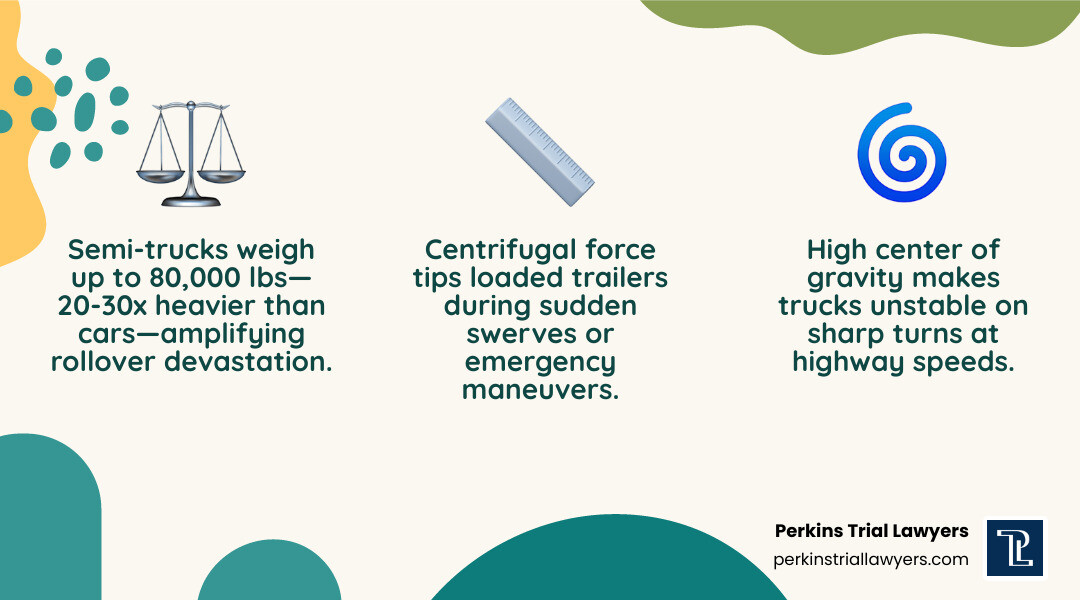
A fully loaded tractor-trailer can weigh up to 80,000 pounds — roughly 20 to 30 times the weight of a typical passenger car. When one of these giants tips over on an Atlanta interstate, the results are devastating.
The physics alone tell the story. A semi-truck’s high center of gravity makes it dangerously unstable during sharp turns, sudden swerves, or emergency maneuvers. At highway speeds, centrifugal force can tip a loaded trailer before the driver even has time to react. Nearby cars and their occupants absorb the full impact.
Atlanta’s dense highway network — packed with heavy commercial traffic every hour of the day — makes these crashes a painful reality for far too many families.
If you or someone you love has been hurt, the decisions you make right now will shape everything that follows.
Relevant articles related to Semi truck rollover Atlanta lawyer:
- 18 wheeler accident Atlanta lawyer
- 18 wheeler fatality Atlanta lawyer
- Atlanta 18 wheeler injury lawyer
Why Semi-Truck Rollovers are a Major Risk on Atlanta Highways
Atlanta isn’t just a city; it’s the logistics heartbeat of the Southeast. Because we are a massive transportation hub, our roads are permanently shared with thousands of heavy-duty vehicles. While most truck drivers are professionals, the sheer volume of traffic combined with the city’s complex infrastructure creates a “perfect storm” for rollover accidents.
When you think about the Downtown Connector or the I-285 Perimeter, you’re looking at some of the most congested and dangerous stretches of road in the country. In May 2026, traffic volume in Atlanta continues to break records, and for a tractor-trailer, congestion isn’t just an annoyance—it’s a hazard. Sudden braking in high-congestion areas is a leading catalyst for semi-truck instability. When 80,000 pounds of momentum meets a sudden stop, the physics of the vehicle can cause it to lurch, jackknife, or tip.
Furthermore, Atlanta’s highway design includes many high-speed ramps and elevated interchanges that require precise maneuvering. If a driver enters one of these with too much speed, the centrifugal force pulls the top-heavy trailer outward. Because a typical passenger car weighs only 2,000 to 4,000 pounds, it stands no chance if it is positioned in the “tip zone” of a falling rig. For more on the dangers of these collisions, see our guide on Atlanta Truck Wrecks: Why You Need a Heavyweight Lawyer for a Heavyweight Crash.
High-Risk Corridors for Atlanta Trucking Accidents
Certain areas in Atlanta are notorious for truck rollovers due to their “procedural architecture”—basically, the way the roads were built decades ago doesn’t always play nice with modern trucking demands.
- Spaghetti Junction (I-285/I-85): The complex, multi-level ramps here are a nightmare for top-heavy loads. One wrong calculation on a curve can send a trailer over the side.
- The Cobb Cloverleaf (I-75/I-285): Known for heavy merging and confusing lane markers, this area sees frequent sudden braking, which is a primary trigger for rollovers.
- I-20 near Cascade Road: Long grades and tight curves make this a hotspot for speed-related instability.
- I-285 at Chamblee-Tucker Road: High-speed interchanges and narrow lanes leave very little room for error when a truck needs to make an evasive maneuver.
- The Downtown Connector (I-75/I-85): The sheer density of traffic here means that if a truck swerves to avoid a distracted driver, the high center of gravity often wins the battle against the tires.
Common Causes and Liability in Georgia Rollover Cases
Proving why a truck rolled over requires a deep dive into the moments leading up to the crash. It is rarely just “bad luck.” Most rollovers are the result of specific, preventable failures.
Driver Error and Speeding Speeding is the number one cause of rollover accidents. Trucking companies often put immense pressure on drivers to meet tight schedules. This leads to drivers taking curves too fast or failing to slow down on highway off-ramps. When a truck travels too fast through a turn, the center of gravity shifts outward, and the trailer begins to lift.
Improper Cargo Loading A truck doesn’t have to be speeding to roll over if the cargo isn’t secured correctly. If freight shifts mid-turn, the sudden movement of weight can pull the entire rig over. Interestingly, research shows that empty or lightly loaded trailers are actually more vulnerable to tipping in high winds than fully loaded ones because they lack the weight to stay pinned to the pavement.
Mechanical Failure Tire blowouts and brake failures are common culprits. If a steering tire blows, the driver often “overcorrects”—a specific type of driver error where they steer too hard in the opposite direction. This sudden jerk of the steering wheel is a classic trigger for a rollover.
If you’ve been involved in such a wreck, a semi truck rollover Atlanta lawyer will look for these factors immediately. You can find more specific legal help on our practice area page.
How a Semi Truck Rollover Atlanta Lawyer Proves Liability
Determining who is at fault isn’t always as simple as pointing at the driver. In Georgia, liability can be spread across several parties:
- The Truck Driver: For speeding, distracted driving, or fatigue.
- The Trucking Company (Motor Carrier): Under the legal doctrine of respondeat superior, companies are often responsible for the actions of their employees. They can also be liable for forcing drivers to skip rest periods.
- Cargo Loaders: If a third-party company loaded the trailer and failed to balance the weight, they may be held responsible for the resulting tip.
- Manufacturers: If a mechanical defect, like a faulty suspension or a tire prone to blowouts, caused the crash.
To prove this, we rely on “the black box”—the Electronic Control Module (ECM) and Electronic Logging Device (ELD). These devices record speed, braking patterns, and how long the driver had been behind the wheel. We also utilize forensic reconstruction professionals who can look at “yaw marks” (curved tire marks) on the Atlanta asphalt to calculate exactly how fast the truck was going when it began to tip.
Navigating Georgia Laws with a Semi Truck Rollover Atlanta Lawyer
Georgia law has specific rules that can either help or hurt your case, depending on how quickly you act.
The Statute of Limitations In Georgia, you generally have two years from the date of the accident to file a personal injury or wrongful death claim. While two years sounds like a long time, it is a blink of an eye in the legal world. Evidence disappears, witnesses move, and trucking companies are legally allowed to destroy certain records after a period unless a formal “litigation hold” is placed on them.
Modified Comparative Negligence Georgia follows a 50 percent bar rule. This means you can recover compensation as long as you are less than 50% responsible for the accident. However, your total payout will be reduced by your percentage of fault. For example, if a jury decides you were 10% at fault because you were slightly over the speed limit, and your total damages are $1 million, you would receive $900,000. For a deeper dive into the settlement process, check out our guide on Navigating the Road to a Settlement.
Federal and State Regulations Critical to Your Claim
Trucking is a heavily regulated industry. When a rollover occurs, we check for violations of:
- 49 CFR Part 396: Federal vehicle inspection standards. If a carrier failed to maintain the brakes or tires, they are in violation of federal law.
- Hours-of-Service (HOS) Rules: Drivers are generally limited to 11 hours of driving after 10 consecutive hours off duty. Fatigue is a massive factor in rollovers because a tired driver is more likely to overcorrect or miss a speed limit sign on a ramp.
- Georgia Department of Public Safety (DPS): The Motor Carrier Compliance Division often performs post-accident inspections that can provide “smoking gun” evidence of negligence.
| Factor | Driver Negligence | Trucking Company Liability |
|---|---|---|
| Speeding | Direct responsibility for vehicle control | Liable if they set unrealistic schedules |
| Fatigue | Choosing to drive while exhausted | Liable for HOS violations or “falsified logs” |
| Maintenance | Failure to perform pre-trip inspections | Failure to pull a dangerous truck out of service |
| Cargo | Failure to double-check the load | Liable for hiring negligent third-party loaders |
Recovering Compensation for Catastrophic Injuries
Rollover accidents are uniquely violent. Unlike a standard “fender bender,” a rollover involves a massive object crushing everything in its path. We frequently see:
- Traumatic Brain Injuries (TBI): Caused by the violent jarring of the skull or impact with the vehicle interior.
- Spinal Cord Damage: Often resulting in permanent paralysis or loss of motor function.
- Crush Injuries: When a trailer falls onto a smaller vehicle, the occupants can suffer severe internal organ damage and broken bones.
- Internal Trauma: Bleeding and organ damage that may not be immediately visible at the scene.
The cost of treating these injuries is astronomical. Compensation isn’t just about paying today’s hospital bills; it’s about securing your future. We fight for “economic damages” (medical bills, lost wages, home modifications) and “non-economic damages” (pain and suffering, loss of enjoyment of life). To understand the potential value of your claim, read our Guide to Maximum Compensation.
Why You Need a Semi Truck Rollover Atlanta Lawyer Immediately
The moment a rollover happens, the trucking company’s insurance “rapid response team” is likely already on its way to the scene. Their goal is to minimize their liability. They may try to:
- Blame the victim: Claiming you cut the truck off or were distracted.
- Pressure you into a lowball settlement: Offering a check within days of the accident before you even know the full extent of your injuries.
- Destroy evidence: If a lawyer doesn’t send a formal “spoliation letter” (litigation hold notice), the company might overwrite the black box data or “lose” the driver’s phone records.
At Perkins Trial Lawyers, we provide tireless advocacy to prevent these tactics. We understand the Fulton County Superior Court procedures and how to move a case through the system effectively. We take the burden of the legal fight off your shoulders so you can focus on healing.
Frequently Asked Questions about Atlanta Truck Rollovers
How long does a semi-truck rollover lawsuit typically take in Fulton County?
In Fulton County courts, a complex truck accident case typically takes 18 to 36 months to reach a trial. Simple cases might settle sooner, but catastrophic injury cases require a lengthy “discovery” phase where we subpoena thousands of pages of records. Most judges in Fulton County also require mandatory mediation, where both sides try to reach an agreement before a trial date is set. While this sounds like a long time, it is necessary to ensure we have every piece of evidence needed to win.
What steps should I take immediately after a rollover accident in Atlanta?
- Seek Medical Attention: Even if you feel “fine,” internal injuries and TBIs often have delayed symptoms.
- Call the Police: Ensure an official report is filed. In Atlanta, this will likely be the APD or Georgia State Patrol.
- Gather Info: Get witness names and phone numbers. Do not rely on the police to get everyone’s contact info.
- Take Photos: Capture the positions of the vehicles, the cargo spill, and any skid marks on the road.
- Avoid Adjusters: Do not give a recorded statement to the trucking company’s insurance adjuster. They are looking for reasons to deny your claim.
- Call an Attorney: The sooner we are involved, the better we can preserve the evidence. For more tips, see The Ultimate Guide to Hiring an Atlanta Semi Truck Accident Lawyer.
What are real examples of settlements in these cases?
While every case is different, semi-truck rollovers often result in multi-million dollar recoveries because of the severity of the injuries and the high insurance policy limits (usually $1 million minimum). Settlements cover everything from lifelong nursing care to the “full value of the life” in wrongful death cases. Our commitment is to hold negligent carriers accountable and ensure they pay the maximum amount allowed by law.
Conclusion
A semi-truck rollover is a life-altering event that leaves victims feeling overwhelmed and outmatched by giant insurance companies. You don’t have to face them alone. At Perkins Trial Lawyers, we provide the tireless advocacy needed to secure the compensation you deserve. We know the roads of Atlanta, we know the physics of these crashes, and we know how to win in Georgia courts.
If you or a loved one has been injured, contact a semi truck rollover Atlanta lawyer at Perkins Trial Lawyers today for a consultation. Let us handle the heavy lifting while you focus on your recovery.