When a Motorcycle Crash Turns Your Life Upside Down in Atlanta
If you’re looking for a motorcycle crash lawyer near me in Atlanta, here’s what matters most right now:
Quick answers for injured riders:
- Call 911 and get medical care immediately, even if you feel okay
- Document everything — photos, witness names, insurance details
- Don’t give a recorded statement to any insurance company before talking to a lawyer
- Contact a motorcycle accident attorney before accepting any settlement offer
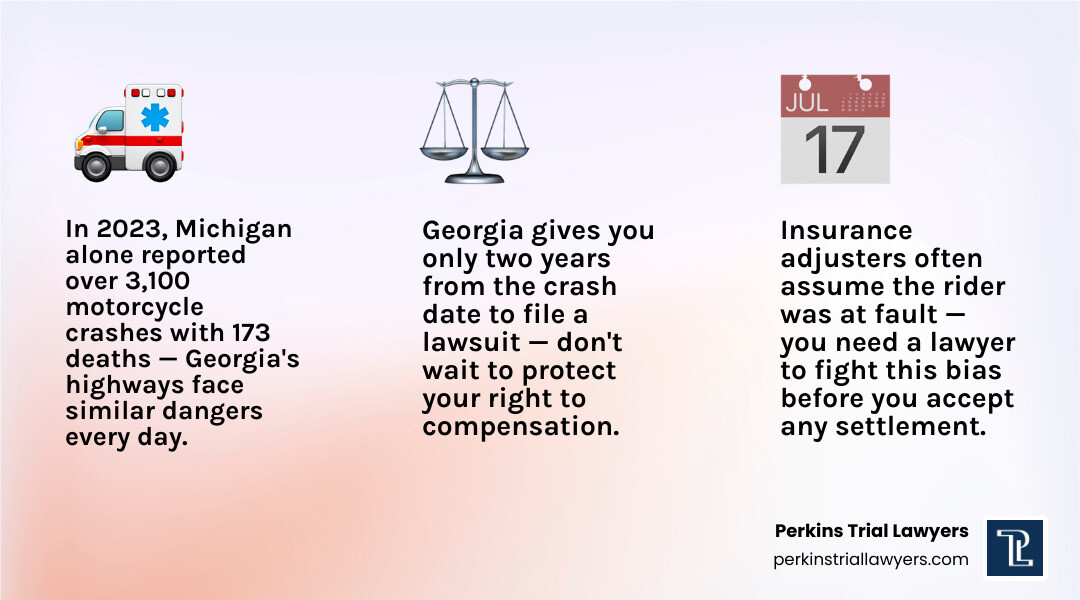
- You have two years from the date of the crash to file a lawsuit in Georgia
A motorcycle crash doesn’t just hurt — it can shatter your finances, your health, and your sense of security overnight. Medical bills pile up fast. Insurance adjusters call quickly. And in many cases, they’re already building a case against you before you’ve even left the hospital.
Georgia roads are dangerous for riders. In Michigan alone, 2023 saw over 3,100 motorcycle crashes resulting in 173 deaths — and Georgia’s highways tell a similar story. Atlanta’s dense traffic, highway merges, and distracted drivers create serious risks every time a rider gets on the road.
What makes motorcycle crashes different from regular car accidents isn’t just the severity of the injuries. It’s the bias. Insurance companies, and sometimes even police reports, tend to assume the rider was at fault. That assumption can cost you everything if you don’t have the right legal help pushing back.
You deserve someone in your corner who understands what you’re up against.
Know your motorcycle crash lawyer near me terms:
- motorcycle accident attorney in atlanta
- motorcycle crash attorney atlanta
- motorcycle injury claim Atlanta
What to Do Immediately After an Atlanta Motorcycle Accident
When you go down on an Atlanta highway, the minutes and hours immediately following the crash are critical. Your adrenaline is pumping, you are likely in pain, and your mind is racing. However, the actions you take right now will lay the groundwork for your physical recovery and your eventual financial compensation.

1. Prioritize Physical Safety and Medical Attention
Before you do anything else, check yourself for injuries. If you can move, get yourself and your passenger to a safe area away from active traffic. Do not attempt to move your motorcycle if doing so puts you in danger.
Even if you believe your injuries are minor, seek emergency medical care immediately. Shock and adrenaline can mask severe trauma, such as internal bleeding, concussions, or soft tissue damage. Having a medical professional evaluate you right away creates an official, unbroken link between the crash and your injuries. If you delay medical care, insurance adjusters will absolutely argue that your injuries were caused by something else or are not as serious as you claim.
For a deeper look at the legal and medical steps to take, read our guide on Atlanta Motorcycle Emergency Legal.
2. Contact the Authorities
Call 911 immediately. Request both police officers and emergency medical personnel at the scene. When the police arrive, provide them with a clear, factual account of what happened. Stick to the facts: what direction you were traveling, how fast you were going, and what the other vehicle did.
Crucial tip: Never admit fault or apologize. Saying “I’m sorry” out of politeness can be twisted by insurance companies as an admission of liability. Let the officers do their job and document the scene.
3. Gather Evidence at the Scene
If you are physically able—or if you can ask a witness or companion to do so—collect as much evidence as possible:
- Photos and Videos: Take high-quality photos of the crash scene from multiple angles. Capture the position of your motorcycle and the other vehicle, skid marks, road debris, traffic signals, and any visible road hazards like potholes or gravel. Photograph your damaged riding gear, your bike’s damage, and your physical injuries.
- Contact Information: Exchange names, phone numbers, addresses, and insurance details with the other driver.
- Witness Details: If anyone stopped to help, get their names and contact information. Witness statements are incredibly powerful because they come from objective third parties.
Why You Need a Motorcycle Crash Lawyer Near Me to Fight Insurance Bias
You might think that if the other driver clearly caused the accident, their insurance company will simply pay your medical bills and repair your bike. Unfortunately, the insurance industry does not work that way. Insurance adjusters are trained to protect their company’s bottom line, which means keeping payouts as low as possible.
To do this, they frequently rely on a systemic, unfair bias against motorcycle riders.
Overcoming the “Reckless Biker” Stereotype
There is an unfortunate cultural stereotype that anyone who rides a motorcycle is a reckless daredevil who weaves through traffic and speeds. Insurance adjusters leverage this prejudice to shift the blame onto you, even when the other driver was completely distracted by their phone. They might claim you should have anticipated the other driver’s mistake or that your reaction time was too slow.
When you work with a skilled personal injury team, we actively fight this bias. We know how to present you as the responsible, safety-conscious rider you are.
The Technical Realities of Motorcycle Dynamics
A standard car accident attorney who does not understand motorcycles may not know how to build a winning crash case. Motorcycles handle, brake, and react entirely differently than four-wheeled passenger vehicles. Proving liability often requires a deep understanding of technical concepts, such as:
- Countersteering: How a rider must steer in one direction to initiate a turn in the opposite direction.
- Lane Positioning: Why riders position themselves in specific parts of a lane to remain visible and avoid road hazards.
- Evasive Manuvers: How a rider must balance front and rear brakes during a sudden stop to avoid a low-side or high-side crash.
By working with an experienced team, we can utilize independent accident reconstruction professionals to analyze skid marks, debris patterns, and vehicle damage. This allows us to prove exactly how the negligent driver caused the crash.
If you want to understand how we manage these complex legal waters, check out our Atlanta Motorcycle Lawsuit Lawyer Guide.
Georgia Motorcycle Laws, Shared Fault, and Helmet Rules
Understanding Georgia’s traffic laws and personal injury statutes is essential for protecting your right to compensation. Several key rules will directly impact your motorcycle accident claim.
Georgia’s Universal Helmet Law
Under Georgia law, all motorcycle operators and passengers are required to wear an approved protective helmet. This is not just a legal requirement; it is a life-saving safety measure. According to the U.S. Centers for Disease Control and Prevention (CDC), helmets reduce the risk of head injury by 69% and reduce the risk of death by 37%.
If you were injured in a crash and were not wearing a helmet, it can complicate your injury claim, but it does not automatically bar you from recovering compensation. We will discuss how this affects your case in the FAQ section below.
Modified Comparative Negligence (The 50% Bar Rule)
Georgia operates under a modified comparative negligence system with a 50% bar. This means you can recover financial damages after an accident as long as you are less than 50% at fault for the crash.
However, your final compensation will be reduced by your percentage of blame. For example, if a jury determines that your total damages are $100,000, but they find you were 20% at fault because you were traveling slightly over the speed limit, your recovery will be reduced by 20%, leaving you with $80,000. If you are found 50% or more at fault, you cannot recover any compensation at all.
Because of this rule, insurance companies will do everything they can to assign as much blame to you as possible. Our job is to gather the evidence necessary to keep your percentage of fault at zero. For a comprehensive roadmap on how we protect your rights under Georgia law, read our guide: Georgia Motorcycle Injury Lawyer Your Roadmap to Recovery.
Lane Splitting is Illegal in Georgia
While lane splitting (riding between lanes of slow-moving or stopped traffic) is legal in states like California, it is strictly illegal in Georgia. If you were lane splitting at the time of your crash, the insurance company will use this violation to argue that you were contributorily negligent, which could severely reduce or completely bar your financial recovery.
Frequently Asked Questions About Atlanta Motorcycle Accidents
How does a motorcycle crash lawyer near me prove fault?
Proving fault in a motorcycle crash requires building a solid wall of evidence that demonstrates the other driver’s negligence. We do this by obtaining the official police report, looking for traffic citations issued at the scene, and gathering traffic camera or dashcam footage.
We also work with accident reconstructionists who use physical evidence—like vehicle damage and skid marks—to prove variables like speed and point of impact. If you want to know more about how we establish liability in court, read about our approach as a Motorcycle Collision Attorney Atlanta.
What is the statute of limitations for an Atlanta motorcycle lawsuit?
In Georgia, the statute of limitations for filing a personal injury lawsuit after a motorcycle accident is two years from the date of the crash. If you are filing a wrongful death claim on behalf of a loved one who was tragically killed, the deadline is also generally two years from the date of passing.
If you miss this strict deadline, the courts will almost certainly dismiss your case, and you will lose your right to seek compensation forever. Do not wait until the last minute; investigating a crash and negotiating with insurance companies takes time. Learn more about these timelines in our article on Atlanta Motorcycle Lawsuit Attorney.
Can I still recover damages if I wasn’t wearing a helmet?
Yes, you can still recover damages, but it is more challenging. Under Georgia’s comparative negligence rules, the insurance company will argue that by choosing not to wear a helmet, you contributed to the severity of your own injuries (specifically head, neck, or brain injuries).
However, if your injuries consist of broken bones, road rash on your limbs, or internal organ damage, the lack of a helmet had no bearing on those injuries. We can argue that your failure to wear a helmet should not reduce your compensation for non-head-related trauma. For a detailed breakdown of how we handle these situations, read our Atlanta Biker Injury Lawyer Guide for Downed Riders.
Secure Your Recovery: Partner with Atlanta’s Dedicated Trial Attorneys
When you are recovering from a devastating crash, the last thing you should have to worry about is fighting with insurance adjusters or managing complex legal deadlines. You need a dedicated legal team to take that burden off your shoulders so you can focus entirely on your physical healing.
At Perkins Trial Lawyers, we provide tireless advocacy against insurance companies to secure the maximum compensation you deserve. We handle all personal injury cases, including car accidents, premises liability, and wrongful death, on a contingency fee basis. This means you pay us absolutely nothing upfront, and we only collect a legal fee if we successfully win compensation for you through a settlement or court verdict.
How to Choose the Right Motorcycle Crash Lawyer Near Me
When searching for local legal representation, look for a firm that is prepared to go to trial. Many “settlement mills” simply take the first low-ball offer the insurance company throws at them to resolve cases quickly. We prepare every single case as if it is heading directly to a courtroom. This aggressive preparation forces insurance companies to take us seriously and offer fair settlements.
We will help you recover economic damages (medical bills, lost wages, and property damage) as well as non-economic damages (pain and suffering, emotional distress, and loss of enjoyment of life). We will also investigate whether you can tap into your own Uninsured/Underinsured Motorist (UM/UIM) coverage if the at-fault driver has little or no insurance.
If you or a loved one has been injured on Georgia roads, do not let the insurance company dictate your future. Contact us today for a free, no-obligation consultation, and let us stand up for your rights. For more information on how we fight for riders in our community, visit our dedicated page on Motorcycle Accidents in Atlanta GA.