
What to Do After a Lyft Accident in Atlanta — And Why It Matters
If you need an Atlanta Lyft accident lawyer, here is what you should know right now:
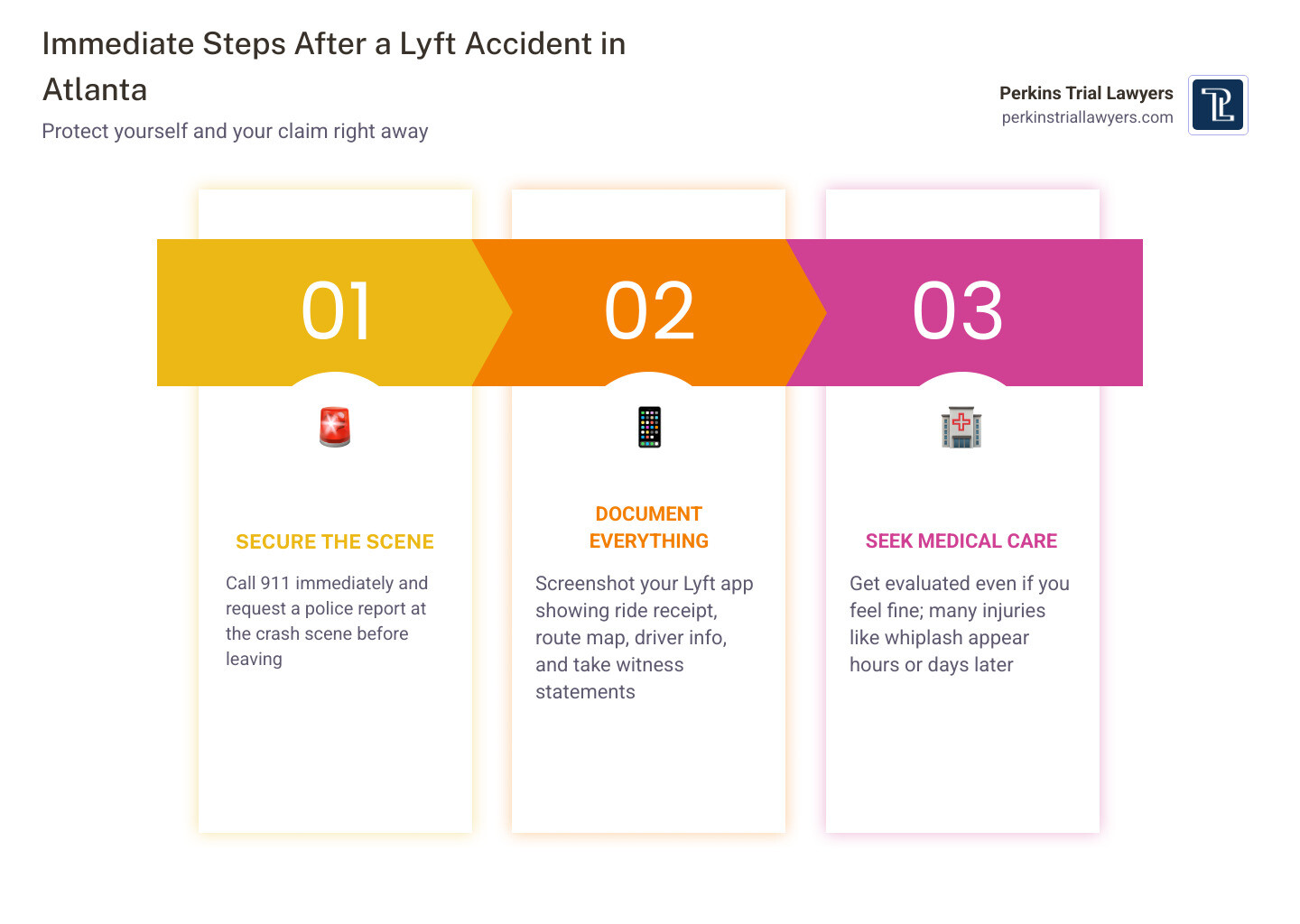
- Call 911 and get a police report at the scene
- Screenshot your Lyft app — save your ride receipt, route, and driver info immediately
- Seek medical attention even if you feel fine — some injuries appear hours or days later
- Do not give a recorded statement to any insurance company before speaking with a lawyer
- You have two years from the date of the crash to file a personal injury claim in Georgia
- Lyft carries up to $1 million in commercial liability coverage when a ride is in progress
- Consultations are free — most Atlanta rideshare injury attorneys work on contingency, meaning no fees unless you win
A Lyft crash in Atlanta hits differently than a regular car accident. You step out of a vehicle you trusted to get you somewhere safely — and suddenly you are dealing with questions no one prepares you for: Which insurance applies? Is the driver liable, or Lyft? What if coverage is denied?
Rideshare services like Lyft have become a fixture of daily life in Atlanta. But as their popularity has grown, so has the risk. Research shows rideshare services have contributed to a 3% annual rise in auto traffic deaths nationwide since their introduction — and Fulton County alone recorded over 51,000 crashes in 2024.
The legal landscape around these accidents is genuinely complicated. Lyft uses tiered insurance coverage that shifts based on what the driver was doing at the exact moment of the crash. Miss that detail, and you could end up filing under the wrong policy — or getting far less than you deserve.
This guide walks you through everything you need to know to protect yourself after a Lyft accident in Atlanta in July 2026.
Quick look at Atlanta Lyft accident lawyer:
Understanding Lyft’s Complex Insurance Tiers in Georgia
When you get into a collision with a standard vehicle, you typically look to the other driver’s personal auto insurance policy. However, Georgia law under O.C.G.A. § 33-1-24 establishes specific insurance requirements for Transportation Network Companies (TNCs) like Lyft.
Because Lyft classifies its drivers as independent contractors rather than employees, the company avoids direct liability for most crashes. Instead, compensation is pursued through a tiered insurance structure. The amount of coverage available depends entirely on the driver’s app status at the exact moment of the collision.
The table below breaks down these coverage phases under Georgia law:
| Driver App Status | Applicable Insurance Policy | Bodily Injury Coverage Limits | Property Damage Limits |
|---|---|---|---|
| Phase 1: Offline / App Closed | Driver’s personal auto insurance only | Georgia minimums (typically $25,000 per person / $50,000 per accident) | $25,000 |
| Phase 2: App Open, Waiting for Request | Driver’s personal policy + Lyft’s contingent liability | $50,000 per person / $100,000 per accident | $25,000 |
| Phase 3: Ride Accepted or Passenger Onboard | Lyft’s primary commercial insurance policy | Up to $1,000,000 third-party liability | Included in the $1M policy limit |
If the driver is offline (Phase 1), Lyft’s commercial policies will not cover your injuries. If they are online and actively looking for a fare (Phase 2), Lyft provides contingent liability coverage only if the driver’s personal policy denies the claim—which is common, as most personal policies exclude commercial “for-hire” driving.
Once a ride is accepted or a passenger is in the vehicle (Phase 3), Lyft’s $1,000,000 third-party liability policy becomes active. This is a massive difference compared to traditional taxi companies in Georgia, which are only required to carry $25,000 in liability coverage. Navigating these overlapping policies is why many victims choose to work with an experienced Atlanta Car Accident Attorney who understands TNC insurance laws.
Immediate Steps to Take After a Rideshare Crash in Fulton County
What you do in the minutes and hours following a crash on Atlanta streets like Peachtree Road or the Downtown Connector can make or break your personal injury claim.
1. Call 911 and Request a Police Report
Never let a rideshare driver convince you to handle things “under the table.” You need an official police report to establish that the crash occurred, who was involved, and the officer’s initial assessment of fault. When the police arrive, tell them exactly what happened.
2. Screenshot Your Lyft App Immediately
This is the single most important step unique to rideshare accidents. Take screenshots of your active ride, the driver’s profile, the route map, and your digital receipt. Lyft has access to this data, but digital logs can occasionally be lost, overwritten, or modified. Having your own visual proof of Phase 3 status is invaluable.
3. Seek Medical Attention Right Away
Even if you believe you walked away unscathed, visit an emergency room or urgent care clinic. Adrenaline can mask severe injuries. Whiplash, internal bleeding, and soft tissue damage often take 24 to 48 hours to manifest.
Furthermore, severe traumatic brain injuries (TBIs) can happen to rear-seat passengers who strike their heads on the seat frame or windows. The lifetime treatment costs for severe TBIs can range from $85,000 to $3 million. Delaying medical care gives insurance adjusters an excuse to argue that your injuries were not caused by the crash.
4. Gather Witness Statements and Scene Evidence
If you are physically able, take photos and videos of:
- The damage to all vehicles involved
- The license plates of all cars
- Road conditions, traffic signs, and skid marks
- Any visible injuries you or your passengers sustained
If bystanders saw the crash, politely ask for their names and phone numbers. Their unbiased statements can prevent the rideshare driver or their insurer from shifting the blame. Once you have stabilized your health, you can begin organizing this evidence to file an Atlanta Auto Accident Claim.
How an Atlanta Lyft Accident Lawyer Protects Your Rights
Rideshare claims are notorious for finger-pointing. Lyft’s insurer may claim the driver was offline, the driver’s personal insurer will likely deny coverage due to commercial use, and third-party drivers will try to blame the rideshare operator.
When you hire a knowledgeable Atlanta Lyft accident lawyer, we take over the stressful logistics of your case:
- Investigating the Crash: We subpoena Lyft’s internal electronic records to verify the exact second the driver logged into the app, accepted the ride, and ended the trip.
- Handling Insurers: We manage all communications with insurance adjusters. You do not have to worry about saying the wrong thing or being pressured into a lowball settlement.
- Trial Preparation: While many claims settle out of court, we prepare every case as if it is heading to trial. This aggressive stance forces insurance companies to take your claim seriously.
Why You Need an Atlanta Lyft Accident Lawyer to Prove Fault
To recover compensation, you must prove that another party’s negligence caused your injuries. This requires establishing four legal elements: duty of care, breach of duty, causation, and damages.
Georgia operates under a modified comparative negligence system. This means you can recover damages as long as you are less than 50% at fault for the accident, though your final compensation will be reduced by your percentage of blame. If the insurance company denies your claim or blames you, having a dedicated attorney is critical. Learn more about overcoming these hurdles by reading Why Your Denied Claim Needs an Atlanta Injury Attorney Now.
How an Atlanta Lyft Accident Lawyer Calculates Your Total Damages
Calculating the true value of your claim goes far beyond adding up your current medical bills. We work with medical and financial professionals to project your long-term needs. Your total damages may include:
- Economic Damages: Past and future medical expenses, physical therapy, lost wages, and loss of earning capacity if you cannot return to your job.
- Non-Economic Damages: Pain and suffering, emotional distress, PTSD, and loss of enjoyment of life.
- Wrongful Death: If you lost a loved one in a fatal rideshare crash, we can pursue funeral costs, lost financial support, and loss of companionship.
To get a clearer picture of how these calculations work in Fulton County, explore our resource on Atlanta Car Crash Compensation.
Frequently Asked Questions About Rideshare Collisions
How much does it cost to hire an attorney after an Atlanta Lyft accident?
Nothing upfront. We handle rideshare accident cases on a contingency fee basis. This means our legal fees are paid as a percentage of the settlement or jury verdict we win for you. If we do not recover compensation on your behalf, you do not owe us a dime for our services.
What happens if the Lyft driver’s personal insurance denies my claim?
This is a standard hurdle. Most personal auto insurance policies contain a “commercial use exclusion,” meaning they do not cover accidents that occur while the driver is operating for profit. When this denial happens, we work to hold Lyft’s contingent or primary insurance policies accountable, ensuring you are not left holding the bill.
Can I recover compensation if I was a passenger in a Lyft crash?
Absolutely. As a passenger, you are virtually never at fault for a car accident. You are entitled to recovery regardless of whether the Lyft driver, another motorist, or a combination of both caused the crash. We will identify all available insurance policies to secure your medical care and financial recovery.
Secure Your Recovery with Perkins Trial Lawyers
If you or a loved one has been injured in a rideshare collision, you do not have to fight multi-billion-dollar corporations on your own. At Perkins Trial Lawyers, we provide tireless advocacy against insurance companies to secure the maximum compensation you deserve.
We know the tactics insurance adjusters use to delay, devalue, and deny claims. Let us handle the legal battle while you focus on your physical recovery. Contact an experienced Atlanta Personal Injury Lawyer today to schedule your free, no-obligation case evaluation.