 Skip to content
What Are Medical Liens and How Do They Work in Georgia?
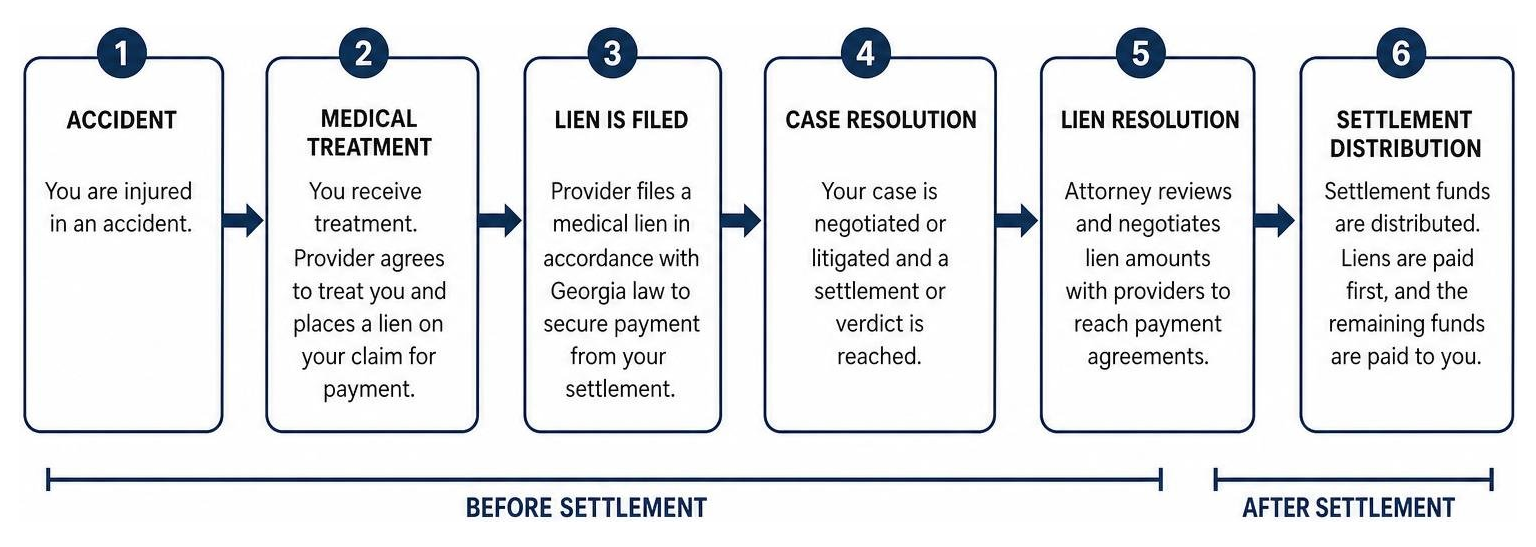
When you are hurt in an accident, your immediate focus is on getting medical care. However, the financial reality of treatment quickly follows. In Georgia, a medical lien is a legal claim or security interest asserted by a healthcare provider or insurance entity against your eventual personal injury settlement or jury verdict. Essentially, it is a legal demand to be paid directly from your recovery before any funds are distributed to you.
Understanding how these liens function is crucial because they directly impact your final take-home recovery. Many injured victims assume that the at-fault driver’s insurance company will pay their medical bills as they roll in. Unfortunately, this is a major misconception. Liability insurance carriers refuse to pay medical bills incrementally. They will only pay a single, lump-sum settlement at the very end of your case in exchange for a full release of liability.
Because of this, you are left to figure out how to cover your medical costs in the interim. If you do not have health insurance, or if your health insurance does not cover the full cost of specialized care, medical providers may agree to treat you on a lien basis. In Georgia, this process is heavily governed by the Georgia Hospital Lien Statute (O.C.G.A. § 44-14-470), which grants hospitals, nursing homes, and certain medical practices the right to file a lien against your legal claim.
At Perkins Trial Lawyers, we actively protect our clients from aggressive and predatory billing practices. As of July 2026, medical billing continues to grow increasingly complex, and without a dedicated legal team advocating on your behalf, a significant portion of your settlement could be consumed by unverified or inflated medical charges.
What is a Statutory Hospital Lien in Georgia?
A statutory hospital lien is a powerful legal tool created by Georgia law under O.C.G.A. § 44-14-470. This statute allows hospitals, traumatic burn centers, and nursing homes to secure payment for the care they provide to injured patients. However, because these liens are created by statute, hospitals must follow strict legal guidelines to make them enforceable:
- Filing Deadlines: Under the statute, a hospital must file its written notice of lien within 75 days of the patient’s discharge from the facility. If they miss this 75-day window, the statutory lien is legally invalid.
- Filing Location: The lien must be filed in the office of the clerk of the superior court of the county in which the hospital is located, as well as the county where the injured patient resides.
- Notice Requirements: The hospital must send a copy of the filed lien to both the injured person and the at-fault party’s insurance carrier via certified mail or statutory overnight delivery within the same 75-day window.
If a hospital makes technical errors—such as filing in the wrong county, missing the 75-day deadline, or failing to send the required certified notice—the statutory lien is legally defective. While the hospital can still attempt to collect the debt from you personally as a standard medical bill, they lose their priority right to demand payment directly from your personal injury settlement proceeds.
How Do Contractual Liens and Letters of Protection (LOPs) Differ?
Unlike statutory hospital liens, which are created by law, contractual liens are created by agreement. When you visit a private medical clinic, such as an orthopedic surgeon, chiropractor, or physical therapist, they may require you to sign a contractual lien. This agreement states that you authorize your attorney to pay the clinic’s bills directly out of your final settlement.
A Letter of Protection (LOP) is a similar but distinct document. While a contractual lien is signed by you, an LOP is a legally binding agreement issued by your personal injury attorney to the medical provider. The LOP acts as a promise that we will protect the doctor’s outstanding bills and pay them directly from the settlement or verdict proceeds once the case is resolved.
Under Georgia law, medical providers cannot charge whatever they want simply because a case is pending. All medical charges must be “reasonable and necessary.” If a clinic attempts to charge inflated, non-standard rates because they know a personal injury settlement is coming, we can legally challenge those bills as unreasonable, using local rate databases and standard fee schedules as leverage.
How Do Atlanta Attorneys Coordinate with Doctors on a Lien Basis?
For many injured victims, the greatest barrier to recovery is the upfront cost of specialized medical care. If you do not have health insurance, or if your insurance has a massive deductible, you might struggle to see a neurologist, get an MRI, or undergo physical therapy.
As a dedicated Personal Injury Lawyer in Atlanta, we routinely coordinate with local medical providers who are willing to treat patients on a lien basis. This means you can receive the immediate, high-quality care you need without paying anything out of pocket.
Our role as your Car Accident Attorney in Atlanta GA involves vetting local chiropractic, orthopedic, and physical therapy clinics to ensure they are reputable, provide excellent patient care, and keep meticulous records. We ensure your medical treatment is thoroughly documented, which is essential to withstand the intense scrutiny of insurance adjusters who look for any excuse to devalue your claim.
Why Do Attorneys Refer Clients to Specific Medical Providers?
When we refer a client to a specific medical provider, our primary goal is to ensure they receive immediate, specialized care from doctors who understand the complexities of personal injury cases. There are several reasons why this coordination is beneficial:
- No Upfront Costs: We connect you with doctors who are willing to delay billing until your case is resolved, ensuring your financial situation does not prevent you from healing.
- Understanding Legal Documentation: Not all doctors know how to document a personal injury case. The providers we coordinate with understand how to write comprehensive medical narratives, clearly explain causation, and accurately document when you reach Maximum Medical Improvement (MMI).
- Avoiding Gaps in Treatment: Insurance adjusters actively look for gaps in your medical treatment to argue that you were not actually hurt. By coordinating your care immediately, we ensure there are no gaps that could devalue your claim.
How Do Letters of Protection (LOPs) Facilitate This Coordination?
An LOP is the bridge that makes this coordination possible. It is a binding legal agreement that protects both the patient and the doctor.
For the doctor, the LOP provides a guarantee that their financial interests are protected and that they will be paid directly from the settlement proceeds. This security allows them to provide expensive treatments, diagnostic imaging, and surgeries without demanding upfront payment.
For you, the client, the LOP allows you to focus entirely on your physical recovery without receiving constant, stressful collection calls or facing damage to your credit score while your lawsuit is pending.
Crucially, there is a strict ethical boundary: while we facilitate this coordination to help you get well, we never control or influence the doctor’s medical decisions, diagnoses, or treatment plans. The doctor’s medical judgment must remain completely independent of the legal case.
Do Doctors Actually Work on a Contingency Basis in Personal Injury Cases?
There is a widespread myth in personal injury law that some doctors work on a “contingency basis.” This stems from a misunderstanding of how medical liens operate.
To be completely clear: doctors do not work on a contingency percentage.
It is legally and ethically impermissible for a medical provider to charge a fee based on a percentage of your legal recovery. State medical boards and legal ethics rules strictly prohibit doctors from taking, for example, “33% of your settlement” as payment for their services.
Instead, doctors charge for the actual services they render based on their standard billing rates. What they do agree to do is delay the collection of those fees until your case resolves. The confusion arises because of how these bills are settled at the end of a case, which often mimics a contingency-like split.
For a deeper dive into this dynamic, you can read more about Understanding Medical Liens: Atlanta Personal Injury Lawyer Explains – Hotel Wiki.
What Is the “Three-Way Split” Myth?
In many personal injury cases, a client will look at their final settlement sheet and see that the attorney received 33.33%, the client received 33.33%, and the medical providers received exactly 33.33%. This is often referred to as the “three-way split.”
This equal division can make it look like the doctor worked on a flat contingency percentage, but that is not what actually happened. In reality, the client’s actual medical bills were likely much higher than one-third of the settlement. To facilitate a resolution and ensure the client does not walk away empty-handed, the attorney negotiated a compromise with the doctors, convincing them to reduce and cap their bills to exactly one-third of the total recovery.
For example, consider a case study where a victim settles their claim for a policy limit of $25,000. If the doctor’s actual, itemized bills totaled $15,000, paying that full amount would leave almost nothing for the client after attorney fees. To resolve the case, the attorney negotiates the doctor’s payout down to exactly $8,333 (one-third), matching the attorney’s fee and leaving the client with an equal $8,333.
However, if your actual medical bills were only $3,000, and a doctor demands a flat 33.33% ($8,333) of a $25,000 settlement, this is highly inappropriate, unethical, and a major red flag. A doctor can never charge more than the actual value of the services they provided.
What Are the Ethical Boundaries of Attorney-Doctor Referrals?
The relationship between personal injury attorneys and treating doctors is strictly regulated. The Georgia State Bar enforces rigid ethical rules to protect consumers:
- No Referral Kickbacks: It is strictly illegal and unethical for an attorney to pay a doctor for referring a patient, or for a doctor to pay an attorney for a legal referral. No money or financial incentives can ever be exchanged for referrals.
- Independent Medical Judgment: A doctor’s diagnosis, treatment plan, and medical opinions must be based solely on your clinical needs, completely independent of how it might affect the value of your lawsuit.
- No Fee-Splitting: Attorneys and doctors cannot split fees. The attorney’s fee is a percentage of the recovery, while the doctor’s payment must always reflect the reasonable cost of actual medical care provided.
If you ever suspect that a lawyer and a doctor are colluding to inflate your medical bills or split a flat percentage of your settlement, you should seek a second legal opinion immediately.
How Are Medical Liens Paid and Negotiated from a Settlement?
When a personal injury case is settled, the insurance company does not send separate checks to you, your lawyer, and your doctors. Instead, they issue a single check made out to both you and your attorney’s firm.
By law, your attorney must deposit these funds into a specialized escrow account called an Interest on Lawyers’ Trust Account (IOLTA). Your attorney has a strict legal and ethical obligation to resolve and pay all valid, outstanding medical liens from these funds before distributing the remaining net recovery to you.
This is where having a skilled negotiator on your side is invaluable. Typically, medical providers will agree to reduce their liens because their initial bills are grossly inflated. Because we hold the settlement funds in trust, we have the leverage to negotiate these bills down, directly increasing the amount of money that goes into your pocket.
To understand how these negotiations impact your bottom line, you can explore our resource on What’s My Case Worth.
How Do Attorneys Negotiate Reductions on Inflated Medical Bills?
We do not simply accept medical bills at face value. Our legal team audits every single medical bill to find errors, duplicate charges, and inflated rates. We use several proven strategies to negotiate massive reductions:
- Benchmarking Rates: We compare the provider’s billed rates against local medical rate databases and Medicare fee schedules to prove that their charges are unreasonable.
- Identifying Billing Errors: We look for double-billed diagnostic tests, unbundled codes, and charges for services that were never actually rendered.
- Leveraging Policy Limits: If the at-fault party has a limited insurance policy (such as Georgia’s minimum $25,000 liability limit) and your bills far exceed that limit, we use this financial reality to force providers to accept a fraction of their bill, arguing that some payment is better than risking a total loss in litigation.
The impact of this advocacy is clear. The Insurance Research Council (IRC) conducted a study showing that represented accident victims received up to 350% more in settlement compensation than unrepresented individuals, even after attorney fees were paid. A massive part of this difference is the attorney’s ability to slash outstanding medical liens.
To illustrate how these negotiations work in practice, consider this detailed comparison of a client’s case where we stacked a $50,000 liability policy, a $25,000 uninsured motorist (UM) policy, and $5,000 in MedPay:
| Medical Provider / Lien Holder | Original Billed Amount | Negotiated Settlement Payout | Total Client Savings |
|---|---|---|---|
| Hospital Statutory Lien | $31,000 | $9,500 | $21,500 |
| Orthopedic Clinic (Contractual/LOP) | $24,000 | $8,200 | $15,800 |
| Physical Therapy Clinic (LOP) | $8,200 | $4,100 | $4,100 |
| ERISA Health Plan Subrogation | $6,000 | $4,000 | $2,000 |
| Medicare Conditional Payment | $14,800 | $9,300 | $5,500 |
| TOTALS | $84,000 | $35,100 | $48,900 |
In this real-world scenario, our negotiations saved the client $48,900, transforming a case where they would have owed money into a highly successful recovery that put substantial funds in their pocket.
What Is the Settlement Distribution Sheet?
Before a single dollar is paid out of the trust account, your attorney must provide you with a written Settlement Distribution Sheet (also called a settlement accounting sheet). This document is a line-by-line breakdown of every penny involved in your case. It shows:
- The total gross settlement amount paid by the insurance company.
- The attorney’s contingency fee (typically 33.33% to 40% depending on whether a lawsuit was filed).
- An itemized list of litigation expenses (court filing fees, deposition costs, medical record retrieval fees).
- An itemized list of every medical provider and the exact negotiated amount they will receive to fully resolve their lien.
- The exact net amount that will be paid directly to you.
You should never sign a settlement release or authorize your attorney to distribute funds until you have reviewed, understood, and signed this distribution sheet. It is your right to know exactly where every dollar is going.
What Are the Legal, Ethical, and Subrogation Risks of Medical Liens?
While coordinating with doctors on a lien basis is a fantastic tool for getting care, medical liens carry significant legal and ethical risks if they are not handled correctly.
One of the most complex areas of personal injury law involves subrogation. Subrogation is the legal right of an insurance company (like your private health insurer, Medicare, or Medicaid) to seek reimbursement from your personal injury settlement for the medical bills they paid on your behalf.
Subrogation claims are legally distinct from provider liens. While a provider lien is filed by a doctor who hasn’t been paid yet, a subrogation claim is filed by an insurer who did pay your bills but wants their money back now that you’ve recovered compensation from the at-fault party.
Whether we are handling a case as a Slip and Fall Attorney in Atlanta or representing a client as a Premises Liability Lawyer Atlanta, we must carefully navigate these competing claims to protect your recovery.
How Does Georgia’s Made-Whole Doctrine Protect Injured Victims?
Fortunately, Georgia law provides a powerful shield for injured victims known as the “Made-Whole Doctrine” (O.C.G.A. § 33-24-56.1).
Under this doctrine, a health insurance company cannot seek reimbursement or subrogation from your personal injury settlement unless you have been “fully compensated” for all of your economic and non-economic losses. This means that if your settlement does not cover all of your pain and suffering, lost wages, and future medical needs because of limited insurance policies, your health insurer is legally barred from taking any of your settlement money.
As your attorneys, we use the Made-Whole Doctrine to aggressively challenge subrogation claims from private health insurance companies. In many cases, we can completely eliminate their reimbursement claims, ensuring that money stays with you.
Why Do ERISA Plans and Government Programs Have Different Rules?
While Georgia’s Made-Whole Doctrine is highly protective, it does not apply to every health plan. There are two major exceptions that require skilled legal navigation:
- ERISA Self-Funded Plans: Many large employers offer health insurance plans governed by the federal Employee Retirement Income Security Act (ERISA). Because ERISA is a federal law, self-funded ERISA plans bypass state laws, meaning they are not bound by Georgia’s Made-Whole Doctrine. These plans have incredibly strong reimbursement rights and can demand 100% of their money back, though we can still negotiate reductions using federal “common fund” doctrines.
- Medicare and Medicaid “Super-Liens”: Government programs operate under federal and state statutes that grant them automatic “super-liens.” You cannot use the Made-Whole Doctrine against Medicare or Medicaid. If you ignore a Medicare conditional payment claim, the government can sue both you and your attorney, assess heavy financial penalties, and cut off your future benefits.
Resolving Medicare and Medicaid claims requires a meticulous, line-by-line review of their conditional payment letters to ensure they are not demanding reimbursement for medical treatments that were completely unrelated to your accident.
Frequently Asked Questions About Atlanta Medical Liens
Is it normal for a doctor to get 33.33% of my personal injury settlement?
No, it is not normal or ethical for a doctor to charge a flat 33.33% contingency fee for their services. Doctors must bill based on the actual medical care they provided.
However, if you see exactly 33.33% of your settlement going to your doctors on your distribution sheet, it is usually because your attorney negotiated a massive discount to cap their high bills. This is done to ensure an equal “three-way split” so that you, your attorney, and your medical providers each receive an equal share, preventing your medical bills from wiping out your entire recovery.
Can I ignore a hospital lien if they didn’t file it correctly?
While technical errors—such as missing the 75-day filing deadline or failing to send notice via certified mail—can legally invalidate a statutory hospital lien under Georgia law, you should never simply ignore it.
Even if the lien is legally invalid, the underlying debt for your medical treatment still exists. The hospital can still send your account to a collections agency, sue you personally, or damage your credit score. Instead of ignoring the error, an experienced attorney will use these filing mistakes as powerful leverage to negotiate a massive reduction in the total amount you owe.
Should I use my health insurance instead of treating on a lien?
Yes, you should always present your health insurance, Medicare, Medicaid, or auto Medical Payments (MedPay) coverage first.
Using your health insurance keeps your overall medical bills much lower because health insurance companies have pre-negotiated, deeply discounted rates with hospitals and doctors. It also avoids the high-interest rates and complications associated with third-party medical liens. While your attorney may still have to resolve a subrogation claim with your health insurer at the end of your case, the total amount owed will be significantly lower than if you treated on a lien.
Maximizing Your Recovery with Perkins Trial Lawyers
At Perkins Trial Lawyers, we believe that winning your personal injury case is only half the battle. The other half is protecting your settlement from being drained by aggressive insurance adjusters, subrogation agents, and inflated medical bills.
Our legal team advocates tirelessly against insurance companies and medical providers alike to maximize your net, take-home recovery. We audit every medical bill, challenge invalid statutory liens, exploit technical filing errors, and aggressively negotiate contractual reductions on your behalf.
Whether you were injured in a car crash, a truck collision, a slip and fall, or a premises liability incident, we are committed to providing transparent, honest, and relentless representation.
Do not let medical liens consume the compensation you deserve. Contact us today or schedule a free, confidential case evaluation directly on our Consultation Calendar. We are here to stand in your corner and ensure you get a clean, successful finish so you can focus on your life.
