Elevator Accidents in Atlanta Are More Common — and More Serious — Than You Think
If you’re looking for an elevator injury attorney in Atlanta, here’s what you need to know right away:
Quick Answer: What an Elevator Injury Attorney Does for You
- Investigates the accident and preserves critical evidence
- Identifies all liable parties (property owners, maintenance companies, manufacturers)
- Builds your case using inspection records, maintenance logs, and professional analysis
- Negotiates with insurance companies on your behalf
- Fights for maximum compensation — including medical bills, lost wages, and pain and suffering
Most people step into an elevator without a second thought. But elevators are complex machines — and when they fail, the consequences can be devastating.
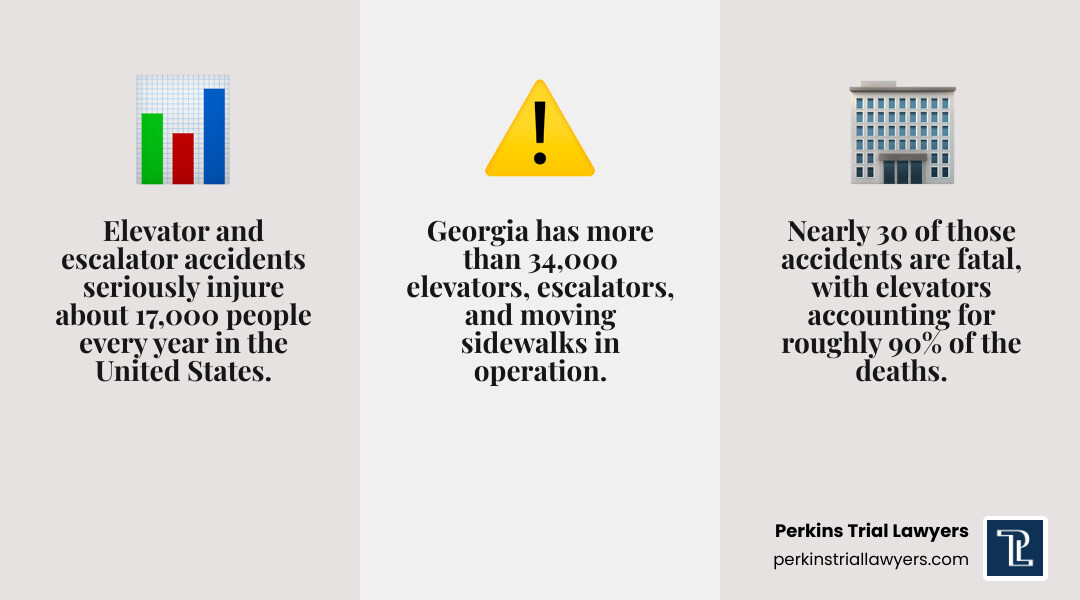
According to the U.S. Bureau of Labor Statistics and the Consumer Product Safety Commission, elevator and escalator accidents seriously injure about 17,000 people every year in the United States. Nearly 30 of those accidents are fatal.
What’s more alarming? Elevators account for roughly 90% of the deaths caused by elevator and escalator incidents combined.
These aren’t just statistics. Behind every number is a real person — someone who got on an elevator expecting a routine ride and got off facing broken bones, a traumatic brain injury, or worse.
In Georgia alone, there are more than 34,000 elevators, escalators, and moving sidewalks in operation. When building owners neglect inspections, when maintenance companies cut corners, or when manufacturers ship defective equipment, ordinary people pay the price.
If you or a loved one was hurt in an elevator accident in Atlanta, you may have a legal right to compensation — but the window to act is limited.
Common Causes of Elevator and Escalator Accidents in Georgia
Elevators are intricate networks of cables, pulleys, electrical wiring, and computerized sensors. When even a single component is poorly maintained, the entire system can fail. In Georgia, elevator safety is regulated by the Georgia Department of Insurance and Safety Fire, which adopts strict safety codes (including ASME standards). However, building inspectors are often spread thin, and many properties fall behind on their annual inspection requirements.
When systems are neglected, several dangerous conditions can arise.
Mechanical Failures and Poor Maintenance
The mechanical components of an elevator require constant lubrication, testing, and replacement. Some of the most severe accidents are caused by:
- Pulley and Cable Malfunctions: If a pulley system fails or a cable snaps, the elevator car can experience sudden drops or free falls. While backup braking systems are supposed to catch the car, a lack of maintenance on these safety brakes can result in a catastrophic drop.
- Rope Gripper Failures: Designed to stop the elevator from moving if the doors are open or if it exceeds safe speeds, failing rope grippers can cause the cabin to move unexpectedly.
- Electrical Failures: Faulty wiring can cause power surges, sudden stops, or even electrocution risks for passengers and repair workers alike.
A tragic example of what happens when safety standards are ignored occurred in Atlanta when a 19-year-old student lost his life. He was in a student housing building when a strained elevator collapsed. Investigators later discovered that the building’s operating permit had expired the previous year, and multiple complaints about the malfunctioning elevator had been ignored by management.
Mis-leveling and Door Malfunctions
Not all elevator injuries happen during a dramatic drop. In fact, some of the most common injuries occur when passengers are simply trying to get in or out of the car.
- Mis-leveling: This occurs when an elevator car does not stop flush with the floor of the hallway. Even a difference of an inch or two creates a major trip-and-fall hazard. Passengers stepping out may not notice the uneven floor, leading to severe ankle, knee, hip, and spinal injuries.
- Door Strikes and Sensor Failures: Elevator doors are equipped with sensors to detect when a person is in the doorway. If these sensors fail, the heavy doors can slam shut with immense force, crushing limbs or knocking passengers to the ground.
- Elevator Entrapment: Getting stuck inside an elevator can be a terrifying experience, often leading to severe panic attacks, oxygen depletion in poorly ventilated shafts, or injuries when passengers attempt to escape. If you find yourself in this situation, understanding how to handle hotel elevator entrapment claims can help you hold the right parties accountable for the trauma and physical harm suffered.
Determining Liability: Who Is Responsible for Your Injuries?
Elevator accidents rarely involve straightforward liability. Because multiple parties are responsible for the installation, operation, and maintenance of these systems, determining who is at fault requires a deep dive into the relationships between building owners, management companies, and third-party contractors.
If you are injured, a qualified premises liability lawyer in Atlanta can help sort through these complex legal relationships to identify every viable source of compensation.
Property Owners and Building Managers
Under Georgia law (O.C.G.A. § 51-3-1), property owners and building managers owe a high duty of care to keep their premises safe for invitees. This includes commercial office buildings, hotels, apartment complexes, and shopping malls.
To meet this duty, property owners must:
- Request and pass annual safety inspections.
- Immediately shut down an elevator if a tenant or visitor reports a malfunction.
- Post clear warnings and labels near any elevator that is behaving abnormally.
- Hire qualified, licensed technicians to perform all repairs.
If a property owner knows (or should have known) that an elevator was malfunctioning and failed to take action or warn the public, they can be held legally liable under premises liability law.
Maintenance Companies and Manufacturers
In many cases, building owners outsource their elevator upkeep to third-party maintenance companies. If a maintenance company performs negligent repairs, fails to identify worn-out parts during routine checks, or uses unqualified workers to service the equipment, the liability may shift to or be shared with them.
Additionally, some accidents are caused by design or manufacturing defects. For example, the U.S. Consumer Product Safety Commission (CPSC) recalled approximately 31,000 residential elevators due to dangerous gaps that posed child entrapment risks. When a product is inherently dangerous from the factory, victims can pursue a product liability claim against the manufacturer or installer.
How an Elevator Injury Attorney Proves Negligence
Proving that a property owner or maintenance contractor was negligent requires more than just showing that you were hurt. You must prove that a dangerous condition existed, the responsible party knew or should have known about it, and their failure to fix it directly caused your injuries.
An experienced personal injury lawyer in Atlanta will immediately begin gathering the technical evidence required to build a solid claim.
Why You Need an Elevator Injury Attorney Immediately
Evidence in elevator cases can disappear quickly. Property owners may rush to repair the elevator after an accident to cover up the defect, or security footage might be overwritten.
When you hire an attorney right away, they will take swift action to preserve:
- Maintenance Logs and Repair History: These documents show whether the elevator had a history of similar malfunctions and whether the owners ignored recommended repairs.
- Inspection Reports: Georgia requires annual inspections. If the building’s operating permit was expired or if the elevator failed its last state inspection, this is powerful evidence of negligence.
- Surveillance Footage: Video from the building lobby or inside the elevator car can capture the exact moment of the malfunction.
- “Black Box” Electronic Data: Modern elevators use computerized control boards that log errors, sudden stops, and door failures. Retrieving this data can pinpoint the exact mechanical or electrical failure.
- Witness Statements: Getting statements from other tenants or employees who previously complained about the elevator shaking, dropping, or mis-leveling is critical.
Choosing the Right Elevator Injury Attorney for Your Case
Elevator cases are highly technical and often defended by aggressive corporate insurance companies. When choosing an attorney to represent you, look for a firm with:
- Strong Trial Experience: Insurance companies are more likely to offer fair settlements when they know your legal team is fully prepared to take the case to a jury.
- A Proven Track Record in Premises Liability: Elevator cases fall under premises liability law, which has unique legal standards in Georgia.
- Excellent Communication: You deserve an attorney who keeps you updated on your case, explains complex legal concepts in plain English, and treats you with compassion.
- Negotiation Skills: Most personal injury cases settle out of court, but securing a maximum settlement requires a strategic, aggressive approach to negotiations.
Damages You Can Recover in an Elevator Accident Claim
The injuries sustained in elevator accidents can be life-altering. Whether you suffered a traumatic brain injury from a sudden drop, broken bones from a mis-leveling trip, or lost a loved one in a tragic shaft fall, the financial and emotional toll can be overwhelming.
By filing a personal injury or wrongful death claim, you can pursue compensation for both economic and non-economic damages. In the most tragic circumstances, families can file wrongful death claims to cover funeral costs and the loss of financial and emotional support.
| Damage Type | What It Covers | Examples |
|---|---|---|
| Economic Damages | Verifiable financial losses resulting from the accident | Emergency room bills, surgeries, physical therapy, prescription medications, lost wages, and future loss of earning capacity. |
| Non-Economic Damages | Subjective, non-monetary losses that impact your quality of life | Physical pain and suffering, emotional distress, mental anguish, PTSD, permanent disfigurement, and loss of enjoyment of life. |
Frequently Asked Questions About Elevator Injuries
What should I do immediately after an elevator accident?
Your actions in the minutes and hours following an accident can protect both your health and your future legal claim:
- Seek Medical Attention Immediately: Even if you feel fine, adrenaline can mask serious injuries like internal bleeding or concussions. A medical evaluation establishes a direct link between the accident and your injuries.
- Report the Incident: Notify building management or security immediately. Ensure they write an official incident report and ask for a copy.
- Document the Scene: If you are physically able, take photos and videos of the elevator car, the buttons, any mis-leveling gaps, and the surrounding area.
- Gather Witness Info: Collect names and phone numbers of anyone who saw the accident or helped you out of the elevator.
- Contact an Attorney: Before speaking to the building’s insurance adjusters, consult with a qualified attorney to protect your rights.
How long do I have to file an elevator injury lawsuit in Georgia?
In Georgia, the statute of limitations for personal injury claims is generally two years from the date of the accident.
Because we are currently in June 2026, if your accident occurred today, you would have until June 2028 to file a lawsuit. However, there are exceptions. If the elevator was located in a government-owned building (like a county courthouse or municipal transit station), you may have only a few months to file a formal notice of claim. It is always best to consult an attorney as soon as possible to avoid missing critical deadlines.
Can I sue if I was injured while working on an elevator?
Yes, but the legal path depends on your role. Nearly half of all elevator-related deaths involve technicians conducting maintenance, repairs, or installation.
If you were injured while working on an elevator as an employee, you are likely covered by workers’ compensation. However, workers’ comp may not cover the full extent of your damages. If a third party’s negligence (such as a manufacturer who shipped a defective component or a building owner who failed to disclose a known hazard) caused your injury, you may be able to file a third-party personal injury lawsuit in addition to your workers’ comp claim.
Fight for Your Recovery with Perkins Trial Lawyers
When an elevator malfunction turns your life upside down, you shouldn’t have to fight corporate insurance companies alone. At Perkins Trial Lawyers, we provide tireless advocacy for victims of negligence in Atlanta, GA.
We understand the complex safety regulations governing Georgia elevators and know how to hold negligent property owners, maintenance contractors, and manufacturers accountable. Our sole focus is helping you secure the maximum compensation you need to heal and rebuild your life.
For more information on your legal options, explore our resources on premises liability cases to learn more about your rights under Georgia law.
Do not let an insurance company minimize your pain or pressure you into a quick, lowball settlement. Contact us today for a free, confidential consultation, and let us stand up for your rights.