When a Big Rig Hits Your Car in Atlanta, Here’s What You Need to Know
If you need an Atlanta big rig accident attorney, here is what matters most right now:
Quick answers for truck accident victims in Atlanta:
- You have 2 years to file a personal injury lawsuit in Georgia (O.C.G.A. § 9-3-33) — the clock starts the day of the crash
- Do not speak to the trucking company’s insurance adjuster without a lawyer present — their goal is to minimize your payout
- Multiple parties can be liable — not just the driver, but the trucking company, cargo loader, and more
- Evidence disappears fast — black box data can be overwritten; you need an attorney to send a spoliation letter immediately
- You can still recover compensation even if you were partly at fault, as long as you are less than 50% responsible under Georgia law
- Most truck accident attorneys work on contingency — no upfront fees, no payment unless you win
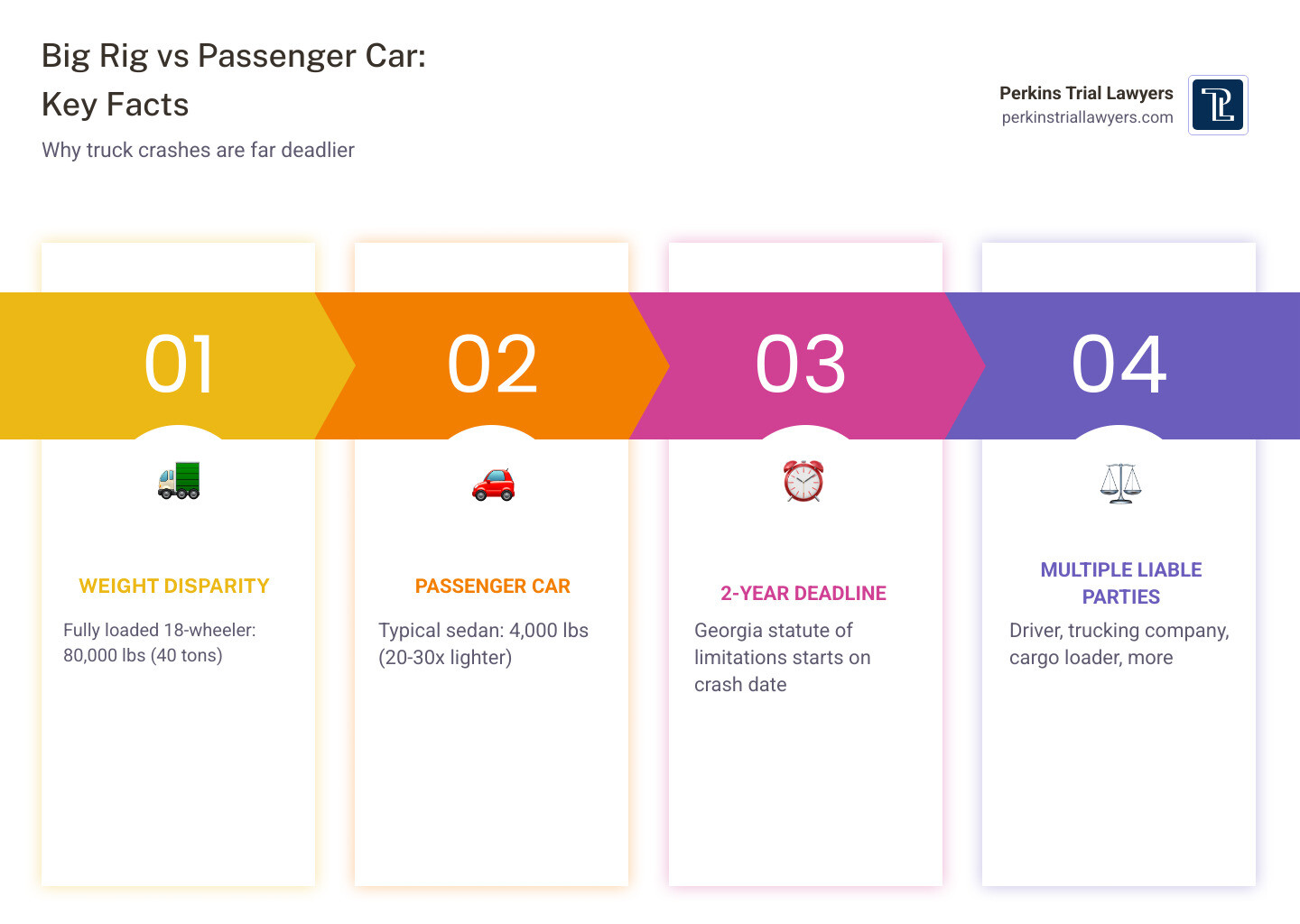
A fully loaded 18-wheeler can weigh up to 80,000 pounds — roughly 20 to 30 times the weight of a typical passenger car. When that kind of mass collides with your vehicle on a busy Atlanta highway like I-285 or I-75, the results are rarely minor. We are talking about life-altering injuries, crushing medical bills, lost income, and an immediate response from the trucking company’s legal team working to protect their interests — not yours.
Big rig accident cases are fundamentally different from regular car accident claims. They involve federal regulations, multiple potentially liable parties, complex insurance policies, and evidence that can vanish within days. The stakes are high, and the other side comes prepared.
This guide explains everything you need to know about your rights, your options, and how an experienced Atlanta big rig accident attorney can level the playing field.
Simple guide to Atlanta big rig accident attorney terms:
Why Atlanta Big Rig Accidents Are More Dangerous Than Car Crashes

When we talk about “big rigs,” we are talking about massive machines that dominate our Atlanta roads. In April 2026, traffic on the I-285 Perimeter is as heavy as ever, and the presence of these 40-ton vehicles creates a high-stakes environment for every other driver. The primary reason these accidents are so much more dangerous than a typical fender-bender comes down to basic physics: force equals mass times acceleration.
A typical passenger car weighs about 4,000 pounds. A fully loaded semi-truck weighs up to 80,000 pounds. That is a 20-to-1 weight disparity. When an 80,000-pound vehicle hits anything, the force of impact is catastrophic. Furthermore, these trucks require a massive amount of space to stop. A tractor-trailer traveling at highway speeds can take the length of two football fields to come to a complete stop. If a driver is distracted or fatigued, they simply cannot react in time to avoid a collision.
Common types of truck accidents we see in Atlanta include:
- Jackknife Accidents: This occurs when the trailer swings out at a 90-degree angle from the cab, often because the wheels lock up.
- Underride Collisions: These are particularly deadly, occurring when a smaller vehicle slides underneath the back or side of a trailer.
- Rollovers: High centers of gravity make big rigs prone to tipping, especially during sharp turns or sudden maneuvers.
- Tire Blowouts: When a truck tire fails at high speed, the driver can lose total control of the 40-ton vehicle.
The physical toll is often devastating. According to the CDC’s research on traumatic brain injury (TBI), vehicle accidents are a leading cause of TBI, making up about 20% of cases. In a truck crash, the violent shaking and direct impact make these brain injuries—along with spinal damage and internal organ rupture—far more likely than in standard car crashes. For a deeper dive into why these crashes require a different legal approach, see our guide on Atlanta Truck Wrecks: Why You Need a Heavyweight Lawyer for a Heavyweight Crash.
Determining Liability and the Role of an Atlanta Big Rig Accident Attorney
One of the biggest hurdles in a trucking case is figuring out exactly who is responsible. In a car accident, it’s usually just “Driver A vs. Driver B.” In a commercial truck accident, the “web of liability” is much larger. This is where an Atlanta big rig accident attorney becomes essential. We look beyond the driver to see if corporate negligence played a role.
Under the legal doctrine of respondeat superior, a trucking company is generally responsible for the actions of its employees while they are on the clock. However, we also investigate theories like negligent hiring (did the company hire someone with a history of DUIs?) or negligent entrustment (did they put a driver in a truck they knew had faulty brakes?).
| Potential Defendant | Why They Might Be Liable |
|---|---|
| Truck Driver | Fatigue, speeding, distracted driving, or DUI. |
| Motor Carrier | Forcing drivers to exceed hours-of-service or failing to maintain the fleet. |
| Cargo Loader | Improperly secured or unbalanced loads that cause rollovers or spills. |
| Parts Manufacturer | Defective brakes, tires, or underride guards. |
| Maintenance Contractor | Failing to properly repair or inspect the vehicle’s critical systems. |
| Third-Party Brokers | Negligently hiring a carrier with a poor safety rating. |
Navigating these parties requires a lawyer who understands both state and federal law. For our Spanish-speaking community, we offer specialized resources at Accidentes de Camiones en Atlanta GA to ensure everyone understands their rights.
How Georgia’s Comparative Negligence Law Affects Your Atlanta Big Rig Accident Attorney Case
Georgia operates under a “modified comparative fault” rule (O.C.G.A. § 51-12-33). This is a fancy way of saying that your compensation can be reduced based on your percentage of fault. For example, if a jury decides you are 20% responsible for the crash and your total damages are $1,000,000, you would receive $800,000.
However, there is a “50% bar rule.” If you are found to be 50% or more at fault, you recover nothing. Insurance companies know this and will try to shift even a small amount of blame onto you to save money. We work to ensure the facts are presented clearly so you aren’t unfairly blamed for a professional driver’s mistake.
Critical Evidence Your Atlanta Big Rig Accident Attorney Will Secure
In the trucking industry, data is king. Most modern big rigs are equipped with “black boxes” known as Event Data Recorders (EDR). These devices record speed, braking, and steering maneuvers in the seconds leading up to a crash. There are also Electronic Logging Devices (ELD) that track exactly how long a driver has been behind the wheel.
Warning: This evidence can disappear. Trucking companies are only required to keep some records for a short period—sometimes as little as 30 days. We immediately send “spoliation letters” to the trucking company. This is a formal legal notice that requires them to preserve all evidence, including:
- Driver qualification files and background checks
- Dashcam footage (if available)
- Post-accident drug and alcohol test results
- Maintenance logs and inspection reports
Securing this data is the foundation of building a strong case. You can learn more about this process in The Atlanta 18-Wheeler Injury Lawyer Guide to Maximum Compensation.
Navigating Georgia Laws and Federal Trucking Regulations
Commercial trucking isn’t just governed by the rules of the road; it’s governed by the Federal Motor Carrier Safety Administration (FMCSA). These federal regulations are strict and are designed to keep the public safe. When a company or driver violates these rules, it can be used as evidence of “negligence per se,” meaning the violation itself proves they were negligent.
Key regulations include:
- Hours of Service (HOS): Property-carrying drivers are generally limited to 11 hours of driving after 10 consecutive hours off duty. Fatigue is a massive factor in Atlanta crashes, and we check logbooks to see if drivers were pushed past their limits.
- Weight Limits: Trucks cannot exceed 80,000 pounds without special permits. Overweight trucks are harder to stop and more likely to cause catastrophic damage.
- Maintenance Schedules: Every truck must undergo regular, documented inspections.
- Hazardous Materials: If a truck is carrying dangerous chemicals, it must be clearly marked and follow specific routes.
Georgia also has its own intrastate commerce rules that apply to trucks that only operate within state lines. Whether it’s a local delivery truck or a cross-country 18-wheeler, we know which rules apply. For more information on choosing the right legal partner for these complex cases, check out The Ultimate Guide to Hiring an Atlanta Semi Truck Accident Lawyer.
Compensation and Evidence in Trucking Litigation
When we take on a case, our goal is to recover the “full value of the life” or the full cost of the injuries. This falls into several categories:
- Economic Damages: These are the quantifiable bills. It includes current and future medical expenses, lost wages, and “lost earning capacity” if you can no longer work in your previous profession.
- Non-Economic Damages: This covers the human cost. Pain and suffering, emotional distress, and “loss of consortium” (the impact the injury has on your relationship with your spouse).
- Punitive Damages: Under O.C.G.A. § 51-12-5.1, punitive damages may be awarded if the trucking company showed “willful misconduct” or “entire want of care.” For example, if a company knew a driver was consistently falsifying logs or driving drunk, a jury might award punitive damages to punish the company and discourage others from doing the same.
In the most tragic cases involving a loss of life, we file wrongful death claims. Georgia law allows families to recover the full value of the deceased’s life, including the money they would have earned and the intangible value of their presence and companionship. Our Atlanta Big Rig Accident Attorney Services are designed to handle these heavy burdens for you.
Frequently Asked Questions about Atlanta Truck Crashes
What is the statute of limitations for a truck accident in Georgia?
In Georgia, the statute of limitations is generally two years from the date of the accident (O.C.G.A. § 9-3-33). If you miss this deadline, you lose your right to sue. However, if the accident involved a government-owned vehicle (like a city garbage truck), you might have as little as six months to file an “ante litem” notice. This is why it is so important to act quickly.
Should I speak to the trucking company’s insurance adjuster?
No. Insurance adjusters are trained professionals whose job is to save the insurance company money. They may seem friendly, but they are looking for any statement they can use to lower your payout. They might offer a “quick settlement” that looks like a lot of money now but won’t even cover your future medical bills. Let your attorney handle all communications.
What are common injuries in big rig accidents?
Because of the immense force involved, injuries are often catastrophic. We frequently see:
- Traumatic Brain Injuries (TBI): Ranging from concussions to permanent cognitive impairment.
- Spinal Cord Damage: Which can lead to partial or total paralysis.
- Internal Organ Rupture: Often caused by the seatbelt or steering column during high-impact crashes.
- Compound Fractures: Broken bones that often require multiple surgeries and hardware to fix.
- Third-Degree Burns: Especially if the truck was carrying fuel or hazardous chemicals.
Scientific research on vehicle accident injury types shows that truck accident victims are significantly more likely to require long-term rehabilitation and home modifications compared to those in standard car accidents.
Conclusion
If you or a loved one has been involved in a crash with an 18-wheeler, you don’t have to face the trucking giants alone. At Perkins Trial Lawyers, we provide tireless advocacy against insurance companies to ensure you receive the maximum compensation you deserve. We understand the specific dangers of Atlanta’s highways and the complex federal laws that govern the trucking industry.
We work on a contingency fee structure, which means you pay us nothing upfront. We only get paid if we win your case. This allows you to focus on your recovery while we handle the investigations, the paperwork, and the courtroom battles.
Don’t let a trucking company’s legal team dictate your future. Contact an Atlanta big rig accident attorney today for a free consultation and let us help you steer the journey from crash to recovery.