
What Every Injured Rider in Atlanta Needs to Know First
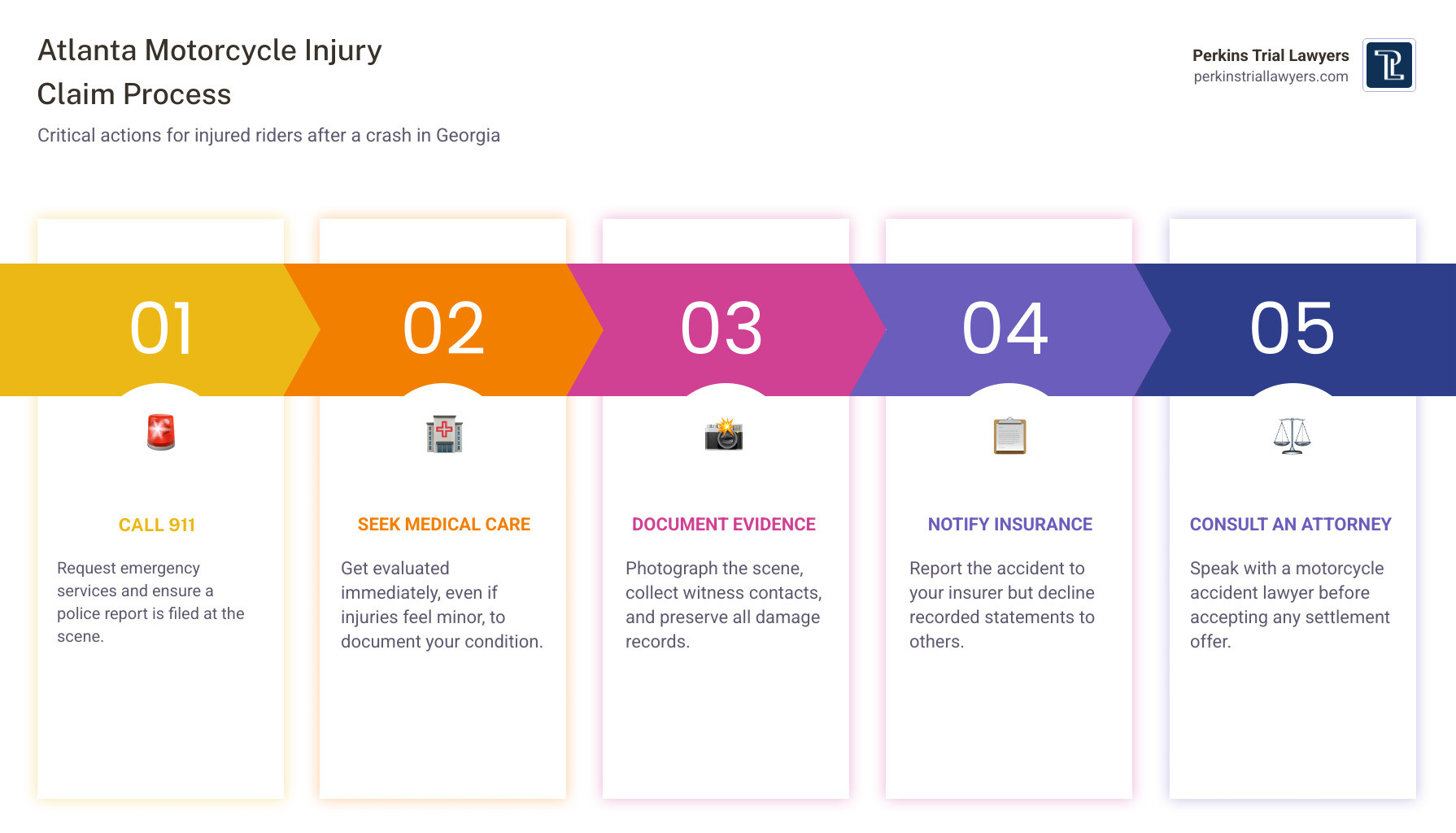
If you’re dealing with a motorcycle injury claim in Atlanta, here’s the fast answer on how to move forward:
- Call 911 and get a police report filed at the scene
- Seek medical attention immediately — even if you feel okay
- Document everything — photos, witness contacts, damage
- Notify your insurance company of the accident
- Avoid giving recorded statements to the other driver’s insurer
- Consult a motorcycle accident attorney before accepting any settlement
- File your claim within two years — Georgia’s statute of limitations under O.C.G.A. § 9-3-33
Riding a motorcycle in Atlanta puts you at serious risk. Motorcyclists make up 14% of all traffic-related fatalities in Georgia — despite being a tiny fraction of registered vehicles on the road.
Atlanta’s roads make things worse. The city ranks 186th out of 200 major U.S. cities for driver safety, with aggressive braking events happening 30 times per 1,000 miles driven. That’s a lot of close calls — and for riders, close calls often become catastrophic crashes.
Here’s what makes motorcycle claims especially hard: insurance companies tend to blame the rider by default. Even when a distracted or reckless driver caused the crash, adjusters routinely use anti-biker bias to deny or shrink payouts.
This guide walks you through every step — from the moment after impact to getting the compensation you’re owed.
Motorcycle injury claim Atlanta word list:
Immediate Steps to Take After an Atlanta Wreck
The moments immediately following a crash are chaotic, but what you do in these crucial minutes can make or break your motorcycle injury claim in Atlanta. When adrenaline is pumping, it is easy to make mistakes that insurance companies will later use to deny your claim. Following a structured set of actions will protect both your health and your legal rights.
1. Prioritize Safety and Call 911
First, move to a safe area if you are physically able to do so. Atlanta highways like I-285, I-75, and the Downtown Connector are notoriously dangerous, and secondary collisions are a major risk. Call 911 immediately. Request both police presence and emergency medical services (EMS). Even if you believe your injuries are minor, you need an official police report.
When the police arrive, stick to the facts of what happened. Do not apologize, and do not say “I’m fine.” In the shock of the moment, your body releases endorphins that mask severe pain. Saying you are uninjured at the scene can severely damage your credibility when injuries manifest hours or days later.
2. Seek Immediate Medical Evaluation
You must get evaluated by a medical professional on the day of the wreck. If EMS recommends taking you to the hospital, go. If not, go straight to an emergency room or urgent care clinic in Atlanta.
Delaying medical care is the number one reason insurance companies deny injury claims. They will argue that if you waited three days to see a doctor, your injuries must not have been that serious, or that they were caused by a completely different event. Having professional documentation of your injuries immediately following the crash is essential for your Atlanta Motorcycle Emergency Legal strategy.
3. Document the Scene and Preserve Evidence
If you are physically capable, or if you have a passenger who can assist, gather as much evidence as possible before the vehicles are cleared:
- Take photos and videos of the damage to your motorcycle, the other vehicles, road conditions, skid marks, traffic signs, and your visible injuries.
- Collect the contact details, driver’s license numbers, and insurance information of all drivers involved.
- Identify witnesses who stopped to help and write down their names and phone numbers. Do not rely solely on the police to gather witness information, as police reports sometimes leave out key contacts.
- Keep your damaged riding gear, including your helmet, jacket, and boots. Do not clean them or throw them away; they serve as critical physical evidence of the impact forces.
4. Avoid Giving Recorded Statements to Insurers
In the days following the crash, the at-fault driver’s insurance adjuster will likely call you. They may sound friendly and deeply concerned about your well-being. Do not be fooled. Their goal is to get you on a recorded line saying something that minimizes your injuries or shifts the blame onto you.
You are under no legal obligation to give a recorded statement to the other driver’s insurance company. Politely decline and tell them that your attorney will handle all communications.
How to File a Motorcycle Injury Claim Atlanta
Filing a motorcycle injury claim in Atlanta is a structured legal process. To get the maximum cash payout for your recovery, you must build a bulletproof case that accounts for every dollar you have lost and will lose in the future.
Step 1: Insurance Notification and Investigation
Your claim officially begins when you notify the relevant insurance companies of the accident. In Georgia, which is an at-fault state, you will typically file a third-party claim against the negligent driver’s liability insurance.
Once the claim is opened, an insurance adjuster will investigate the crash. They will review the police report, look at vehicle damage, and examine medical records. During this phase, having a skilled Atlanta Motorcycle Lawsuit Attorney by your side is invaluable. We can handle all communication, ensuring the insurance company does not twist your words.
Step 2: Calculating Your Damages
To demand a fair settlement, you must calculate your total damages. These are split into two main categories:
Economic Damages (Special Damages)
These are your tangible, out-of-pocket financial losses. They are calculated using receipts, bills, and pay stubs:
- Medical Bills: Emergency room visits, surgeries, hospital stays, doctor appointments, physical therapy, and prescription medications.
- Future Medical Care: If your injuries require ongoing treatment, rehabilitation, or prosthetic devices, these future costs must be estimated by medical professionals.
- Lost Wages: The income you lost while recovering from your injuries.
- Loss of Earning Capacity: If your injuries prevent you from returning to your previous job or working at all, you are entitled to compensation for your lost future income.
- Property Damage: The cost to repair or replace your motorcycle and riding gear.
Non-Economic Damages (General Damages)
These are intangible losses that do not have a direct price tag but deeply affect your quality of life:
- Pain and Suffering: The physical pain and discomfort caused by your injuries.
- Emotional Distress: Anxiety, depression, PTSD, and sleep disturbances following the trauma of the crash.
- Loss of Enjoyment of Life: The inability to participate in hobbies, recreational activities, or daily routines that you enjoyed before the accident.
- Disfigurement and Physical Impairment: Compensation for permanent scarring, amputations, or loss of mobility.
For a deeper look into how these damages are calculated and maximized, consult our comprehensive Motorcycle Injury Settlement Atlanta Guide.
Step 3: Sending the Demand Letter
Once you have reached Maximum Medical Improvement (MMI) — meaning your injuries have healed as much as they are expected to — your lawyer will draft and send a formal demand letter to the insurance company. This letter details the facts of the accident, establishes the other driver’s liability, outlines your injuries and medical treatments, and demands a specific financial sum to settle the claim.
The insurance company will then either accept the demand, make a counteroffer (which is usually very low), or deny the claim. This kicks off the negotiation phase. If the insurer refuses to offer a fair settlement, your attorney can file a formal lawsuit to take your case to court.
Proving Fault and Overcoming Insurance Bias in Georgia
Proving fault is the most critical hurdle in any motorcycle injury claim in Atlanta. Under Georgia law, the party who caused the accident is responsible for paying the damages. However, insurance adjusters and even juries often harbor a deep-seated bias against motorcyclists, assuming that anyone who rides a bike must be reckless, speed-obsessed, or inherently dangerous.
To overcome this bias, you must present overwhelming, objective evidence of driver negligence.
Common Causes of Driver Negligence
Most motorcycle accidents in Atlanta are caused by passenger vehicle drivers who fail to share the road safely. Common examples include:
- Left-Turn Collisions: A driver turns left at an intersection directly into the path of an oncoming motorcycle, claiming they “didn’t see” the rider.
- Distracted Driving: Drivers looking at smartphones, navigating GPS, or eating, completely failing to notice smaller vehicles in their vicinity.
- Blind Spot Merges: Drivers changing lanes without checking their blind spots, forcing a motorcyclist off the road or sideswipe-colliding with them.
- Tailgating: Following a motorcycle too closely, leading to devastating rear-end collisions when traffic slows down.
To build a strong case against these negligent behaviors, read our Atlanta Biker Injury Lawyer Guide for Downed Riders.
Georgia’s Modified Comparative Negligence Law (O.C.G.A. § 51-12-33)
Georgia follows a modified comparative negligence system with a 50% bar rule. This means:
- You can recover compensation as long as you are less than 50% at fault for the crash.
- Your financial recovery will be reduced by your percentage of fault. For example, if your total damages are $100,000, but you are found to be 20% at fault (perhaps for speeding slightly), your payout will be reduced by 20%, leaving you with $80,000.
- If you are found to be 50% or more at fault, you cannot recover any compensation at all.
Because of this law, insurance companies will fight tooth and nail to shift even a small percentage of the blame onto you. They might argue that your lane positioning, speed, or lack of a helmet (even though helmet use is required under O.C.G.A. § 40-6-315) contributed to the crash or the severity of your injuries. Securing a dedicated Motorcycle Collision Attorney Atlanta is vital to fighting these unfair tactics and proving the driver was solely at fault.
| Driver Negligence Scenario | How Insurers Try to Blame the Rider | Evidence Used to Prove Driver Fault |
|---|---|---|
| Left turn in front of oncoming motorcycle | Claiming the rider was speeding or had headlights off | Traffic camera footage, accident reconstruction, witness statements |
| Sideswipe during lane change | Claiming the rider was lane-splitting illegally | Dashcam footage, paint transfer analysis, damage patterns |
| Rear-end collision at traffic light | Claiming the rider braked suddenly or had broken taillights | Brake light inspections, skid mark analysis, police report |
Frequently Asked Questions About Atlanta Wrecks
What is the average value of a motorcycle injury claim Atlanta?
There is no single “average” value for an Atlanta motorcycle claim, as payouts depend heavily on the unique circumstances of each case. However, because motorcyclists have zero structural protection, their injuries are often catastrophic, leading to higher average settlement values than typical car accident claims.
Your case valuation will depend on:
- The severity of your injuries (e.g., traumatic brain injuries, spinal cord damage, or multiple fractures fetch much higher settlements than minor road rash).
- The total cost of your past and future medical care.
- Your lost wages and whether your injuries permanently impact your earning capacity.
- The available liability insurance policy limits of the at-fault driver.
- Whether you share any percentage of fault for the accident.
To get a realistic estimate of what your specific case might be worth, you should have your medical records and accident details reviewed by an attorney.
How long do you have to file a motorcycle injury claim Atlanta?
Under Georgia law (O.C.G.A. § 9-3-33), the statute of limitations for filing a personal injury lawsuit is generally two years from the date of the accident. If you do not file a lawsuit within this two-year window, you permanently lose your right to seek compensation for your injuries.
There are very few exceptions to this rule. For instance, if the injured rider was a minor at the time of the crash, the clock may not start ticking until they turn 18. Additionally, if you are filing a claim against a government entity (such as a city of Atlanta maintenance vehicle that caused a crash), you must file a formal notice of claim (ante litem notice) much sooner — often within six months to one year. Because of these strict deadlines, it is vital to start the legal process as early as possible.
Can you recover damages if you were partially at fault?
Yes, you can still recover damages if you were partially at fault, provided your share of the blame is under 50%. Under Georgia’s modified comparative negligence law, your final compensation will simply be reduced by the percentage of fault assigned to you.
For example, if a jury determines your total damages are $200,000, but finds you were 10% responsible because you did not avoid a hazard quickly enough, your recovery will be reduced by 10% ($20,000), resulting in a final award of $180,000. Be aware that insurance companies will aggressively try to push your percentage of fault over the 50% threshold to avoid paying you anything at all. This is why having strong representation is critical to protecting your financial recovery.
Secure Your Recovery with Aggressive Atlanta Legal Representation
When you are recovering from a serious motorcycle crash, the last thing you need is the stress of fighting aggressive insurance adjusters who want to undervalue your pain. You deserve an advocate who understands the unique physics of motorcycle wrecks, the medical realities of your injuries, and the law-based strategies required to win.
At Perkins Trial Lawyers, we provide tireless advocacy against insurance companies to secure the maximum compensation you deserve. We know the local Atlanta courts, we understand how to dismantle anti-biker bias, and we prepare every single case as if it is heading to trial.
Whether we are negotiating a high-value settlement or presenting your case to a jury in a motorcycle injury trial Atlanta, we do not back down.
If you or a loved one has been injured on Atlanta’s roads, do not let your case stall. Learn more about your options by visiting our page on Motorcycle Accidents in Atlanta GA, and contact us today for a free, no-obligation consultation. Let us do the heavy lifting so you can focus on healing and getting back on the road.