
What to Do After a Pedestrian Hit and Run Claim in Atlanta
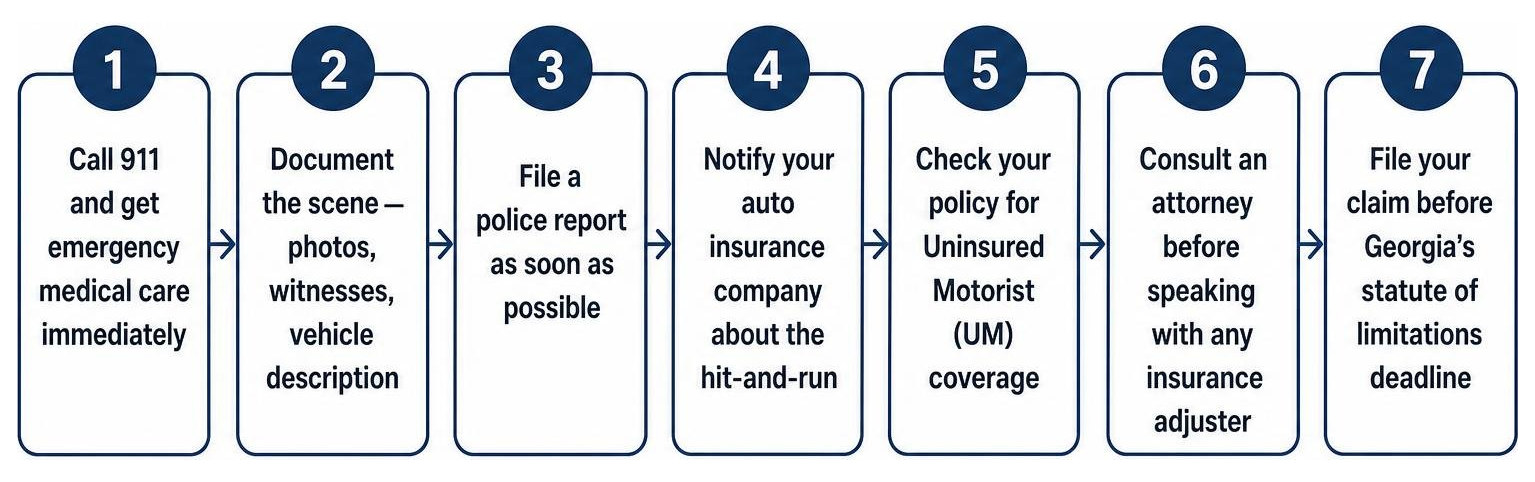
Filing a pedestrian hit and run claim is how injured victims — or their families — pursue financial compensation after a driver flees the scene of a crash. Here is what that process looks like at a glance:
- Call 911 and get emergency medical care immediately
- Document the scene — photos, witnesses, vehicle description
- File a police report as soon as possible
- Notify your auto insurance company about the hit-and-run
- Check your policy for Uninsured Motorist (UM) coverage
- Consult an attorney before speaking with any insurance adjuster
- File your claim before Georgia’s statute of limitations deadline
Being struck by a vehicle is terrifying on its own. When the driver speeds away, it adds a layer of injustice that can leave you feeling completely powerless. You’re dealing with injuries, mounting medical bills, missed work — and the person responsible is gone.
But disappearing doesn’t mean they win. Georgia law gives you real options to recover compensation, even when the driver is never found.
The road ahead involves insurance claims, legal deadlines, and — often — a fight with your own insurer. Knowing your rights from the start makes a significant difference in what you ultimately recover.
I’m Kimberly Perkins, a trial lawyer at Perkins Trial Lawyers with a strong focus on personal injury cases — including pedestrian hit and run claims — representing injured individuals in Georgia. I’ve seen how quickly evidence disappears and deadlines pass, which is why acting fast matters in every one of these cases.
Pedestrian hit and run claim terms to learn:
Immediate Actions to Take After Being Struck by a Fleeing Vehicle

When a vehicle strikes you while you are walking, your body absorbs the direct force of thousands of pounds of metal. Adrenaline spikes immediately. You may feel disoriented, shocked, or even think you are “fine” because shock temporarily masks severe internal injuries, concussions, or soft-tissue damage.
What you do in the first minutes and hours following a crash directly impacts both your medical recovery and your ability to file a successful pedestrian hit and run claim.
1. Call 911 and Request Emergency Medical Services
Your safety and health take priority over everything else. If you are able, call 911 immediately or ask a bystander to call for you. Request both law enforcement and an ambulance. Even if you believe your injuries are minor, let paramedics evaluate you on-site and transport you to an emergency room if necessary. Immediate medical documentation creates an official timeline connecting your physical injuries directly to the accident.
2. Document the Scene and Preserve Evidence
If your injuries allow you to stay conscious and safely move, start preserving details right where you are:
- Vehicle Description: Write down or dictate into your phone any memory of the vehicle — make, model, color, partial license plate digits, body style, or visible damage (e.g., broken headlight, dented bumper).
- Direction of Travel: Note which street the driver turned onto or which direction they fled.
- Photos and Videos: Take photos of the intersection or roadway, skid marks, broken vehicle debris, torn or bloodied clothing, and all visible bodily injuries.
3. Identify and Collect Eyewitness Contact Details
Bystanders, fellow pedestrians, or nearby store clerks are frequently the most valuable assets in a hit-and-run investigation. Ask for their names, phone numbers, and brief statements regarding what they saw. A quick audio recording or written note of an eyewitness statement taken while memories are fresh can make or break a liability dispute later.
4. Ensure an Official Police Report Is Filed
When police officers arrive, provide a factual, objective account of what happened without speculating. Make sure the responding officer notes that the driver fled the scene. Request the incident report number before leaving. This report serves as foundational evidence when submitting an uninsured motorist claim to an auto insurer.
How to Track Down a Hit-and-Run Driver Without a License Plate
A common misconception is that if you didn’t catch the fleeing driver’s license plate, they can never be identified. In reality, law enforcement officers and our legal team use modern investigative tools and forensic techniques to track down hit-and-run drivers who think they escaped cleanly.
Video Surveillance and Traffic Cameras
In modern urban and suburban environments like Atlanta, cameras are everywhere. Identifying a fleeing vehicle often relies on gathering footage from multiple sources quickly:
- Commercial Security Cameras: Storefronts, gas stations, banks, and office buildings frequently capture street traffic.
- Residential Cameras: Ring doorbells and home security systems near neighborhood intersections often capture fleeing vehicles.
- Municipal and Traffic Cameras: City-managed traffic monitors and license plate readers (ALPRs) record vehicles passing through key corridors.
Because commercial security systems often overwrite digital footage within 24 to 72 hours, issuing formal spoliation letters to property owners immediately is critical to preserve this footage.
Forensic Debris and Paint Transfer Analysis
When a vehicle strikes a pedestrian, physical evidence is almost always left behind:
- Paint Transfers: Microscopic paint flecks left on your clothing or personal items can reveal the precise make, model, and year range of the vehicle.
- Broken Vehicle Parts: Shattered headlight glass, broken side-view mirrors, or plastic grille fragments contain manufacturer part numbers that pinpoint exact vehicle specs.
- Damage Patterns: Matching dent patterns and radiator leaks help police locate damage when canvassing local auto body repair shops.
Recovering Compensation Through Your Pedestrian Hit and Run Claim
Many victims assume that if the police never catch the hit-and-run driver, there is no way to obtain financial compensation for medical bills and lost wages. Fortunately, that is not how insurance law works in Georgia. You have reliable paths to financial recovery even when the driver remains completely anonymous.
Through a properly managed pedestrian hit and run claim, you can seek damages for:
- Medical Expenses: Past emergency room visits, surgeries, hospitalization, physical therapy, and future projected medical needs.
- Lost Income: Wages lost during recovery and reduced future earning capacity if injuries lead to long-term disability.
- Pain and Suffering: Compensation for physical pain, emotional trauma, PTSD, anxiety, disfigurement, and loss of enjoyment of life.
- Wrongful Death: If a hit-and-run collision results in a tragic loss of life, surviving family members can seek compensation for full value of life, funeral costs, and final medical expenses through a wrongful death pedestrian claim.
Comparing Insurance Recovery Routes
| Recovery Pathway | Who Pays? | When Is It Used? | Key Requirements |
|---|---|---|---|
| Third-Party Liability Claim | Fleeing driver’s insurance carrier | When driver is identified and has active auto insurance | Must prove driver fault and identity |
| Uninsured Motorist (UM) Claim | Your personal auto policy or resident relative’s policy | When driver is unidentified or lacks sufficient coverage | Contact with vehicle or independent witness corroboration |
| MedPay / Personal PIP | Your auto insurance policy | Immediately after collision regardless of fault | Covers initial medical bills up to policy limits |
Uninsured Motorist Coverage in a Pedestrian Hit and Run Claim
The most important source of financial recovery in a hit-and-run pedestrian case is Uninsured Motorist (UM) coverage.
A critical rule that many policyholders don’t realize is that Uninsured Motorist coverage follows the person, not just the car. If you own an auto insurance policy in Georgia that includes UM coverage, that coverage protects you whenever you are injured by an uninsured or hit-and-run driver — whether you were driving, riding a bicycle, or walking across the street as a pedestrian.
What If You Don’t Own a Car?
If you don’t own a car, you may still be covered! Under Georgia law, if you live in the same household as a relative (spouse, parent, sibling) who holds auto insurance with UM benefits, you are generally considered an insured family member under their policy.
Stacking UM Policies
In Georgia, policyholders can purchase “add-on” (excess) Uninsured Motorist coverage. If multiple auto policies exist within the same household, you may be able to “stack” those policy limits together to create a much larger pool of financial coverage to pay for catastrophic injuries.
To explore how UM limits apply to your specific situation, speaking with a dedicated Pedestrian Accident Lawyer Atlanta ensures you do not leave money on the table.
Filing a Pedestrian Hit and Run Claim With Your Own Auto Insurance
When you file a pedestrian hit and run claim under your own policy’s UM coverage, your relationship with your insurance company changes. Even though you have paid your premiums faithfully on time, your insurance company takes on the legal role of the fleeing driver’s defense.
Because the insurance company wants to minimize what they pay out, they will carefully scrutinize every detail of your claim.
Crucial Guidelines for Handling Your Own Insurer:
- Report Promptly: Auto policies require “prompt notice” of a hit-and-run incident. Failing to notify your insurer within the timeframe written in your policy contract (often 30 days) can lead to a denial of benefits.
- Beware of Recorded Statements: Insurance adjusters are trained to ask leading questions designed to get you to downplay your injuries or admit fault (e.g., “Did you look both ways?” or “How are you feeling today?”). Never give a recorded statement until you have consulted a lawyer.
- Avoid Quick Settlement Offers: Insurers frequently offer early lowball settlements before the full physical extent of your injuries is known. Accepting an early check releases the insurer from paying any future medical costs or ongoing therapy bills.
- Document Everything: Keep a dedicated binder or digital folder containing every bill, prescription receipt, diagnostic report, and email exchange with insurance adjusters.
Key Statutes, Legal Deadlines, and Fault Rules in Pedestrian Claims
Navigating a pedestrian hit and run claim requires strict compliance with state procedural statutes and legal deadlines.
Statute of Limitations
In Georgia, under O.C.G.A. § 9-3-33, the statute of limitations for personal injury claims is generally two years from the date of the accident. If you fail to initiate legal action or settle your claim within this two-year window, you permanently lose your right to collect compensation.
Special Notice for Government Entities: If your accident was caused by a city-owned or state-owned vehicle that fled (or if poor municipal road design/malfunctioning crosswalk signals contributed to the incident), much shorter notice deadlines apply — known as ante litem notices. These formal claims must often be submitted within 6 months for municipal claims or 12 months for county/state claims.
Georgia’s Modified Comparative Negligence Rule
Insurance adjusters frequently argue that the pedestrian shared fault for the collision — claiming the pedestrian was jaywalking, wearing dark clothing at night, or distracted by a smartphone.
Georgia operates under a modified comparative negligence framework (50% bar rule):
- Under 50% Fault: You can still recover compensation as long as you are determined to be less than 50% at fault for the accident. However, your financial recovery is reduced proportionally by your percentage of fault. For example, if your total damages are $100,000 and a jury determines you were 10% responsible for stepping off the curb, your final recovery is $90,000.
- 50% or Greater Fault: If you are found to be 50% or more responsible for the collision, you are barred from recovering any damages whatsoever under Georgia law.
This rule makes early evidence preservation critical. An experienced car accident attorney in Atlanta GA will counter unfair allegations of fault by gathering physical evidence, timing crosswalk signals, and working with accident reconstruction specialists.
Answers to Frequently Asked Questions About Pedestrian Accidents
Can I Still Recover Damages If I Was Partially at Fault for the Accident?
Yes. Under Georgia’s modified comparative negligence system, being partially at fault does not automatically eliminate your right to receive compensation. As long as your level of fault remains under 50%, you can recover damages, though the overall payout will be reduced by your assigned percentage of responsibility.
For example, if you were crossing the road slightly outside a designated crosswalk but the fleeing driver was speeding or texting, a court might determine the driver was 80% at fault and you were 20% at fault. In this scenario, you would still receive 80% of your calculated total damages.
How Does a Criminal Hit-and-Run Case Differ From My Civil Claim?
It is vital to understand that a criminal prosecution and a civil injury claim are two completely separate legal processes:
- Criminal Prosecution: Initiated by state prosecutors to enforce criminal hit-and-run laws. The goal is to punish the driver through jail time, fines, and license suspension. The standard of proof is high (“beyond a reasonable doubt”).
- Civil Claim: Brought directly by you and your personal injury lawyer to secure financial compensation for your medical expenses, lost wages, and suffering. The standard of proof is lower (“a preponderance of the evidence”).
You do not have to wait for the criminal investigation or trial to complete before launching your civil claim. In fact, waiting can harm your civil case because physical evidence degrades over time.
When Should I Hire an Attorney After Being Struck by a Fleeing Driver?
You should consult a trial lawyer as soon as possible after receiving initial emergency medical care. Retaining legal counsel early provides vital advantages:
- Evidence Preservation: An attorney can immediately issue formal spoliation letters to secure commercial video footage before auto-deletion cycles overwrite it.
- Managing Insurers: Your attorney handles all correspondence with insurance adjusters, preventing you from accidentally making statements that compromise your UM claim.
- Accurate Valuation: A lawyer calculates the true long-term value of your claim, including future surgical needs, physical therapy, and lost career advancement.
If you are unsure how to evaluate prospective legal representation, review The Ultimate Guide to Finding a Pedestrian Injury Attorney Near Me for clear guidance on selecting trial counsel.
Protect Your Legal Rights and Recover Full Financial Settlement
Sustaining injuries in a hit-and-run crash leaves you dealing with physical pain, emotional distress, and sudden financial hardship. But you do not have to fight insurance companies alone while trying to physically heal.
At Perkins Trial Lawyers, we provide tireless advocacy against insurance companies to secure the maximum compensation our clients deserve. Whether we are hunting down camera footage, uncovering hidden household UM coverage, or taking auto insurers to court when they refuse to pay fair value, our focus remains on standing up for injured pedestrians.
If you or a loved one was injured by a hit-and-run driver, learn more about your options by talking to a dedicated personal injury lawyer in Atlanta. Contact us today for a free, confidential consultation to protect your legal rights and take the first step toward securing full financial recovery.