
What a Georgia Motorcycle Crash Settlement Is Actually Worth
Motorcycle crash settlement Georgia values vary widely — but here’s a quick look at what injured riders typically recover:
| Injury Type | Typical Settlement Range |
|---|---|
| Road rash / soft tissue | $5,000 – $40,000 |
| Fractures | $30,000 – $200,000 |
| Traumatic brain injury (TBI) | $100,000 – $1,500,000 |
| Spinal cord injury / amputation | $500,000 – $3,000,000+ |
| Wrongful death | $1,000,000 – $10,000,000+ |
These ranges are starting points. Your actual number depends on injury severity, who is at fault, what insurance coverage exists, and how well your claim is built.
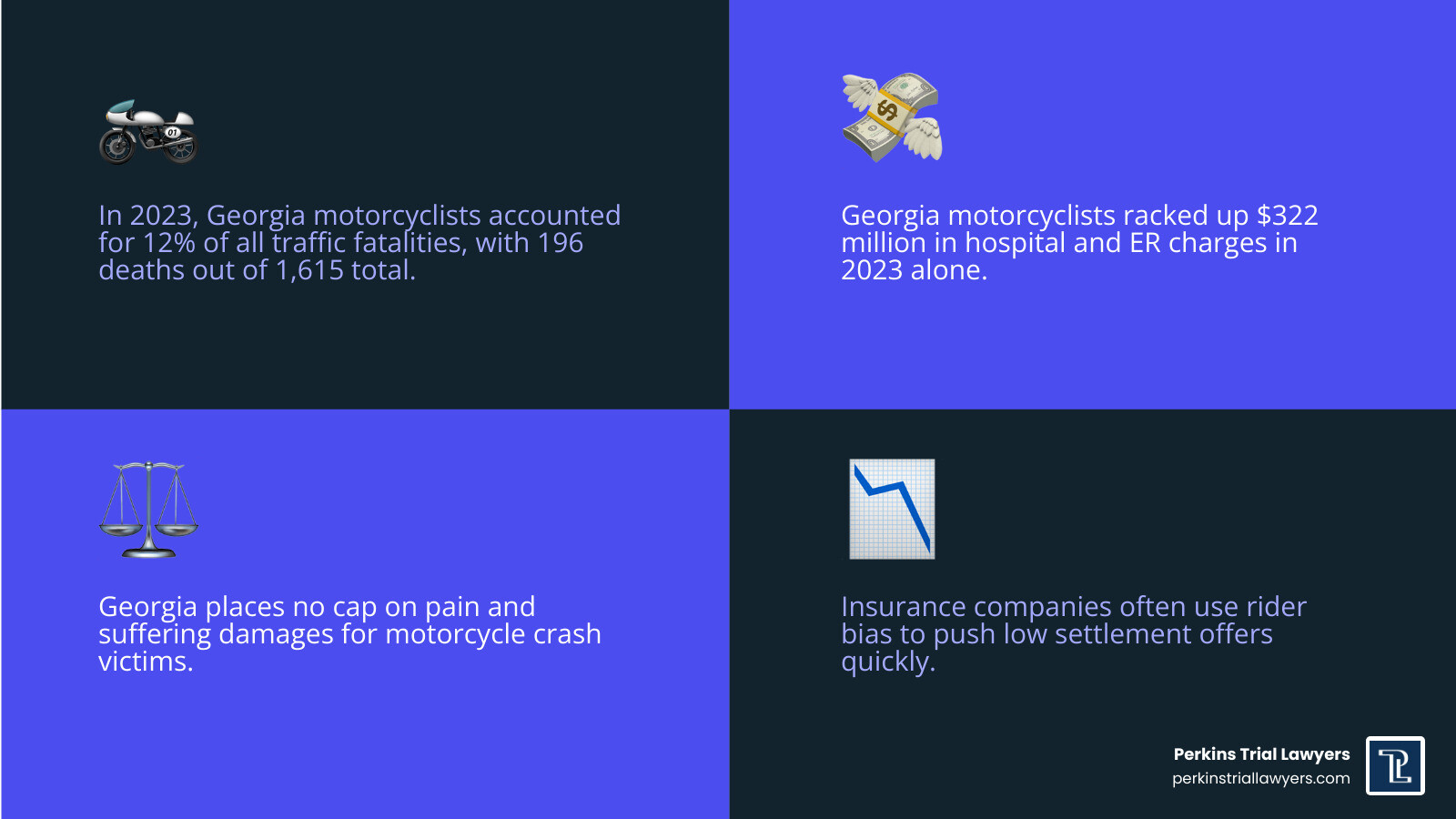
Georgia is a tough state for injured riders. Insurers know that juries sometimes blame motorcyclists before hearing a single fact. They use that bias to push low offers — fast. In 2023 alone, Georgia motorcyclists accounted for 12% of all traffic fatalities (196 deaths out of 1,615 total) and racked up $322 million in hospital and ER charges. The financial hit from a crash can be devastating.
The good news? Georgia places no cap on pain and suffering damages, and skilled legal representation can make a dramatic difference in what you walk away with.
This guide breaks down exactly how Georgia law shapes your payout, what traps to avoid, and how to protect your claim from the start.
Easy motorcycle crash settlement Georgia glossary:
- motorcycle injury claim Atlanta
- motorcycle injury settlement atlanta
- bike accident compensation atlanta
What is the Average Motorcycle Crash Settlement Georgia Range?
If you are looking for a quick, one-size-fits-all average settlement number, you will not find a reliable one. Why? Because a rider who walks away with mild road rash will have a vastly different financial recovery than a rider who suffers a permanent spinal cord injury.
To get a highly accurate estimate tailored to your specific situation, you can use the Georgia Motorcycle Accident Settlement Calculator: Average Values by Injury (2026) .
Generally, the value of your motorcycle crash settlement Georgia is determined by the severity of your injuries, your total medical bills, lost wages, and the amount of insurance coverage available. Because motorcycles offer virtually no structural protection, the physical damage—and therefore the financial compensation—skews much higher than typical passenger vehicle claims.
Average Payouts by Injury Severity
The medical reality of a motorcycle accident dictates the legal strategy. Let’s look at how different injury categories translate into settlement ranges:
- Road Rash and Soft Tissue Injuries ($5,000 to $40,000): Often dismissed by insurance adjusters as “just scrapes,” severe road rash can require painful debridement, skin grafts, and leave permanent, disfiguring scars.
- Fractures ($30,000 to $200,000): Broken bones are incredibly common when a rider is thrown from their bike. Simple fractures that heal with a cast sit on the lower end of this range. However, complex or compound fractures requiring orthopedic surgery, plates, and screws quickly push settlements toward the $200,000 mark.
- Traumatic Brain Injuries (TBI) ($100,000 to $1,500,000): Even when wearing a helmet, the violent force of a crash can cause concussion, long-term cognitive deficits, or permanent brain damage. These claims require comprehensive medical evaluations to capture future care needs. For more details on valuing these complex cases, see our Motorcycle Injury Settlement Atlanta Guide.
- Spinal Cord Injuries and Amputations ($500,000 to $3,000,000+): Paraplegia, quadriplegia, or loss of a limb represent life-altering catastrophic injuries. Settlements in this tier must account for millions of dollars in lifetime medical care, home modifications, and lost earning capacity.
- Wrongful Death ($1,000,000 to $10,000,000+): When a crash turns fatal, the rider’s family can seek the “full value of the life of the decedent” under Georgia law.
Real-World Atlanta Verdicts and Settlements
To see how these numbers translate in Georgia courtrooms, look at these notable legal outcomes:
- The Fulton County Transit Verdict ($6,397,178): In 2023, a Fulton County jury awarded over $6.3 million to a motorcyclist who was struck and ejected by a MARTA bus. The massive award reflected the catastrophic nature of the injuries and the clear liability of the transit operator.
- The Gwinnett County Fatal Crash Verdict ($7.5 Million): A 2018 trial involving a fatal collision between a motorcycle, a van, and a truck resulted in a $7.5 million verdict, highlighting how Georgia juries value wrongful death claims when liability is aggressively proven.
- The Highway 293 Left-Turn Settlement ($530,000): A rider suffered multiple fractures requiring two surgeries after a driver made an improper left turn. The case resolved for more than half a million dollars due to clear liability and extensive surgical documentation.
- The Moderate Injury Gwinnett Verdict ($67,000): Proving that smaller cases still hold real value, a 2019 jury awarded $67,000 to a rider with moderate injuries after a driver pulled out of a parking lot.
To understand how to position your case for this level of recovery, explore our guide on working with a Motorcycle Injury Trial Atlanta Lawyer.
How Georgia Laws Directly Impact Your Compensation
Georgia has several specific laws and statutes that can make or break your motorcycle accident claim. If you do not understand these rules, the insurance company will easily use them to slash your payout.
The Universal Helmet Law (O.C.G.A. § 40-6-315)
Georgia is one of a handful of states with a strict universal helmet law. Under O.C.G.A. § 40-6-315, all motorcycle operators and passengers must wear a helmet approved by the Department of Transportation (DOT).
If you are injured in a crash while not wearing a helmet, the insurance company will invoke the “helmet defense.” They will argue that your failure to wear a helmet directly caused or worsened your head or neck injuries. Under Georgia’s comparative negligence rules, this can drastically reduce your compensation.
However, if you suffered injuries completely unrelated to a helmet—such as broken legs or severe road rash on your torso—the lack of a helmet should not affect your recovery. Interestingly, state data from 2023 shows that the vast majority of riders comply with this law: out of 196 motorcyclist fatalities that year, 178 were wearing helmets, while only 17 were not. Learn more about how we counter these defenses by visiting our Atlanta Motorcycle Lawsuit Attorney page.
Georgia’s 50% Modified Comparative Fault Bar
The single biggest threat to your motorcycle crash settlement Georgia is the state’s modified comparative negligence rule under O.C.G.A. § 51-12-33.
Under this law, you can only recover damages if you are less than 50% at fault for the accident. If a jury or insurance adjuster determines that you were 50% or more responsible for the wreck, you get absolutely nothing.
If you are found to be partially at fault but under the 50% threshold (say, 20% at fault), your total compensation is reduced by your percentage of blame. For example:
Insurance adjusters are trained to assign even a small percentage of fault to riders to save their companies money. They will claim you were speeding, lane splitting, or reacting too slowly. To fight back, read the Atlanta Motorcycle Lawsuit Lawyer Guide.
Lane Splitting and Liability (O.C.G.A. § 40-6-312)
Lane splitting—the practice of riding a motorcycle between rows of stopped or moving traffic in the same lane—is strictly illegal in Georgia under O.C.G.A. § 40-6-312.
If you were lane splitting when the crash occurred, the insurance company will argue that you committed “negligence per se” (negligence as a matter of law because you broke a safety statute). This makes it incredibly easy for them to push your apportioned fault past the 50% bar, completely blocking you from a recovery. If lane splitting is an issue in your accident, consulting a Motorcycle Collision Attorney Atlanta is vital to finding a path forward.
Overcoming Insurance Bias and Proving Liability
Motorcyclists face a massive uphill battle against societal bias. Many drivers, insurance adjusters, and potential jurors view riders as reckless thrill-seekers who assume all risk the moment they kick up their kickstands.
When an accident happens, the default assumption of the insurance company is often: “The biker must have been speeding or weaving through traffic.” Overcoming this prejudice requires objective, undeniable evidence.
Key Factors That Influence a Motorcycle Crash Settlement Georgia
To neutralize rider bias and secure a maximum settlement, we must build an ironclad case using concrete evidence:
- The Official Georgia Crash Report: Always call 911 immediately after a crash. Ensure the responding officer takes statements and documents the scene. You can retrieve your official report through BuyCrash.com.
- Physical Evidence and Gear Compliance: Preserve your damaged motorcycle, torn riding gear, and your scratched DOT-approved helmet. This physical evidence proves the force of the impact and demonstrates that you were riding responsibly and wearing proper safety gear.
- Eyewitness Statements: Unbiased accounts from other drivers or pedestrians who saw the crash are incredibly powerful in defeating insurance company finger-pointing.
- Video Footage: Dashcam footage, nearby business security cameras, or intersection traffic cameras can provide indisputable proof of how the crash occurred.
- Favorable Venue Selection: Where your lawsuit is filed matters. Metro Atlanta venues like Fulton County and DeKalb County are historically more progressive and plaintiff-friendly. Conversely, rural Georgia counties tend to be much more conservative, meaning a jury there may award lower damages.
For a complete look at how to navigate these factors, check out our guide: Georgia Motorcycle Injury Lawyer Your Roadmap to Recovery.
The Critical Role of UM/UIM Coverage
Georgia law only requires drivers to carry a bare-minimum liability insurance policy of 25/50/25:
- $25,000 for bodily injury per person
- $50,000 for bodily injury per accident (if multiple people are hurt)
- $25,000 for property damage
Because motorcycle injuries are so severe, a $25,000 policy is often drained within the first hour of emergency room care. To make matters worse, an estimated 19% of Georgia drivers are completely uninsured.
This is why Uninsured/Underinsured Motorist (UM/UIM) coverage is the most important insurance policy a rider can own. If you are hit by an uninsured driver, or a driver with minimum limits, your own UM/UIM policy steps in to cover your remaining medical bills, pain and suffering, and lost wages.
In Georgia, you can choose “add-on” (stackable) UM coverage, which adds your policy limits on top of the at-fault driver’s liability limits, maximizing your total available recovery. See our breakdown of Atlanta Motorcycle Injury Attorney Options for Downed Riders to learn how to locate every dollar of available coverage.
Step-by-Step Guide to Protecting Your Claim
What you do in the hours, days, and weeks following a motorcycle crash will directly dictate the size of your settlement check.
How to Maximize Your Motorcycle Crash Settlement Georgia
To ensure the insurance company does not shortchange you, follow these steps:
- Seek Immediate Medical Attention: Even if you think you just have minor bruises, go to an emergency room or urgent care. Adrenaline can mask severe injuries like internal bleeding or concussions. A delay in treatment gives the insurance adjuster an excuse to claim your injuries were not caused by the crash.
- Document Your Injuries Thoroughly: Take high-resolution photos of your injuries immediately after the crash, during your recovery, and after surgeries. If you have road rash, photograph the healing process and any permanent scarring.
- Preserve Your Gear: Do not throw away your damaged helmet, ripped jacket, or scuffed boots. Keep them in a safe place. They serve as physical proof of the crash’s violence.
- Do Not Accept the First Settlement Offer: Insurance companies often call injured riders within days of a crash, offering a quick cash settlement. This initial offer is almost always a “lowball” designed to get you to sign away your rights before you know the true cost of your medical care.
- Be Careful on Social Media: Do not post about your crash, your injuries, or your recovery. Insurance investigators routinely monitor public social media accounts looking for photos or comments they can use to claim you are not as injured as you say you are.
For a detailed walkthrough of the claims process, read our step-by-step guide: Get Your Cash Step by Step Atlanta Motorcycle Injury Claims.
Meeting Strict Deadlines and Ante Litem Notices
Under O.C.G.A. § 9-3-33, the standard statute of limitations for filing a personal injury lawsuit after a motorcycle crash in Georgia is two years from the date of the accident. If you miss this deadline, your right to seek compensation is permanently lost.
However, if your crash involved a government vehicle—such as a city bus, a county road maintenance truck, or a state trooper—your timeline is drastically shorter. You must file a formal warning called an ante litem notice to preserve your right to sue:
- City / Municipal Claims: Must file within 6 months of the crash.
- County or State Claims: Must file within 12 months of the crash.
Because these government deadlines are incredibly strict and highly technical, missing them by even a single day will completely kill your case. For emergency situations involving tight deadlines, review our Atlanta Motorcycle Emergency Legal resources.
Frequently Asked Questions About Georgia Motorcycle Claims
Are there caps on pain and suffering damages in Georgia?
No. In the landmark case Atlanta Oculoplastic Surgery v. Nestlehutt (2010), the Georgia Supreme Court ruled that statutory caps on non-economic damages (pain and suffering) are unconstitutional. This means there is no legal limit to the amount of compensation a jury can award you for your physical pain, mental anguish, loss of enjoyment of life, and disfigurement.
Additionally, if the at-fault driver was driving under the influence of drugs or alcohol, Georgia law allows you to seek punitive damages, which are designed to punish the wrongdoer rather than compensate the victim. In DUI cases, Georgia’s standard $250,000 cap on punitive damages is completely lifted, allowing for much higher recovery. For more on this, consult with a Motorcycle Crash Attorney Atlanta.
What is the statute of limitations for a Georgia motorcycle accident?
For personal injuries, you have exactly two years from the date of the crash to file a lawsuit under O.C.G.A. § 9-3-33. For property damage claims (such as fixing or replacing your motorcycle), the limit is generally four years.
While two years might seem like a long time, building a winning case requires gathering medical records, accident reconstruction, and negotiating with insurers. If you let your case stall, evidence can disappear, and witnesses can forget key details. Read more about protecting your timeline in Don’t Let Your Case Stall Choosing a Motorcycle Accident Attorney in Atlanta.
How does lacking a Class M license affect my claim?
State data reveals that 53% of motorcycle operators involved in 2023 Georgia crashes did not have a valid Class M motorcycle designation on their driver’s license.
If you were riding without a Class M license, the insurance company will try to use this administrative violation to paint you as an incompetent, illegal rider. However, lacking a license does not automatically make you at fault for the crash.
To reduce your payout, the insurer must prove that your lack of licensing actually caused the accident. For example, if you were stopped at a red light and got rear-ended, your licensing status had absolutely zero impact on the crash. To learn how we protect unlicensed or under-licensed riders, visit our page on Smyrna Motorcycle Accident Lawyer Services to Get You Back in the Saddle.
Claim Your Full Compensation with Perkins Trial Lawyers
You do not have to let an insurance company exploit unfair rider bias or use complex state laws to drain your financial future. At Perkins Trial Lawyers, we provide tireless advocacy against insurance giants to secure the maximum compensation you deserve.
Our team understands the unique mechanics of motorcycle crashes and the deep-seated prejudices riders face. We know how to gather the right evidence, construct bulletproof claims, and present your case in a way that forces insurers to take your injuries seriously.
If you or a loved one has been injured on Georgia roads, let us handle the legal heavy lifting while you focus on healing. Contact us today to discuss your case and discover your options for Motorcycle Accidents in Atlanta GA.