 Skip to content
When a Big Rig Hits You in Atlanta, the Clock Starts Immediately
If you need an Atlanta 18-wheeler collision lawyer, here are the attorneys and steps that matter most right now:
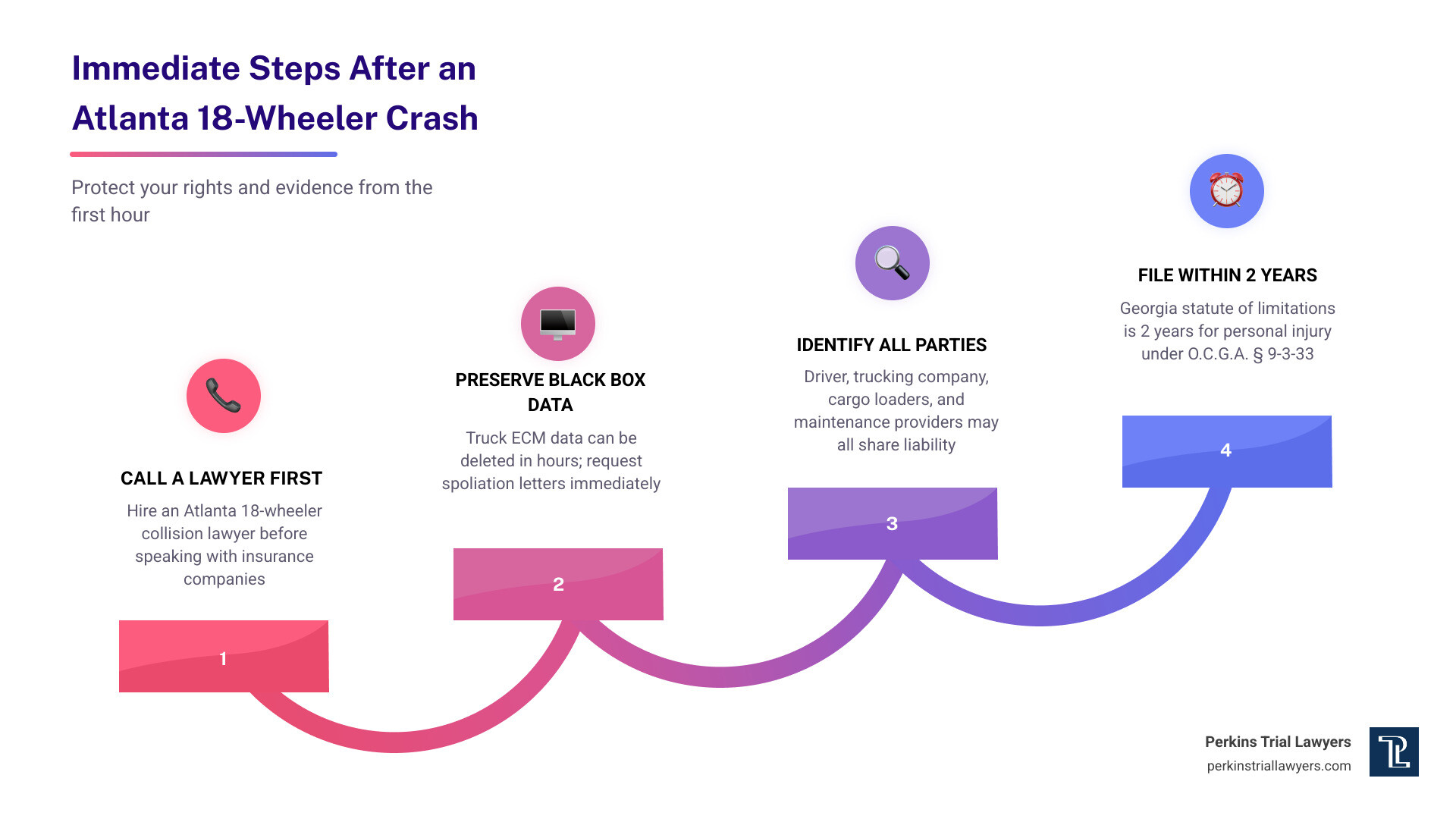
Top reasons to act fast after an Atlanta truck crash:
- Hire a truck accident lawyer immediately — trucking companies send investigators to the scene within hours
- Preserve black box (ECM) data — carriers are only required to keep it for a limited time
- File within 2 years — Georgia’s statute of limitations under O.C.G.A. § 9-3-33
- Identify all liable parties — driver, trucking company, cargo loaders, and maintenance providers may all share fault
- Do not give recorded statements to insurance adjusters before speaking with an attorney
Getting hit by an 18-wheeler is nothing like a typical car crash. A fully loaded commercial truck can weigh up to 80,000 pounds — roughly 20 times more than a passenger car. The injuries are often catastrophic. The legal battle that follows is almost always complex.
And it starts before you leave the hospital.
Trucking companies and their insurers move fast. They have lawyers, adjusters, and investigators working immediately to protect their interests. Victims who wait — or try to handle claims alone — often find critical evidence has disappeared and initial settlement offers are a fraction of what their case is actually worth.
That’s getting run over twice.
The good news: Georgia law gives you real rights and real remedies. But only if you act quickly and with the right legal team behind you.
Relevant articles related to Atlanta 18-wheeler collision lawyer:
Why You Need an Atlanta 18-Wheeler Collision Lawyer
When you are involved in a wreck with a standard passenger car, the insurance claim process is relatively straightforward. Usually, you deal with one driver, one insurance company, and a clear-cut set of traffic laws.
An 18-wheeler accident is an entirely different beast.
First, the commercial insurance policies involved are massive. While a typical driver might carry a $25,000 or $50,000 liability policy, commercial trucking outfits routinely carry policies worth millions of dollars. Because the financial stakes are so high, commercial insurers do not play nice. They employ teams of aggressive adjusters and high-priced defense lawyers whose sole job is to minimize your payout or deny your claim altogether.
Second, the trucking industry is governed by a dense web of federal and state laws. The Federal Motor Carrier Safety Administration (FMCSA) sets strict rules regarding everything from how many hours a driver can spend behind the wheel to how often the brakes must be inspected. If your attorney does not understand these regulations, they cannot effectively build your case.
We often see victims try to negotiate with commercial adjusters on their own, only to receive lowball settlement offers that barely cover their initial ER bills. By the time they realize they need help, critical evidence may have been lost or destroyed. To avoid these traps, you need to understand the value of having dedicated legal representation. Read more about why you shouldn’t handle this alone in our guide on Dont Go It Alone Why You Need an Atlanta Trucking Accident Attorney.
The Brutal Physics and Common Causes of Georgia Truck Wrecks
The sheer size disparity between a standard passenger vehicle and a fully loaded tractor-trailer explains why these collisions are so devastating. While the average sedan weighs between 3,000 and 4,000 pounds, an 18-wheeler is legally authorized under the FMCSA to carry loads of up to 80,000 pounds.
When that much mass is moving at highway speeds on I-285, I-75, or I-85, stopping is not a simple task. A fully loaded commercial truck requires up to 525 feet to come to a complete stop—that is nearly the length of two full football fields. If traffic suddenly grinds to a halt on the Downtown Connector, a distracted or speeding trucker simply does not have the physical space to avoid a catastrophic rear-end collision.
| Vehicle Type | Average Weight | Required Stopping Distance (at 65 mph) |
|---|---|---|
| Passenger Car | 3,000 – 4,000 lbs | ~300 feet |
| Loaded 18-Wheeler | Up to 80,000 lbs | ~525 feet (nearly two football fields) |
Because of these brutal physics, motor vehicle crashes remain the leading cause of injury deaths in Georgia and the second leading cause of hospitalizations. In fact, traffic deaths in Georgia occur out of proportion to our state’s population relative to the rest of the country.
Understanding the mechanics of these crashes is the first step toward holding negligent parties accountable. For a deeper dive into how we calculate the true value of these claims, check out The Atlanta 18 Wheeler Injury Lawyer Guide to Maximum Compensation.
How an Atlanta 18-Wheeler Collision Lawyer Proves Trucker Fatigue
Among the most common—and preventable—causes of commercial truck wrecks is driver fatigue. The FMCSA estimates that driver fatigue is a contributing factor in approximately 13% of all commercial truck crashes.
Because truck drivers are often paid by the mile, they face immense financial pressure to stay on the road as long as possible. To combat this, federal “Hours of Service” (HOS) regulations strictly limit driving time to a maximum of 11 hours after 10 consecutive hours off duty.
Historically, fatigued drivers kept paper logbooks, which were easily falsified (often referred to in the industry as “comic books”). Today, most trucks are equipped with Electronic Logging Devices (ELDs) that automatically track driving time. However, desperate drivers and complicit trucking companies still find ways to bypass these systems or pressure drivers to ignore them.
When we investigate a crash, we dig deep into the driver’s HOS records, fuel receipts, toll booth logs, and GPS data to expose the truth. When a trucking company prioritizes profits over public safety, the consequences can be fatal. Learn more about holding these negligent operations accountable in our article on 18 Wheeler Fatality Atlanta Lawyer Holding Negligent Truckers Accountable.
Mechanical Failures and Cargo Securement Issues
Even the most alert driver cannot control a truck with failing brakes or a shredded tire. Commercial trucks travel tens of thousands of miles every month, placing extreme wear and tear on vital mechanical systems.
Federal regulations mandate that drivers perform daily pre-trip and post-trip inspections, and that motor carriers perform regular, thorough maintenance. Yet, during roadside inspections in 2016, approximately 464,000 commercial trucks were found in violation of one or more safety regulations. Common mechanical failures include:
- Worn brake pads and drums that reduce stopping power
- Bald or improperly inflated tires leading to catastrophic blowouts
- Defective steering mechanisms that cause a driver to lose control
- Broken or missing reflective tape making the trailer invisible at night
Additionally, improperly loaded cargo poses a massive threat. If cargo is not securely fastened or is loaded unevenly, it can shift during a turn, causing a devastating jackknife or rollover accident. In these scenarios, the cargo loading company or the logistics broker may share liability for the resulting wreck. You can read more about these specific mechanical and cargo issues in our post on Atlanta Truck Collision Lawyer.
Identifying All Liable Parties in a Commercial Truck Accident
One of the biggest differences between a standard car accident and an 18-wheeler crash is the sheer number of parties who may be legally responsible for your injuries.
Depending on what caused the crash, we may pursue compensation from several entities:
- The Truck Driver: For negligent behaviors like distracted driving, speeding, driving under the influence, or violating HOS rules.
- The Trucking Company (Motor Carrier): Trucking companies are responsible for hiring qualified drivers, conducting background checks, and ensuring their fleet is safe. Under the legal doctrine of respondeat superior, employers are generally liable for the negligent actions of their employees while on the job.
- The Cargo Loader/Shipper: If the crash was caused by shifting cargo or an overloaded trailer, the third-party company that loaded the truck can be held liable.
- Maintenance Providers: Many trucking companies outsource their fleet maintenance to third-party mechanics. If a mechanic failed to repair a known brake issue or installed defective parts, they may share the blame.
- Manufacturers: If a defective component—such as a tire, brake system, or trailer coupling—failed and caused the crash, the manufacturer of that part can be held liable under product liability laws.
Uncovering these layers of liability requires an aggressive, exhaustive investigation. For tips on how to choose the right legal team to handle this complex process, read Choosing the Best Atlanta Truck Accident Lawyer for Your Case.
When to Hire an Atlanta 18-Wheeler Collision Lawyer for Multi-Party Claims
Navigating a claim with multiple defendants is incredibly difficult. Each company’s insurance provider will try to point the finger at the others to avoid paying. The trucking company will claim the driver was an independent contractor; the driver will claim the maintenance company failed to fix the brakes; the maintenance company will claim the cargo was loaded improperly.
Without an attorney, you can easily get caught in this endless loop of finger-pointing.
We know how to cut through the corporate noise. By utilizing federal regulations as our roadmap, we can establish “statutory employment,” meaning that even if a trucking company classifies a driver as an independent contractor, federal law often treats them as an employee for liability purposes. This prevents trucking companies from escaping responsibility through legal loopholes. To understand how we navigate these multi-party claims, check out The Ultimate Guide to Hiring an Atlanta Semi Truck Accident Lawyer.
Georgia Laws That Impact Your Truck Accident Claim
If you are pursuing a truck accident claim in Atlanta, several key Georgia statutes will directly impact your case.
The Statute of Limitations (O.C.G.A. § 9-3-33)
Under Georgia law, you generally have two years from the date of the accident to file a personal injury or wrongful death lawsuit. If you miss this deadline, the court will almost certainly dismiss your case, and you will lose your right to seek compensation forever. While two years might sound like a long time, building a robust truck accident case takes months of investigation, expert analysis, and deposition preparation.
Modified Comparative Negligence
Georgia follows a modified comparative negligence rule with a 50 percent fault threshold. This means you can still recover damages if you were partially at fault for the accident, provided your percentage of fault is less than 50 percent.
For example, if a jury determines that your total damages are $1,000,000, but finds you were 10% at fault because you were traveling slightly over the speed limit, your recovery would be reduced by 10% to $900,000. However, if you are found to be 50% or more at fault, you are completely barred from recovering any compensation. Because insurance defense lawyers will do everything they can to shift the blame onto you, having an attorney to protect your rights is essential. Read our detailed breakdown of the legal journey in From Crash to Courtroom Your Guide to an Atlanta Trucking Accident Claim.
Frequently Asked Questions About Atlanta Truck Accidents
To help you better understand your rights, we have compiled answers to some of the most common questions our clients ask after a commercial truck collision. For a broader look at the settlement process, you can also explore our article on Truck Accident Settlement Atlanta Lawyer.
What damages can I recover after an 18-wheeler crash in Georgia?
If you are injured due to a truck driver’s or trucking company’s negligence, you are entitled to pursue both economic and non-economic damages. In rare cases, you may also qualify for punitive damages.
- Economic Damages: These cover your tangible, financial losses, including:
- Past and future medical bills (hospital stays, surgeries, physical therapy, and medication)
- Lost wages from missed work
- Loss of earning capacity if your injuries prevent you from returning to your career
- Property damage to repair or replace your vehicle
- Non-Economic Damages: These compensate you for the intangible, human cost of the wreck, such as:
- Physical pain and suffering
- Emotional distress and mental anguish (including PTSD, anxiety, and depression)
- Loss of enjoyment of life and inability to participate in hobbies
- Disfigurement or permanent disability
- Punitive Damages: Under O.C.G.A. § 51-12-5.1, punitive damages are intended to punish the defendant and deter others from similar conduct. They are only awarded in cases of egregious misconduct, such as a truck driver operating under the influence of drugs or alcohol, or a trucking company intentionally falsifying maintenance records to keep an unsafe vehicle on the road.
To learn more about the specific types of compensation available, read Tractor Trailer Accident Lawyer Atlanta.
How long do I have to file a lawsuit in Atlanta?
As mentioned, the standard personal injury statute of limitations in Georgia is two years from the date of the crash. If you are filing a wrongful death claim on behalf of a loved one who was killed in a truck wreck, you also have two years from the date of their passing to file.
However, there are rare exceptions that can pause (toll) or shorten this timeline:
- Government Vehicles: If the truck was owned by a government entity (such as a municipal utility vehicle or a state-owned truck), you may have as little as six months to file an official ante litem notice to preserve your right to sue.
- Criminal Charges: If the truck driver was issued a criminal citation or charged with a crime (like a DUI) at the scene, the statute of limitations may be paused while those charges are resolved in court, up to a maximum of six years.
Regardless of these exceptions, waiting to take action is highly risky. Evidence can be lost, and witnesses’ memories fade quickly. For more details on navigating wrongful death and fatal truck accidents, see Fatal Truck Crash Atlanta Lawyer.
What evidence is critical to preserve immediately after the collision?
In a commercial truck accident case, evidence is everything. Trucking companies are highly sophisticated and will begin protecting themselves immediately. To build a strong case, we must move quickly to secure the following critical evidence:
- The Black Box (ECM) Data: Modern commercial trucks are equipped with Electronic Control Modules that record crucial data in the seconds leading up to a crash, including vehicle speed, brake application, steering angles, and throttle position.
- Electronic Logging Device (ELD) Records: These digital logs prove whether the driver was operating within legal hours of service or driving fatigued.
- Driver Qualification Files: This includes the driver’s commercial driver’s license (CDL) records, medical examiner certificates, road test results, and drug/alcohol test history.
- Maintenance and Inspection Records: These show whether the trucking company ignored vital repairs or operated an unsafe vehicle.
- Dashcam Footage: Many commercial trucks and passenger vehicles carry dash cameras that provide direct visual evidence of how the crash occurred.
To prevent the trucking company from erasing or destroying this data, we immediately draft and send a formal spoliation letter. This legal notice obligates the carrier to preserve all evidence related to the crash under penalty of severe court sanctions. For an in-depth look at how we gather and use this data to secure a fair settlement, check out 18 Wheeler Lawsuit Atlanta Attorney Navigating the Road to a Settlement.
Take Back Control: Partner with Perkins Trial Lawyers
If you or a loved one has been injured in an 18-wheeler wreck, the physical, emotional, and financial toll can feel overwhelming. You do not have to fight this battle alone.
At Perkins Trial Lawyers, we provide tireless, aggressive advocacy against insurance companies to ensure our clients receive the maximum compensation they deserve. We understand the complex state and federal regulations that govern the trucking industry, and we have the resources needed to stand up to billion-dollar trucking corporations.
We handle all personal injury and wrongful death cases on a contingency fee basis, which means you pay nothing upfront, and we only get paid if we successfully recover compensation for you.
Do not let the insurance companies run you over a second time. Contact us today to schedule your 100% free, no-obligation consultation. Let us put our experience to work for you. To get started, visit our dedicated page on Truck Accident Lawyer Atlanta GA.
