When an 18-Wheeler Changes Everything: What Atlanta Truck Accident Victims Need to Know First
If you need an Atlanta truck accident lawyer, here is what matters most right now:
Quick answers for truck accident victims in Atlanta:
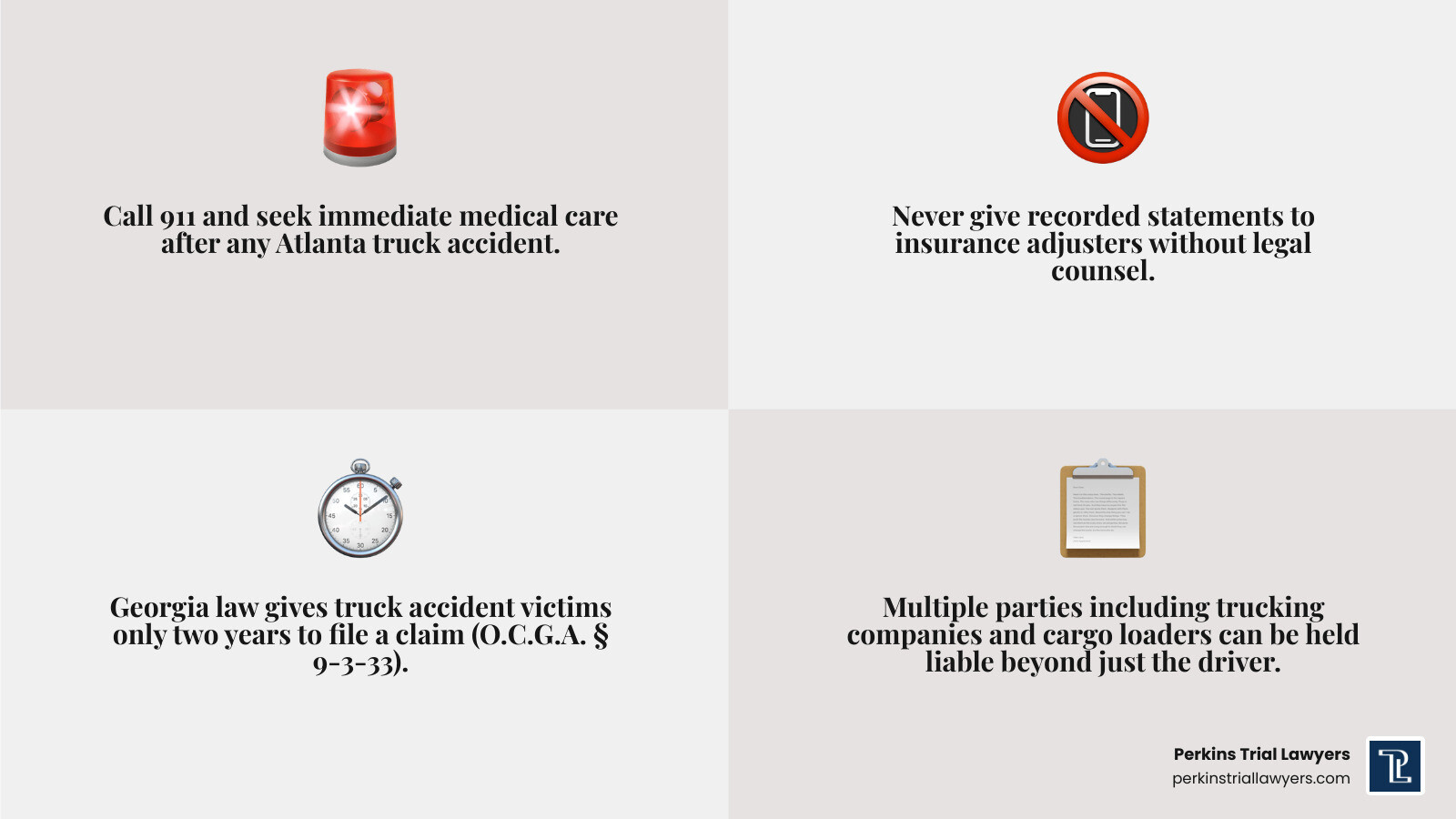
- Call 911 and seek medical care immediately after the crash
- Do not give recorded statements to any insurance adjuster
- Contact a truck accident attorney as soon as possible — evidence like black box data can disappear within days
- You have two years from the date of the accident to file a claim in Georgia (O.C.G.A. § 9-3-33)
- Multiple parties may owe you compensation — not just the driver, but also the trucking company, cargo loaders, and others
- Most attorneys work on contingency — you pay nothing unless you win
Atlanta is one of the busiest trucking hubs in the United States. Highways like I-285, I-75, I-20, and GA-400 carry massive volumes of commercial freight every single day. That volume comes with a cost.
In 2024 alone, nearly 500 crashes in Atlanta likely involved serious injuries, and 58 resulted in deaths. Large trucks account for nearly 12% of all fatal road collisions in Georgia. And when an 80,000-pound tractor-trailer collides with a passenger vehicle weighing 3,000 pounds, the results are rarely minor.
These are not just statistics. Behind each number is a family dealing with catastrophic injuries, overwhelming medical bills, lost income, and an insurance system that is already working against them.
The trucking company’s investigators and lawyers often arrive at the crash scene within hours. Evidence gets documented — or quietly disappears — fast. That is why the decisions you make in the days immediately after a truck crash can shape the outcome of your entire case.
This guide walks you through everything you need to know: how truck accident cases work in Atlanta, who can be held liable, what your claim may be worth, and how to choose the right legal representation to fight for you.
Simple guide to Atlanta truck accident lawyer:
- 18 wheeler accident Atlanta lawyer
- Fatal truck crash Atlanta lawyer
- Truck accident settlement Atlanta lawyer
How Atlanta Truck Accidents Differ From Standard Car Crashes
At first glance, a truck crash might look like a regular car accident, just on a larger scale. But legally, medically, and physically, they belong in completely different categories.
The most obvious difference is the sheer size of the vehicles. A fully loaded tractor-trailer can weigh up to 80,000 pounds, whereas the average passenger car weighs between 2,000 and 4,000 pounds. This massive weight discrepancy creates a violent transfer of energy during a collision.
Furthermore, the physics of stopping a commercial truck are vastly different. A semi-truck traveling at highway speeds requires the length of nearly two football fields to come to a complete stop under ideal conditions. If the roads are wet, or if the driver’s perception-reaction time is delayed by even a second, a collision is almost inevitable.
Because of these unique crash dynamics, the laws, insurance policies, and evidence-gathering techniques required for these cases are highly technical. If you treat a commercial vehicle crash like a standard fender-bender, you risk leaving substantial compensation on the table. To understand the legal steps necessary to protect your rights, consulting an experienced Atlanta Truck Collision Lawyer is crucial.
Common Causes of Commercial Vehicle Collisions
Commercial truck drivers are under immense pressure. They operate under tight delivery schedules and are often paid by the mile, which can lead to dangerous decision-making on the road. Some of the most common causes of commercial truck accidents in Atlanta include:
- Driver Fatigue: Despite strict federal regulations limiting driving hours, many truckers push past their physical limits to meet demanding deadlines.
- Distracted Driving: Texting, adjusting navigation systems, or using dispatch devices while driving a multi-ton vehicle is highly dangerous. Federal rules strictly prohibit commercial drivers from texting, even when stopped at traffic lights.
- Speeding and Aggressive Driving: Traveling too fast for road or weather conditions is a leading cause of jackknife and rollover accidents.
- Improper Cargo Loading: If cargo is unbalanced or poorly secured, it can shift during a turn, causing the driver to lose control of the vehicle.
- Negligent Maintenance: Worn brake pads, bald tires, and defective underride guards are common mechanical failures that lead to catastrophic wrecks.
- Inadequate Training: Trucking companies sometimes put inexperienced or poorly trained drivers behind the wheel to combat driver shortages.
Catastrophic Injuries and Long-Term Impacts
The injuries resulting from a collision with an 18-wheeler are often life-altering. Unlike minor car crashes where victims might walk away with mild whiplash, truck accidents frequently result in severe, long-term trauma:
- Traumatic Brain Injuries (TBIs): Forceful impacts can cause permanent cognitive impairment, memory loss, and personality changes.
- Spinal Cord Damage: Damage to the spine can lead to partial or complete paralysis, including paraplegia and quadriplegia.
- Severe Burn Injuries: Ruptured fuel tanks can cause devastating fires, requiring intensive treatment at advanced burn centers.
- Amputations and Orthopedic Fractures: Crushing forces often result in lost limbs or complex fractures requiring multiple surgeries.
- Wrongful Death: Tragically, many truck accidents are fatal, leaving families to pick up the pieces after a sudden loss.
Proving the long-term financial and physical impact of these injuries requires a deep understanding of medical causation. We work closely with medical professionals, life-care planners, and economists to ensure your settlement covers not just your current hospital bills, but your lifetime care needs.
Determining Liability Under Georgia and Federal Trucking Laws
Establishing who is at fault in a commercial truck accident is rarely simple. In a typical car accident, you are usually dealing with one driver and their insurance company. In a truck accident, liability is layered, often involving multiple corporate entities, complex contracts, and commercial insurance policies worth millions of dollars.
Because multiple parties may share the blame, identifying every liable entity is essential to securing full compensation. For a detailed breakdown of how these complex cases are handled, you can read more from a Tractor-Trailer Accident Lawyer in Atlanta.
Who Can Be Held Liable for a Truck Crash?
Depending on the facts of the crash, we may pursue claims against several different parties:
- The Truck Driver: For negligent behaviors like speeding, driving under the influence, or distracted driving.
- The Trucking Company: Under the legal doctrine of respondeat superior, employers are generally responsible for the actions of their employees. Additionally, companies can be held directly liable for negligent hiring, failing to perform background checks, or forcing drivers to violate safety rules.
- Maintenance Providers: If an independent mechanic or maintenance shop failed to repair faulty brakes or replace worn tires, they may share liability.
- Cargo Loaders: If a third-party logistics company improperly loaded or secured the cargo, causing it to shift mid-transit, they can be held responsible.
- Parts Manufacturers: If a defective part—such as a blown tire or a failing brake system—caused the crash, the manufacturer may be liable under product liability laws.
How Federal Regulations and Georgia Laws Impact Your Claim
The commercial trucking industry is heavily regulated by the Federal Motor Carrier Safety Administration (FMCSA). These regulations are designed to keep the motoring public safe, and any violation of these rules can serve as powerful evidence of negligence in your case.
Key federal regulations include:
- Hours of Service (HOS) Rules: Commercial drivers are strictly limited in how long they can operate. For example, property-carrying drivers are limited to 11 hours of driving after 10 consecutive hours off-duty. They must also take a mandatory 30-minute break after 8 cumulative hours of driving.
- Drug and Alcohol Testing: Trucking companies must conduct pre-employment, random, and post-accident drug and alcohol screenings. Furthermore, the legal limit for commercial drivers is a blood alcohol concentration (BAC) of 0.04%—half the legal limit for standard drivers.
- Driver Qualification Standards: Companies must maintain comprehensive driver qualification files, including road test results, medical examiner certificates, and annual driving records.
Georgia’s Comparative Negligence Rule
Under Georgia law (O.C.G.A. § 51-12-33), the state follows a modified comparative negligence rule with a 50% bar. This means you can still recover compensation even if you were partially at fault for the accident, provided your percentage of fault is less than 50%.
However, your recovery will be reduced by your percentage of responsibility. For example, if a jury determines your total damages are $1,000,000, but finds you were 20% at fault for speeding, your final recovery will be reduced to $800,000.
Because insurance companies know this rule well, they will aggressively try to shift the blame onto you to reduce their payout. We know how to counter these tactics with solid, evidence-backed arguments.
| Total Damages | Your Percentage of Fault | Net Compensation Recovered |
|---|---|---|
| $1,000,000 | 0% | $1,000,000 |
| $1,000,000 | 10% | $900,000 |
| $1,000,000 | 30% | $700,000 |
| $1,000,000 | 50% or more | $0 (Recovery is barred) |
Critical Steps and Evidence Needed to Protect Your Rights
The hours and days immediately following a truck accident are critical. Trucking companies and their insurance carriers have rapid-response teams of investigators and reconstructionists who deploy to the scene of major crashes almost immediately. Their goal is simple: minimize the company’s liability.
To protect your rights and build a strong case, you need to know what steps to take and what evidence must be preserved. For immediate support and personalized legal guidance, visit our Atlanta Truck Accident Lawyer Practice Area.
What to Do Immediately After an Atlanta Truck Accident

If you are involved in a collision with a commercial vehicle, take the following steps to protect your physical health and your legal rights:
- Prioritize Safety: If possible, move your vehicle to the shoulder of the road and turn on your hazard lights. Stay in your vehicle if it is unsafe to exit.
- Call 911: Request both police and emergency medical services. Ensure the responding officer files an official police report, and make sure your version of events is accurately recorded.
- Seek Medical Attention: Even if you feel fine, go to the emergency room or see a doctor immediately. Adrenaline can mask serious injuries, and insurance companies will use any delay in treatment to argue that your injuries were not caused by the crash.
- Document the Scene: If you can do so safely, take high-quality photos and videos of the vehicle damage, skid marks, road conditions, traffic signs, and the position of the truck.
- Collect Witness Information: Get the names, phone numbers, and email addresses of anyone who saw the accident happen.
- Do Not Admit Fault: Avoid saying “I’m sorry” or discussing responsibility at the scene. Stick strictly to the facts when speaking with the police.
- Avoid Recorded Statements: Do not speak to the trucking company’s insurance adjusters or sign any documents without consulting an attorney first.
Essential Evidence for Your Atlanta Truck Accident Lawyer
Proving negligence in a commercial truck accident requires technical, electronic, and physical evidence that is unique to the trucking industry:
- Black Box (ECM) Data: Modern trucks are equipped with Electronic Control Modules (ECMs) that record critical data in the seconds leading up to a crash, including speed, brake application, throttle position, and steering angles.
- Electronic Logging Devices (ELDs): These devices automatically record a driver’s hours of service, helping us prove if the driver was operating over legal limits and likely fatigued.
- Driver Logbooks and Trip Sheets: Hand-written or digital logs can reveal discrepancies in travel times and resting periods.
- Maintenance and Inspection Records: These documents show whether the truck was regularly serviced and compliant with safety standards.
- Spoliation Letters: We immediately send a formal spoliation letter to the trucking company. This legal notice obligates them to preserve all physical and electronic evidence related to the crash. If they destroy or overwrite this data after receiving the letter, they can face severe legal penalties in court.
Maximizing Your Compensation and Meeting Legal Deadlines
When you are facing a long recovery, multiple surgeries, and mounting bills, securing the maximum possible compensation is essential to protecting your family’s future. Commercial trucking companies carry substantial insurance policies—often ranging from $750,000 to upwards of $5,000,000—which means there are resources available to cover catastrophic losses.
Understanding how to calculate and pursue these funds is the first step toward recovery. For a comprehensive look at how we build these claims, refer to the Atlanta 18-Wheeler Injury Lawyer Guide to Maximum Compensation.
Types of Damages Recoverable in Georgia
In a Georgia personal injury claim, you can recover several types of damages:
- Economic Damages: These are quantifiable financial losses, including:
- Current and future medical bills
- Physical therapy and rehabilitation costs
- Lost wages from missed work
- Loss of future earning capacity if you can no longer work in the same field
- Property damage and vehicle replacement costs
- Non-Economic Damages: These cover intangible, subjective losses that do not come with a receipt, such as:
- Pain and suffering
- Emotional distress and mental anguish
- Loss of enjoyment of life
- Loss of consortium (impact on your relationship with your spouse)
- Punitive Damages: In rare cases involving gross negligence—such as a trucking company knowingly hiring a driver with a history of DUI or a driver operating under the influence of drugs—a court may award punitive damages to punish the wrongdoer and deter similar behavior in the future.
Georgia Statute of Limitations and Deadlines
In Georgia, the statute of limitations for personal injury and wrongful death claims is generally two years from the date of the accident (O.C.G.A. § 9-3-33). If you fail to file a lawsuit before this deadline, you will lose your right to pursue compensation forever.
However, there are a few exceptions that can affect this timeline:
- Tolling for Criminal Prosecutions: If the truck driver received a traffic citation or is facing criminal charges related to the crash, the statute of limitations may be paused (tolled) until the citation or criminal case is fully resolved (up to a maximum of six years).
- Government Vehicles: If the truck was owned by a government entity (such as a municipal utility truck), you may need to file a formal “ante litem” notice within six months to preserve your claim.
- Minor Victims: If the victim was a child at the time of the crash, the two-year clock generally does not begin ticking until their 18th birthday.
Regardless of these exceptions, waiting is never a good idea. Evidence degrades, witnesses move away, and memory fades. The sooner we can begin investigating your crash, the stronger your case will be.
Why You Need a Dedicated Atlanta Truck Accident Lawyer
Trucking companies and their commercial insurers have virtually unlimited resources to fight injury claims. They employ skilled adjusters and corporate defense lawyers whose sole job is to settle your case for as little as possible.
To level the playing field, you need a legal team with a trial-ready strategy. We prepare every single case as if it is going to court. This aggressive approach signals to the insurance companies that we will not accept lowball settlement offers. For a detailed roadmap on selecting the right advocate, read The Ultimate Guide to Hiring an Atlanta Semi-Truck Accident Lawyer.
What to Look For in an Atlanta Truck Accident Lawyer
When choosing an atlanta truck accident lawyer to represent you, look for the following qualities:
- Trial Experience: Many personal injury firms are “settlement mills” that avoid the courtroom at all costs. You need a trial lawyer who is comfortable presenting your case to a Georgia jury if negotiations break down.
- Knowledge of Federal Regulations: Your attorney must understand the complex web of FMCSA rules to identify safety violations that can prove liability.
- A Contingency Fee Basis: You should never have to pay upfront fees to get high-quality legal help. We work on a contingency basis, meaning we only get paid if we successfully recover compensation for you.
- Resources for Investigation: Commercial cases require substantial financial resources to hire accident reconstructionists, medical professionals, and forensic engineers.
- Clear, Direct Communication: You deserve an attorney who treats you like family, answers your questions promptly, and keeps you updated on your case.
Frequently Asked Questions About Atlanta Truck Accidents
Navigating the aftermath of a major crash is stressful, and you likely have many questions about what to expect. For a deeper dive into the financial aspects of these claims, check out our Atlanta Truck Accident Settlement Guide.
How long does a truck accident case take to resolve in Georgia?
There is no single timeline for these cases. A straightforward claim with clear liability and moderate injuries might settle within a few months. However, complex cases involving severe injuries, multiple liable parties, or disputed liability can take a year or more, especially if we need to file a lawsuit and proceed through the litigation process. We generally advise waiting until you have completed your medical treatment before settling to ensure we capture the full cost of your future medical needs.
What is the average settlement value for a semi-truck crash?
Because every accident involves unique injuries, insurance policies, and liability factors, there is no “average” settlement value. A minor injury claim might settle for five figures, while catastrophic injury cases involving permanent disability or wrongful death frequently result in multi-million dollar recoveries. The value of your case depends on your medical expenses, lost earning capacity, pain and suffering, and the strength of the evidence proving the trucking company’s negligence.
Can a trucking company destroy evidence like black box data after a crash?
Under federal law, trucking companies are only required to retain certain records, like driver logs, for a limited time (often six months). However, once we send a formal spoliation letter, they are legally obligated to preserve all relevant data, including ECM black box recordings. If they destroy or overwrite this data after receiving notice, the court can instruct the jury to assume the destroyed evidence would have proven the trucking company’s fault.
Conclusion
A collision with a commercial truck can turn your life upside down in an instant. But you do not have to face the physical, emotional, and financial recovery alone.
At Perkins Trial Lawyers, we provide tireless advocacy against insurance companies to secure the maximum compensation you deserve. We understand the complex laws, the federal safety regulations, and the corporate tactics used to minimize your claim. Let us handle the legal battle while you focus on healing and rebuilding your life.
Contact us today for a free, no-obligation consultation to learn how we can advocate for you. To get started, visit our page on Atlanta truck accident services and let us help you protect your future.