
After a Georgia Car Accident, Here’s What You Need to Know First
If you’re searching for a car accident attorney in Georgia, here are the top things to know right now:
Quick answers for Georgia car accident victims:
- You have 2 years to file a personal injury lawsuit in Georgia (O.C.G.A. § 9-3-33)
- Georgia is an at-fault state — the driver who caused the crash is responsible for damages
- You can still recover compensation even if you were partially at fault (as long as you’re less than 50% responsible)
- Never give a recorded statement to the insurance company without speaking to an attorney first
- Most car accident attorneys work on contingency — no upfront fees, no payment unless you win
Georgia’s roads are among the most dangerous in the country. In 2024 alone, the state recorded 367,523 crashes, resulting in 143,863 injuries and 1,596 fatalities. In Fulton County alone, more than 50,000 accidents occurred in a single year.
After a crash, you’re dealing with a lot at once. Medical bills. Missed work. Pain. And insurance adjusters who are trained to pay you as little as possible.
The right Georgia car accident attorney can level the playing field — handling the legal fight so you can focus on getting better.
This guide breaks down the top-rated car accident attorneys in Georgia, what to look for, and how Georgia law affects your claim.
Quick look at car accident attorney georgia:
What to Do Immediately After a Wreck in Atlanta
It happens in a split second. The screech of tires, the jarring impact, and the sudden rush of adrenaline. After the dust settles, what you do in the next few minutes and days can dramatically impact both your physical recovery and your eventual legal claim.
First and foremost, safety is the absolute priority. If you are able, move your vehicle out of active traffic to a safe location, turn on your hazard lights, and check yourself and your passengers for injuries. Even if you feel fine, adrenaline is a powerful natural painkiller. Many serious injuries, such as whiplash, internal bleeding, and soft tissue damage, do not show symptoms until hours or even days later.
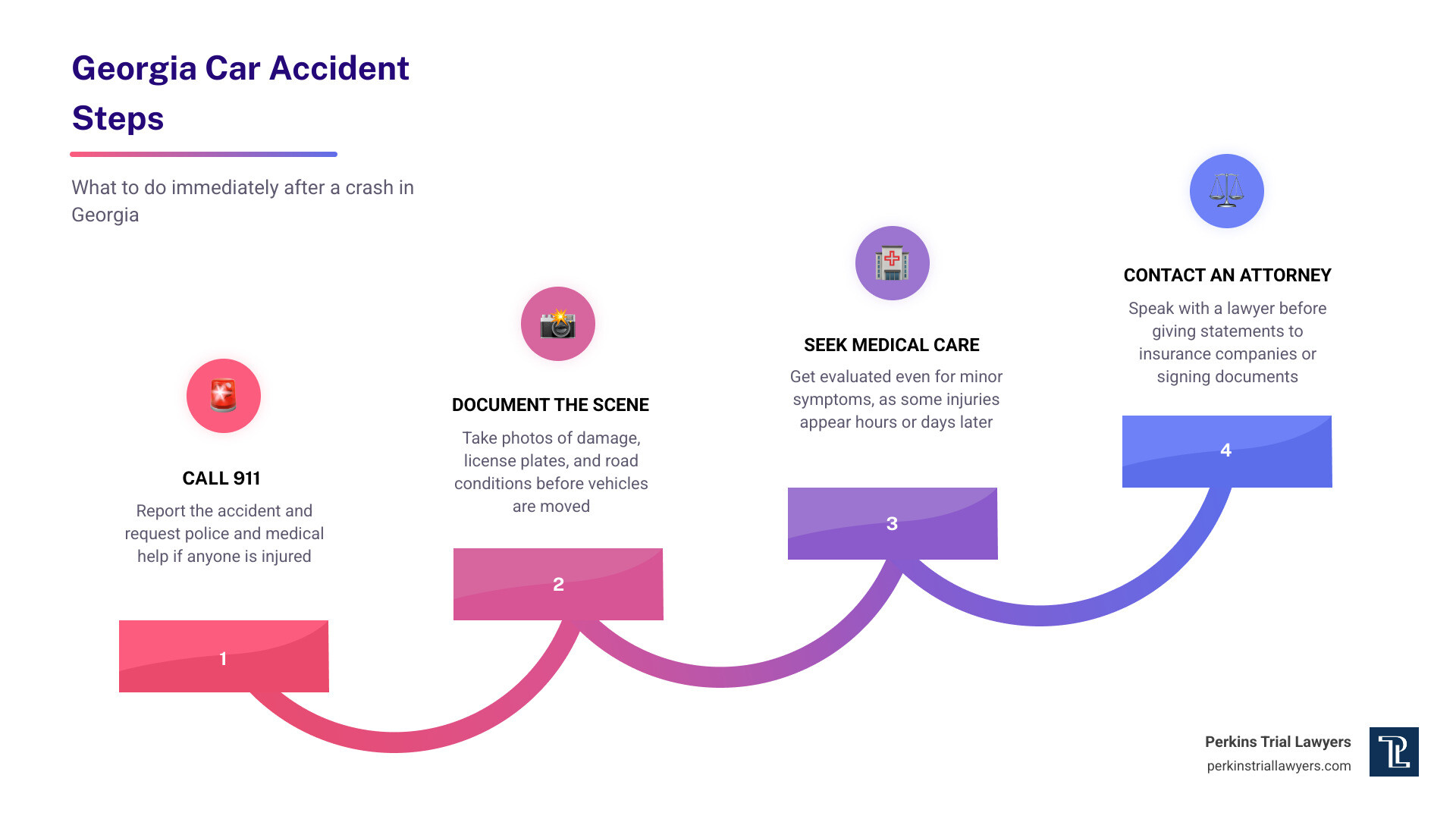
Here is a step-by-step checklist of what to do immediately after a wreck:
- Call 911 immediately: Request both police officers and emergency medical services. A formal police report is a cornerstone of evidence for any future claim.
- Document the scene: While waiting for the police, use your phone to take photos and videos of the vehicles, their positions, license plates, road conditions, skid marks, and any visible injuries.
- Exchange information: Get the name, contact info, driver’s license number, and insurance details of the other driver. Avoid discussing who caused the crash or apologizing—even a polite “I’m sorry” can be twisted by insurance adjusters as an admission of fault.
- Gather witness contacts: If anyone stopped to help, get their names and phone numbers. Their unbiased accounts can be invaluable later.
- Seek professional medical evaluation: Go to an emergency room, urgent care, or your primary physician as soon as possible. Delaying medical care gives insurance companies a reason to argue that your injuries were not caused by the accident.
- Obtain the police report: This document will contain the officer’s initial assessment of fault and any traffic citations issued.
- Consult an attorney: Before you speak to any insurance adjusters or sign any settlement offers, consult a legal professional who knows how to protect your rights.
Navigating this chaotic aftermath alone is incredibly challenging. To understand why having professional legal support from day one makes such a difference, read our article on Why You Need an Atlanta Car Crash Lawyer After a Wreck.
Understanding Fault and Liability Under Georgia Law
Georgia operates under a traditional “at-fault” insurance system. This means that the driver who is determined to have caused the collision is legally responsible for paying the resulting damages, including medical bills, property damage, and lost wages.
To drive legally on Georgia roads, motorists must carry minimum liability insurance coverages:
- $25,000 for bodily injury per person
- $50,000 for bodily injury per accident (when multiple people are hurt)
- $25,000 for property damage per accident
Unfortunately, these minimum limits are often entirely consumed by a single night in an emergency room or a major vehicle repair. When damages exceed these amounts, victims must look for other avenues of recovery, such as underinsured motorist (UM/UIM) coverage or pursuing the at-fault driver’s personal assets.
But what happens if both drivers share some blame for the crash? This is where Georgia’s negligence rules come into play.
| Driver’s Fault Percentage | Impact on Your Financial Recovery | Can You Recover Damages? |
|---|---|---|
| 0% | You receive 100% of the awarded compensation. | Yes |
| 20% | Your compensation is reduced by 20% (e.g., $100,000 becomes $80,000). | Yes |
| 49% | Your compensation is reduced by 49% (e.g., $100,000 becomes $51,000). | Yes |
| 50% or more | You are barred from recovering any compensation under Georgia law. | No |
Georgia’s 50% Modified Comparative Negligence Rule
Under Georgia’s modified comparative negligence rule, you can recover financial compensation as long as your share of the blame is less than 50%. However, your final financial recovery will be reduced proportionally by your percentage of fault.
For example, if a jury determines that your total damages equal $100,000, but finds that you were 20% at fault because you were traveling slightly over the speed limit when the other driver blew through a red light, your award will be reduced by 20%. You would receive $80,000. If you are found to be 50% or more at fault, you receive nothing.
Because insurance adjusters know this rule inside and out, they will actively look for ways to shift the blame to you. Even minor admissions or inconsistent statements can be used to inflate your percentage of fault. To avoid these costly traps, review our guide on Atlanta Car Wreck Attorney Mistakes.
When to Contact a Car Accident Attorney Georgia Insurance Companies Respect
It is a common misconception that insurance adjusters are neutral parties looking to help you. In reality, insurance companies are businesses focused on protecting their bottom lines. They employ a variety of tactics to minimize payouts, including making quick, lowball settlement offers before the full extent of your injuries is even known, delaying claims processing, or outright denying valid claims.
You should contact a car accident attorney in Georgia immediately if:
- You or your passengers sustained moderate to severe injuries.
- The other driver’s insurance company is disputing who was at fault.
- You are being pressured to sign a release or give a recorded statement.
- The settlement offer does not cover your medical bills or lost income.
Hiring an attorney who works on a contingency basis means you pay no upfront legal fees, aligning your attorney’s goals directly with yours. Learn more about how this fee structure protects you in our post on Why a Contingency Car Accident Attorney.
How a Car Accident Attorney Georgia Residents Trust Proves Fault
Proving negligence in a car accident case requires more than just pointing fingers. It requires demonstrating four key legal elements: duty of care, breach of that duty, causation, and actual damages.
An experienced attorney acts as an investigator, collecting and organizing the puzzle pieces to build a compelling case. This is especially true for high-speed highway collisions, where determining fault among multiple vehicles is highly complex. For specialized insights on these types of wrecks, check out our guide on the Highway Car Accident Lawyer.
To prove fault, a lawyer will:
- Obtain Event Data Recorder (EDR) data: Modern vehicles contain “black boxes” that record crucial metrics like speed, braking, and steering inputs in the seconds leading up to a crash.
- Work with accident reconstructionists: These professionals use physics and computer modeling to recreate the crash scene and prove how the impact occurred.
- Interview witnesses: Securing clear, formal statements from bystanders before their memories fade.
- Review police reports: Analyzing traffic citations and the physical evidence noted by responding officers.
Crucial Evidence in Auto Accident Claims
Without strong evidence, your claim is simply your word against theirs. To secure the compensation you deserve, your legal team will gather:
- Comprehensive medical records: Documenting the immediate and long-term physical impact of the crash.
- Surveillance and dashcam footage: Sourcing video from nearby businesses, traffic cameras, or vehicles.
- Cell phone records: Proving if the at-fault driver was texting or distracted at the exact moment of the crash.
- Proof of traffic violations: Such as citations for driving under the influence (DUI), speeding, or failure to yield.
If you want to know what evidence is needed for your specific situation, you can easily Get a Free Consultation with Auto Injury Lawyer Atlanta.
How to Choose the Best Car Accident Attorney Georgia Has to Offer
Finding the right attorney can feel overwhelming when you are bombarded with billboards and television commercials. To cut through the noise, look for a firm with a proven track record, extensive trial experience, and a client-first approach.
Key factors to consider include:
- Trial readiness: Some firms operate as “settlement mills,” taking on massive caseloads and settling quickly for whatever the insurance company offers. Choose a firm that prepares every case as if it is going to trial; this aggressive stance forces insurers to take your claim seriously.
- Local court experience: An attorney who regularly practices in the local courts of Fulton County or Metro Atlanta understands the local rules, judges, and jury dynamics.
- Transparent communication: You deserve direct access to your attorney, not just paralegals or case managers.
- Verified client reviews: Look for consistent praise regarding communication, empathy, and successful outcomes.
For a deeper dive into choosing the right advocate, read The Ultimate Guide to Hiring an Atlanta Car Accident Lawyer.
Frequently Asked Questions About Georgia Car Accidents
We understand that you have questions. Here are clear, straightforward answers to the questions we hear most often from car accident victims in Georgia.
What is the statute of limitations for a car accident lawsuit in Georgia?
In Georgia, under O.C.G.A. § 9-3-33, you generally have two years from the date of the accident to file a personal injury lawsuit. If you fail to file your lawsuit before this window closes, you lose your legal right to pursue compensation forever.
There are very few exceptions to this rule. For instance, if the victim is a minor, the clock may be paused (tolled) until they turn 18. Conversely, if your accident involved a government-owned vehicle (such as a city bus or state vehicle), you may have as little as six months to file a formal notice of claim. For property damage claims, you generally have four years to file.
Can I still recover compensation if I was partially at fault?
Yes, absolutely. As discussed under Georgia’s modified comparative negligence rules, you can recover compensation as long as your percentage of fault is under 50%. Your final financial recovery will simply be reduced by your percentage of responsibility. If you are found to be 50% or more at fault, you will be barred from recovering any damages.
What damages can I recover in a Georgia car accident claim?
You can pursue both economic and non-economic damages to make you whole again after a crash:
- Economic Damages: These are measurable financial losses with a clear paper trail, including emergency room bills, ongoing medical treatments, physical therapy, prescription costs, lost wages, loss of future earning capacity, and vehicle repair or replacement costs.
- Non-Economic Damages: These cover subjective, non-monetary losses such as physical pain and suffering, emotional distress, loss of enjoyment of life, disfigurement, and loss of consortium (the impact of the injuries on your relationship with your spouse).
- Punitive Damages: In rare cases involving extreme recklessness—such as drunk driving or street racing—punitive damages may be awarded to punish the at-fault driver and deter similar behavior in the future.
Conclusion
A car accident can turn your life upside down in a fraction of a second. Between managing painful injuries, missing work, and dealing with aggressive insurance adjusters, the path to recovery can feel incredibly steep.
You do not have to walk this path alone. At Perkins Trial Lawyers, we provide tireless, aggressive advocacy against insurance companies to ensure you secure the maximum compensation you deserve. We prepare every single case with the depth and dedication required for a courtroom trial, making sure your voice is heard and your future is protected.
If you speak Spanish, we also provide dedicated legal support tailored to your needs. You can learn more about how we assist Spanish-speaking clients by reading about our Abogado de Accidentes de Coche en Atlanta GA.
Ready to take your life back and fight for the compensation you deserve? Contact us today to schedule your free consultation with a dedicated Car Accident Attorney in Atlanta GA. Let us handle the legal battle while you focus on your healing.