
What You Need to Know About Bike Accident Compensation in Atlanta
If you’re looking for bike accident compensation Atlanta, here’s a quick overview of what you can recover and how:
What compensation can you get after a bike accident in Atlanta?
| Type of Compensation | Examples |
|---|---|
| Medical expenses | ER visits, surgery, rehab, future care |
| Lost wages | Time off work, reduced earning capacity |
| Pain and suffering | Physical pain, emotional distress, trauma |
| Property damage | Bike repair or replacement |
| Punitive damages | Rare cases involving reckless or intentional conduct |
To start your claim, you generally need to:
- Get medical care immediately after the crash
- Report the accident to police and get a report
- Gather evidence — photos, witness contacts, bike damage
- File a claim with the at-fault driver’s insurance
- Consult a personal injury lawyer before accepting any offer
Atlanta’s streets are becoming more popular with cyclists every year. But more riders on the road also means more crashes — and the injuries from a bike accident can be devastating.
Unlike drivers, cyclists have no metal frame protecting them. A collision with a car, truck, or even a road defect can mean broken bones, traumatic brain injuries, spinal damage, and months of painful recovery. Meanwhile, medical bills pile up fast. A single hospital stay in Georgia can cost over $8,000 per day.
And here’s what makes it even harder: insurance companies don’t make it easy. Their job is to pay out as little as possible — and unrepresented cyclists often accept far less than their claim is actually worth.
The good news? Georgia law gives injured cyclists the right to pursue full compensation. Understanding how the process works is the first step toward getting what you deserve.
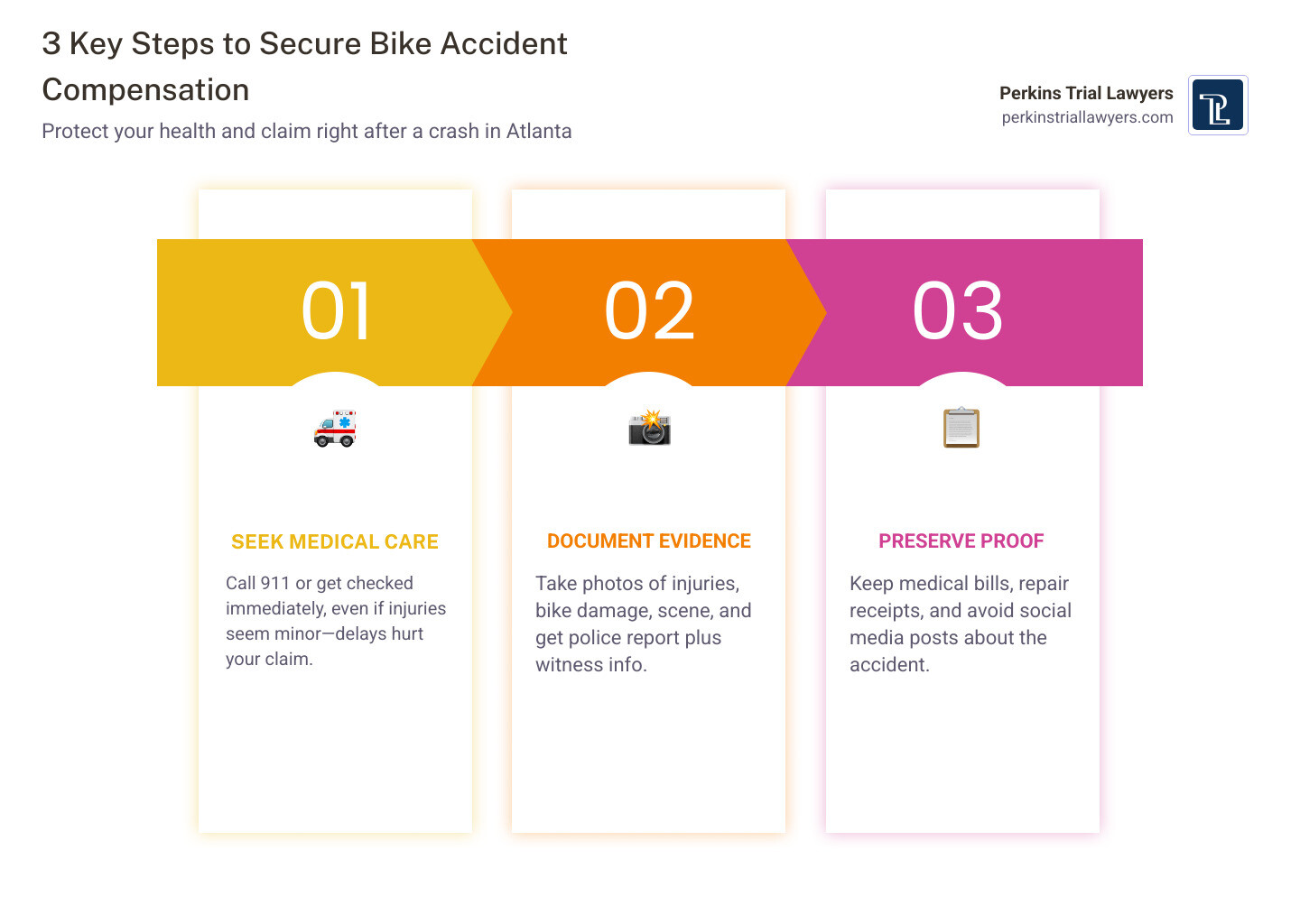
Immediate Steps to Protect Your Health and Claim
The moments following a bicycle accident are chaotic. You’re likely in shock, your adrenaline is pumping, and your bike might be in several pieces. However, what you do in the first hour can significantly impact your physical recovery and your eventual bike accident compensation Atlanta claim.
First and foremost, call 911. Even if you think you’re “fine” or just have a few scrapes, you need a law enforcement officer to create an official police report. In Atlanta, this report serves as the foundational document for your insurance claim. It records the officer’s observations, the driver’s information, and often includes a preliminary determination of fault.
While waiting for the police, if you are physically able, start gathering evidence. Use your phone to take photos of:
- The position of your bike and the vehicle.
- The vehicle’s license plate.
- Any visible injuries (road rash, bruising, lacerations).
- The surrounding environment, including skid marks, missing stop signs, or road defects like potholes.
- The driver’s insurance card and ID.
Don’t forget to talk to witnesses. People who saw the crash often leave before the police arrive. Get their names and phone numbers. Their unbiased testimony can be the “silver bullet” if the driver later tries to claim you “came out of nowhere.”
As soon as the police finish their work, head to the emergency room or an urgent care clinic. Many serious injuries, such as internal bleeding or concussions, don’t show symptoms immediately. From a legal standpoint, a “gap in treatment” is an insurance adjuster’s best friend. If you wait three days to see a doctor, the insurance company will argue that your injuries weren’t that serious or were caused by something else entirely.
Finally, keep everything. Do not wash your bloody clothes. Do not fix your bike yet. Do not throw away your cracked helmet. These are physical pieces of evidence that tell the story of the impact. If you need guidance on how to preserve these items while managing your recovery, consulting a Personal Injury Lawyer In Atlanta early on can ensure you don’t accidentally damage your case.
Understanding Liability and Bike Accident Compensation Atlanta Laws
In Georgia, bicycles are legally considered “vehicles.” This means we have the same rights to the road as cars, but we also have the same responsibilities. Understanding the interplay between motorist duties and cyclist rights is essential for determining liability.
| Motorist Duties in Georgia | Cyclist Rights & Responsibilities |
|---|---|
| 3-Foot Rule (O.C.G.A. § 40-6-56): Must maintain at least 3 feet of clearance when passing. | Right to the Road: Bicycles have a legal right to use most public roads (except limited-access highways). |
| Due Caution: Drivers must reduce speed and exercise caution when approaching a cyclist. | Ride with Traffic: Cyclists must ride in the same direction as motor vehicles. |
| Yielding: Drivers must yield to cyclists in bike lanes or at intersections as they would any other vehicle. | Predictability: Cyclists must use hand signals and follow all traffic lights and stop signs. |
A common cause of accidents in Atlanta is the “Right Hook,” where a driver passes a cyclist and then immediately turns right across their path. Another is “Dooring,” when a driver opens their car door into a cyclist’s lane without looking. In these cases, the driver is almost always liable because they breached their duty of care.
However, liability isn’t always limited to the driver. If a deep pothole on a city street or a poorly designed bike lane on the BeltLine caused your crash, the City of Atlanta might be responsible. If your brakes failed due to a manufacturing error, you might have a product liability claim. You can read more about how these complex settlements are handled in this Atlanta City Council bicycle accident settlement report.
For more specific details on driver negligence, our Car Accident Attorney In Atlanta Ga can help identify all potentially liable parties, including employers if the driver was working at the time.
How Georgia’s Fault Rules Impact Bike Accident Compensation Atlanta
Georgia follows a rule called modified comparative negligence (O.C.G.A. § 51-12-33). This is a fancy way of saying that the “fault” for an accident can be split between multiple people.
Under this law, you can still recover compensation as long as you are less than 50% at fault. However, your total payout will be reduced by your percentage of fault. For example, if a jury decides you were 10% responsible because you didn’t have a rear light at dusk, and your total damages are $100,000, you would receive $90,000. If you are found 50% or more at fault, you get nothing.
Insurance adjusters know this rule inside and out. They will often try to “bait” you into admitting partial fault during recorded statements. They might ask, “Were you distracted?” or “Could you have swerved sooner?” This is why we recommend speaking with a Pedestrian Accident Lawyer Atlanta before giving any statements to the insurance company. We know the tactics they use to minimize your bike accident compensation Atlanta.
Proving Negligence for Bike Accident Compensation Atlanta
To win a settlement, we must prove four key elements:
- Duty of Care: The driver had a legal obligation to follow traffic laws and look out for others.
- Breach of Duty: The driver failed that obligation (e.g., they were texting or speeding).
- Causation: The driver’s failure directly caused the crash.
- Measurable Damages: You suffered actual losses (medical bills, pain, etc.).
We use various pieces of evidence to prove these points. In 2026, digital evidence is more important than ever. We look at Strava or GPS data to prove your speed and position. We subpoena cell phone records to see if the driver was on TikTok when they hit you. We also review footage from nearby businesses or dashcams. If a commercial vehicle was involved, a Truck Accident Lawyer Atlanta Ga may be needed to secure “black box” data from the vehicle.
Calculating the Value of Your Atlanta Bicycle Injury Claim
One of the most frequent questions we hear is: “What is my case worth?” The answer depends on your specific losses, which fall into two categories: Economic and Non-Economic.
Economic Damages are the objective, out-of-pocket costs. These include:
- Medical Bills: Hospital stays, surgeries, physical therapy, and even the cost of future care if your injury is permanent.
- Lost Wages: Money you lost because you couldn’t work.
- Lost Earning Capacity: If you can no longer perform the same job you had before the crash.
- Property Damage: The cost to replace your bike and gear.
Non-Economic Damages are more subjective. They cover the human cost of the accident:
- Pain and Suffering: The physical pain you endured.
- Emotional Distress: Anxiety, PTSD, or depression resulting from the trauma.
- Permanent Scarring/Disfigurement: Especially common with severe road rash.
- Loss of Enjoyment of Life: If you can no longer ride your bike or participate in hobbies you love.
In Georgia, there is no cap on non-economic damages in personal injury cases. This means if a crash results in a traumatic brain injury or permanent paralysis, the compensation can reach into the millions. Even “minor” injuries like a fractured wrist or severe road rash often settle for tens of thousands of dollars because of the intense pain and recovery time involved.
Navigating the Legal Process and Deadlines in Georgia
Time is not on your side after a bike crash. Georgia has a strict statute of limitations (O.C.G.A. § 9-3-33). Generally, you have two years from the date of the accident to file a lawsuit. If you miss this deadline, you lose your right to sue forever.
However, if your accident involved a government entity—like an Atlanta city bus or a crash caused by a poorly maintained city street—the timeline is much shorter. You must file what is called an ante litem notice within six months for a claim against a city. This is a crucial deadline that many people miss.
What if the driver who hit you doesn’t have insurance, or it was a hit-and-run? You might still be able to recover through your own Uninsured/Underinsured Motorist (UM/UIM) coverage. Many cyclists don’t realize that their own auto insurance policy often covers them while they are on a bicycle. This can be a lifesaver when the at-fault driver is underinsured.
The process often starts with a demand letter to the insurance company. If they refuse to offer a fair settlement, we move toward litigation. While over 95% of cases settle before trial, being prepared to go to court is what forces insurance companies to take us seriously. Whether your accident involved a car or you need advice from a Motorcycle Accidents In Atlanta Ga legal professional, understanding these deadlines is paramount.
Frequently Asked Questions about Atlanta Bike Crashes
Can I still get compensation if I wasn’t wearing a helmet?
Yes. In Georgia, only cyclists under the age of 16 are legally required to wear a helmet. If you are an adult, not wearing a helmet does not bar you from seeking compensation. However, the insurance company may try to use “contributory negligence” to argue that your injuries would have been less severe if you had been wearing one. We are prepared to counter these arguments by focusing on the driver’s negligence as the primary cause of the crash.
What if a road defect or pothole caused my accident?
You can hold the government responsible for road defects, but it is a complex process. You must prove that the city (or county) knew about the hazard (or should have known) and failed to fix it within a reasonable time. Because of the six-month ante litem notice requirement, you should document the defect with photos and contact a lawyer immediately. The Atlanta Department of Transportation (ATLDOT) is often the target of these claims.
How long does it take to receive a settlement?
There is no “average” timeline. We generally advise against settling until you have reached Maximum Medical Improvement (MMI). This is the point where a doctor says you are as healed as you are going to get. If you settle too early and then discover you need another surgery, you cannot go back for more money. A straightforward case might settle in 6 to 12 months, while a complex case involving litigation could take two years or longer.
Get Legal Help from Perkins Trial Lawyer
Recovering from a bicycle accident is a long road, both physically and financially. You shouldn’t have to fight insurance companies while you’re trying to learn how to walk or ride again. At Perkins Trial Lawyers, we provide tireless advocacy to ensure you receive the maximum bike accident compensation Atlanta possible.
We know the tricks adjusters play to downplay road rash or blame the cyclist for a driver’s failure to yield. Our goal is to handle the legal heavy lifting so you can focus on your health. If you or a loved one has been injured on Atlanta’s streets, don’t wait until a deadline passes.
Contact us today for a free consultation to discuss your case.