
What You Can Recover After an Atlanta Car Crash
Atlanta car crash compensation can cover a wide range of losses — and knowing what you’re entitled to is the first step toward getting paid fairly.
Here’s a quick summary of what Georgia accident victims can typically claim:
| Type of Compensation | Examples |
|---|---|
| Medical expenses | ER visits, surgery, physical therapy, future care |
| Lost wages | Missed work, PTO used, lost commissions |
| Loss of earning capacity | Long-term or permanent inability to earn |
| Property damage | Vehicle repairs, diminished value, rental costs |
| Pain and suffering | Physical pain, emotional distress, mental anguish |
| Punitive damages | Cases involving drunk driving or extreme recklessness |
| Wrongful death | Full value of life, funeral costs, family losses |
Atlanta recorded 35,768 car accidents in 2022 alone — resulting in 98 fatalities and nearly 1,000 severe injuries. Behind every one of those numbers is a person facing medical bills, lost income, and an insurance company that would rather pay as little as possible.
The average bodily injury payout from insurance was just $26,501 in 2022. But Georgia verdicts and settlements have ranged from $18,500 all the way up to $32.55 million — depending on the facts of the case and how well it was handled.
The gap between those numbers is rarely about the injury. It’s about the strategy.
This guide walks you through exactly how to maximize what you recover — step by step.
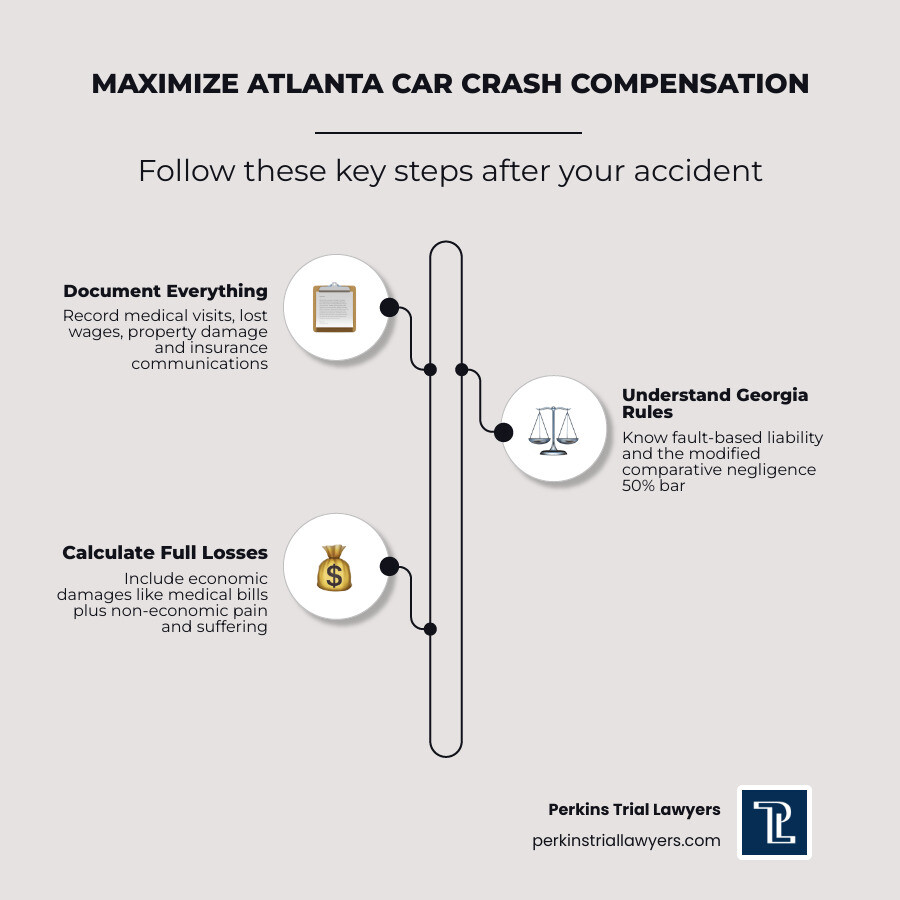
Terms related to Atlanta car crash compensation:
How Georgia’s Fault-Based System Impacts Your Claim
Unlike “no-fault” states where your own insurance company automatically pays for your minor medical bills regardless of who caused the wreck, Georgia operates on a traditional tort (fault-based) system.
In simple terms: the person who caused the accident is responsible for paying for the damage.
While this sounds straightforward, it places a heavy burden of proof on you, the injured victim. To secure Atlanta car crash compensation from the at-fault driver’s insurance company, you must prove three things:
- The other driver owed you a duty of care (e.g., following traffic laws, paying attention to the road).
- The other driver breached that duty (e.g., texting, speeding, running a red light on Peachtree Street).
- That breach directly caused your injuries and financial losses.
Because insurance companies are businesses, they do not hand over checks just because you ask. They will thoroughly analyze the police report, physical evidence, and your medical records to find any excuse to deny liability or shift the blame onto you.
Navigating these liability hurdles while trying to recover from physical trauma is incredibly stressful. That is why having a dedicated advocate is crucial to protect your rights and handle the legal heavy lifting. For a deeper look at why navigating this system alone is a risky move, read our guide on Why You Need an Atlanta Car Crash Lawyer After a Wreck.
Maximizing Your Atlanta Car Crash Compensation Under Georgia Law
Under Georgia law, victims are entitled to “compensatory damages.” These are designed to make you financially whole again after a crash. Compensatory damages are split into two distinct categories: economic damages (tangible, out-of-pocket expenses) and non-economic damages (intangible, quality-of-life losses).
According to historical court records, Georgia Car Accident Settlement and Verdict Amounts for 2025 vary widely depending on the severity of the injury and the strength of the evidence. For example, minor soft tissue injuries like muscle spasms might settle for around $18,500, while catastrophic brain injuries or head-on collisions involving large corporate vehicles can yield multi-million dollar jury verdicts.
To understand how these damages are categorized, review this comparison table:
| Economic Damages (Tangible Losses) | Non-Economic Damages (Intangible Losses) |
|---|---|
| Emergency room and hospital bills | Physical pain and suffering |
| Doctor visits and specialist fees | Mental anguish and anxiety |
| Prescription medications and medical devices | Post-Traumatic Stress Disorder (PTSD) |
| Future medical treatment and surgeries | Loss of enjoyment of life |
| Lost wages from missed workdays | Permanent scarring and disfigurement |
| Value of used Paid Time Off (PTO) | Loss of consortium (impact on family relationships) |
| Diminished earning capacity | Loss of companionship |
Economic Damages: Calculating Your Atlanta Car Crash Compensation
Economic damages are the foundation of your injury claim. They are highly measurable because they come with a paper trail: bills, receipts, invoices, and paystubs.
1. Recoverable Medical Expenses
You can claim compensation for every single medical expense resulting from the crash. This includes:
- Immediate Emergency Care: Ambulance rides, emergency room visits, diagnostic imaging (X-rays, CT scans, MRIs), and trauma care.
- Ongoing Clinical Care: Surgeries, specialist consultations, prescription medications, and medical equipment (like neck braces or crutches).
- Rehabilitative Services: Physical therapy, occupational therapy, and chiropractic care.
This is particularly critical for severe trauma. National statistics reveal that chest injuries are responsible for roughly 35% of all trauma-related deaths in the United States, with 80% of car accident victims experiencing trauma to the head and/or chest. In Georgia, traffic accidents account for over 1,300 chest injuries annually. These injuries often require extensive, multi-month rehabilitation.
When calculating medical damages, we do not just look at what you have already paid. We work with medical experts to project your future medical costs. If you require ongoing surgeries, physical therapy, or home care years down the road, those anticipated costs must be factored into your current settlement demand.
2. Lost Wages and the “PTO Trap”
If your injuries forced you to miss work, you are legally entitled to recover those lost wages. This includes your base salary, hourly wages, missed overtime opportunities, and lost performance bonuses or sales commissions.
Many victims fall into the “PTO trap.” They assume that because they used their accrued Paid Time Off (PTO) or sick leave to cover their missed workdays, they didn’t technically “lose” wages. This is incorrect. Your PTO is a valuable contract benefit that you earned. If you were forced to burn through your vacation or sick days because of someone else’s negligence, you are entitled to be compensated for the value of that used PTO.
3. Loss of Earning Capacity
If your injuries are severe or permanent—such as traumatic brain injuries (TBIs), spinal cord damage, or complex bone fractures—you may never be able to return to your previous line of work, or work at all.
Loss of earning capacity measures the difference between what you realistically could have earned over your lifetime before the accident versus what you can earn now. Calculating this requires analyzing your age, education, career trajectory, life expectancy, and economic inflation. We frequently consult forensic economists to build a bulletproof calculation of these lifetime losses. To begin assessing what your specific injuries might be worth, check out our interactive resource: What’s My Case Worth?.
Non-Economic Damages: Intangible Elements of Atlanta Car Crash Compensation
While economic damages keep your bank account from draining, non-economic damages compensate you for the human cost of the accident.
Non-economic damages cover the intangible ways your life has changed. They address:
- Physical Pain and Suffering: The daily physical agony of healing from broken bones, torn ligaments, or nerve damage.
- Emotional Distress and Mental Anguish: The psychological trauma of the wreck, which frequently manifests as sleep deprivation, depression, severe anxiety, and PTSD.
- Loss of Enjoyment of Life: The inability to participate in hobbies, play with your children, exercise, or enjoy the daily activities that brought you happiness before the crash.
Because there is no invoice for “pain” or “grief,” insurance adjusters will almost always try to undervalue these damages. They often use arbitrary software formulas to minimize your suffering. To secure full value, we must paint a vivid picture of your daily challenges. This is done through consistent medical documentation, personal pain journals, and testimonies from family, friends, and employers who can describe how the injury has altered your daily life.
Handling Property Damage and Punitive Damages Separately
When you are involved in an Atlanta wreck, your physical injuries and your damaged vehicle are treated as two separate claims.
Resolving Property Damage
Your property damage claim covers the costs associated with your vehicle and personal belongings. Under Georgia law, you can seek compensation for:
- Vehicle Repair Costs: The cost to restore your vehicle to its pre-accident condition.
- Diminished Value: Even if your car is perfectly repaired, it now has an accident history on its record, making it worth less on the open market. Georgia is one of the few states that legally requires insurance companies to compensate you for this loss in resale value.
- Rental Car Costs: The cost of a rental vehicle while your car is in the shop.
- Personal Property: Compensation for items damaged inside the car, such as laptops, cell phones, child car seats, or expensive sunglasses.
Crucial Warning: Never sign a settlement release that combines your property damage and bodily injury claims into a single payout. Insurance adjusters often try to rush victims into signing a quick release for their car repairs, sneaking in language that waives their right to file an injury claim later. Always keep these claims strictly separate, and consult an attorney before signing any release. If you need immediate assistance with a complex claim, you can reach out to a skilled Car Accident Attorney in Atlanta GA.
When are Punitive Damages Awarded?
Unlike compensatory damages, which are meant to restore the victim, punitive damages are designed to punish the at-fault driver for egregious, malicious, or highly reckless behavior and deter others from doing the same.
Under Georgia law (O.C.G.A. § 51-12-5.1), punitive damages are not awarded in standard negligence cases (like a simple distraction or failure to yield). Instead, they require proof of “willful misconduct, malice, fraud, wantonness, oppression, or that entire want of care which would raise the presumption of conscious indifference to consequences.”
Common scenarios that justify punitive damages in Atlanta include:
- Drunk or Impaired Driving: Driving under the influence of alcohol or drugs.
- Extreme Road Rage: Intentionally ramming another vehicle or forcing them off the road.
- Hit and Run: Fleeing the scene of an accident to evade responsibility.
In Georgia, punitive damages are generally capped at $250,000. However, there is no cap on punitive damages if the defendant acted with specific intent to cause harm, or if they were actively impaired by alcohol or drugs.
Wrongful Death and Critical Timelines in Georgia
Tragically, some Atlanta car crashes result in fatal injuries. When a loved one is killed due to a negligent driver, the family cannot file a standard personal injury claim. Instead, they must pursue a wrongful death claim.
How Wrongful Death Claims Work in Georgia
Under O.C.G.A. § 51-4-2, Georgia law establishes a strict hierarchy of who is allowed to file a wrongful death lawsuit:
- The Surviving Spouse: If there is a surviving spouse, they have the primary right to file. If the couple has children, the spouse must share the compensation equally with them, but the spouse is guaranteed to receive no less than one-third of the total recovery.
- The Surviving Children: If there is no surviving spouse, the children may file.
- The Surviving Parents: If there is no spouse or child, the deceased person’s parents may file.
- The Estate Representative: If no immediate family members exist, the administrator or executor of the deceased’s estate can file, with the damages held for the benefit of the next of kin.
Understanding “Full Value of Life”
Georgia’s approach to wrongful death damages is unique. Rather than focusing on the financial loss to the surviving family members, Georgia law measures damages based on the “full value of the life of the decedent.”
This value is split into two components:
- The Tangible/Economic Value: The projected lifetime financial earnings, benefits, and household services the deceased would have provided had they lived a full life.
- The Intangible/Human Value: The lost companionship, society, family experiences, and simple joys of living that the deceased was deprived of experiencing.
Additionally, the administrator of the deceased’s estate can file a separate estate claim to recover medical expenses incurred before death, funeral and burial costs, and compensation for any conscious pain and suffering the deceased experienced before passing.
Frequently Asked Questions about Atlanta Car Crash Claims
How do insurance companies undervalue car accident claims?
Insurance companies employ a variety of psychological and legal tactics to minimize their financial exposure. Their goal is to close your file as quickly and cheaply as possible.
Some of their most common tactics include:
- The “Fast Cash” Lowball Offer: Contacting you within days of the crash—before you even know the full extent of your injuries—and offering a quick, small settlement check in exchange for signing a liability release.
- Exploiting Gaps in Treatment: If you delay going to the doctor or miss physical therapy appointments, the insurance adjuster will argue that your injuries must not have been very serious, or that they were caused by something else entirely.
- Blaming Pre-Existing Conditions: Demanding access to your entire lifetime medical history to argue that your current neck or back pain is simply a pre-existing degenerative issue rather than a result of the crash.
To protect yourself from these traps, avoid giving recorded statements to the other driver’s insurer, keep consistent medical appointments, and review our guide on Atlanta Car Wreck Attorney Mistakes to ensure your claim remains on the right track.
Can I recover compensation if I was partially at fault for the crash?
Yes, but your recovery depends on your percentage of fault. Georgia follows a modified comparative negligence system with a “50 percent bar” rule (O.C.G.A. § 51-12-33).
Under this rule:
- You can recover damages as long as you are less than 50% at fault for the accident.
- Your compensation will be reduced by your percentage of fault. For example, if a jury determines your total damages are $100,000, but finds you were 20% at fault because you were traveling slightly over the speed limit, your final payout will be reduced by 20% to $80,000.
- If you are found to be 50% or more at fault, you are legally barred from recovering any compensation whatsoever.
Because the other driver’s insurance company has a massive financial incentive to push your fault percentage above that 50% threshold, establishing clear liability is the most critical part of your case. For expert guidance on how to combat shared-fault allegations, speak with a dedicated Personal Injury Lawyer in Atlanta.
What is the statute of limitations for an Atlanta car accident lawsuit?
Under Georgia law (O.C.G.A. § 9-3-33), the standard statute of limitations for a personal injury claim is two years from the date of the accident. If you do not file a formal lawsuit in a court of law before this two-year window closes, you lose your legal right to seek compensation forever.
However, there are a few critical exceptions to this rule:
- Claims Against Government Entities: If your accident involved an Atlanta city vehicle (like a MARTA bus) or a state-owned vehicle, you must file a formal “ante litem” notice much sooner—often within six months for city claims or one year for state claims.
- Tolling for Criminal Prosecution: If the at-fault driver received a traffic citation (like speeding or DUI), the two-year clock may be “tolled” (paused) while their traffic ticket or criminal case is resolved in court, up to a maximum of six years.
- Estate Administration: If the victim passed away, the estate claim timeline can sometimes be paused for up to several months while an administrator is formally appointed.
Even though two years sounds like a long time, building a winning case takes months of preparation, accident reconstruction, and medical evaluation. Waiting until the last minute can severely damage your chances of success. To understand how these timelines apply to your specific situation, review The Ultimate Guide to Hiring an Atlanta Car Accident Lawyer.
Conclusion
Securing full atlanta car crash compensation is not an automatic process. It requires a deep understanding of Georgia insurance laws, meticulous medical documentation, and a refusal to back down when insurance adjusters offer pennies on the dollar.
At Perkins Trial Lawyers, we believe that you shouldn’t have to pay the price for someone else’s reckless driving. Our team provides tireless advocacy against insurance companies, handling every legal hurdle so that you can focus entirely on your physical and emotional recovery. We operate on a contingency fee basis, meaning you pay us nothing upfront, and we only get paid if we win your case.
Don’t leave your financial recovery to chance or let an insurance adjuster dictate what your recovery is worth. Contact us today to secure your rights.
Secure Your Full Recovery with an Atlanta Car Accident Attorney