
When an Atlanta Car Accident Claim Can Change Everything
Filing an Atlanta car accident claim is one of the most important steps you can take after a crash — and knowing how to do it right can mean the difference between fair compensation and walking away with far less than you deserve.
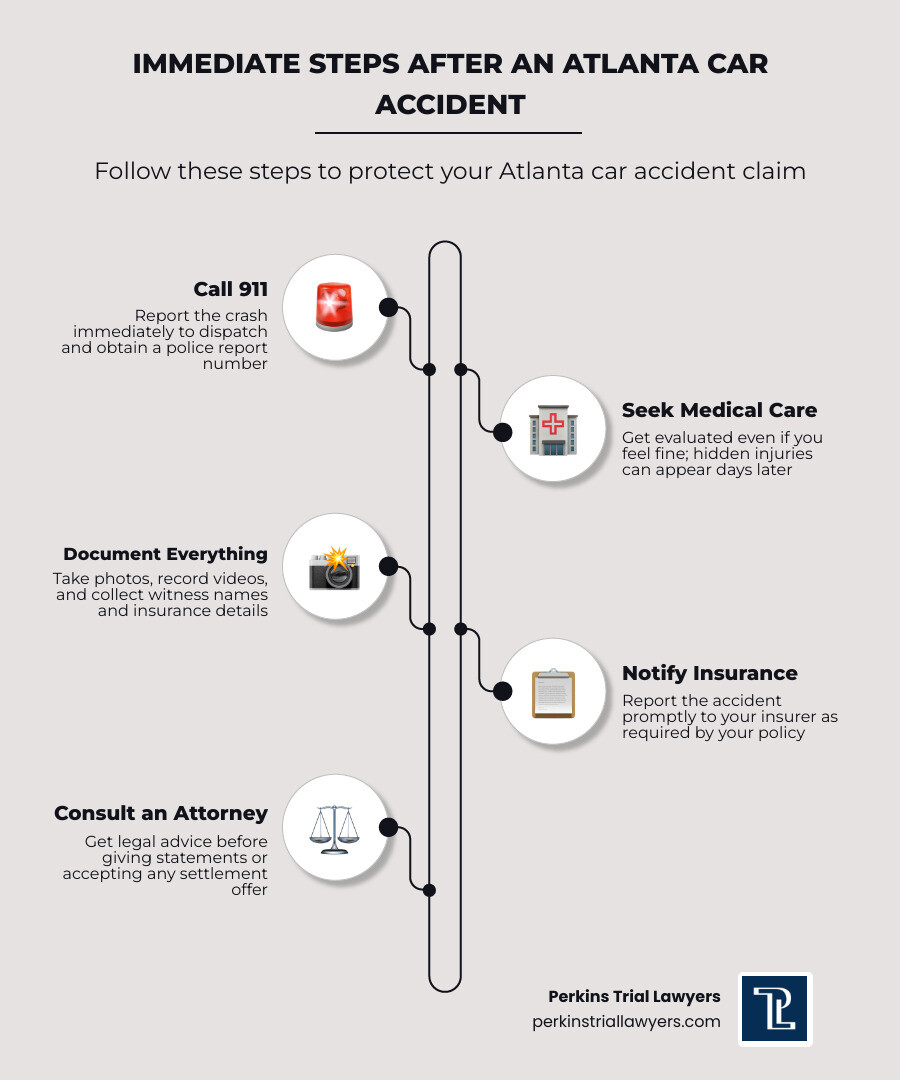
Here’s how to file an Atlanta car accident claim (quick overview):
- Call 911 — Report the accident and get a police report number
- Seek medical care — Even if you feel fine; some injuries appear days later
- Document everything — Photos, videos, witness names, insurance details
- Notify your insurance company — Report the accident promptly as required
- Consult an attorney — Before giving any statements or accepting any settlement
Atlanta’s roads are among the busiest — and most dangerous — in the country. The city sees over 30,000 car accidents every year. In Fulton and DeKalb counties alone, 2023 data recorded more than 90,000 crashes, 272 fatal collisions, and nearly 38,000 injury crashes.
Nearly 1 in 5 Georgia drivers is distracted behind the wheel. That puts everyone on the road at risk, every single day.
If you’ve been hurt in a crash, you’re likely dealing with mounting medical bills, time off work, vehicle damage, and an insurance company that isn’t on your side. The process feels overwhelming — especially while you’re trying to heal.
This guide walks you through everything you need to know: what to do right after a crash, how Georgia law affects your claim, what compensation you can recover, and when to get legal help.
Atlanta car accident claim terms to know:
Immediate Steps to Take After a Collision in Atlanta

The moments immediately following a crash are chaotic. Your adrenaline is pumping, your heart is racing, and you might be in shock. However, the actions you take in these first few minutes can significantly impact your future atlanta car accident claim.
First and foremost: safety. If it is safe to do so, move your vehicle out of the flow of traffic. Atlanta’s highways, like I-285 and the Downtown Connector, are notoriously dangerous for secondary collisions. Turn on your hazard lights and stay in a safe location.
Once you are out of immediate danger, follow these critical steps:
- Call 911 immediately. Even if the other driver begs you not to, or says “it’s just a scratch,” you need an official record. Calling 911 in Atlanta automatically dispatches the correct law enforcement agency. A police report is the bedrock of most successful claims.
- Document the scene. If you can move, use your phone to take wide-angle photos of the entire scene and close-ups of the damage to all vehicles involved. Don’t forget to photograph skid marks, broken glass, road signs, and the current weather conditions.
- Identify witnesses. If anyone stopped to help, ask for their name and contact information. Witness statements are often the “tie-breaker” when drivers give conflicting accounts of what happened.
- Exchange information. Get the other driver’s name, address, phone number, driver’s license number, and insurance policy details. Stay polite, but do not apologize or admit fault. Even a simple “I’m sorry” can be twisted by an insurance adjuster later to mean you were responsible.
- Seek medical evaluation. Do not wait. Many common injuries, like whiplash or traumatic brain injuries (TBI), may not show symptoms for hours or even days. A delay in treatment gives the insurance company an opening to argue that your injuries weren’t caused by the crash.
Knowing Why You Need an Atlanta Car Crash Lawyer After a Wreck is about more than just filing paperwork; it’s about protecting your rights while you focus on getting better.
Filing an Atlanta Car Accident Claim Without a Police Report
While we always recommend getting the police to the scene, sometimes officers don’t respond to minor “fender benders” if there are no apparent injuries. Under Georgia Code Section 40-6-273, you are legally required to report any accident that results in injury, death, or property damage exceeding $500.
If the police didn’t come to the scene, you aren’t necessarily out of luck, but your atlanta car accident claim just got a bit more complicated. You should:
- File a “Desk Report” or “Operator Report”: Go to the nearest Atlanta Police Department precinct or the Georgia Department of Driver Services to file a report manually.
- Double down on evidence: Since you don’t have an officer’s “neutral” opinion, your photos, videos, and witness contacts become your primary weapons.
- Preserve evidence: Keep everything. Repair estimates, medical receipts, and even a journal of your daily pain levels can help fill the gap left by a missing police report.
Insurance companies often use the absence of a police report as an excuse to deny a claim or offer a lowball settlement. If you find yourself in this position, it’s wise to Get a Free Consultation with Auto Injury Lawyer Atlanta to see how you can still prove liability.
Understanding Georgia Laws for Your Atlanta Car Accident Claim
Georgia’s legal landscape for car accidents is specific. Unlike “no-fault” states where your own insurance always pays for your medical bills (PIP), Georgia is a fault-based system. This means the person who caused the accident is responsible for the damages.
This system puts the “burden of proof” on you. To win your atlanta car accident claim, you must prove that the other party was negligent. This involves showing they had a duty to drive safely, they breached that duty (by speeding, texting, or driving drunk), and that breach caused your injuries.
The Statute of Limitations: The Clock is Ticking
In Georgia, you don’t have forever to file a lawsuit. The statute of limitations for personal injury claims is generally two years from the date of the accident. If you miss this deadline, you lose your right to seek compensation forever.
However, there are different timelines to keep in mind:
- Personal Injury: 2 years.
- Wrongful Death: 2 years.
- Property Damage: 4 years.
- Claims against Government Entities: If you were hit by a city bus or a government vehicle, you might have as little as 6 to 12 months to file a formal “ante litem” notice.
Because these rules are strict, understanding the Atlanta Texting While Driving Law and other local regulations is vital for building a timely case.
Recovering Damages in Your Atlanta Car Accident Claim
When we talk about “damages,” we’re talking about the money you receive to make up for your losses. In Georgia, these are categorized into economic and non-economic damages.
Economic Damages (The “Receipt” Damages):
- Medical Bills: Hospital stays, surgeries, physical therapy, and future medical needs.
- Lost Wages: Money you lost because you couldn’t work.
- Loss of Earning Capacity: If your injuries prevent you from returning to your old job or working at all.
- Property Damage: The cost to repair or replace your vehicle.
Non-Economic Damages (The “Human” Damages):
- Pain and Suffering: Compensation for the physical pain and emotional distress you’ve endured.
- Mental Anguish: Dealing with anxiety, PTSD, or depression after a wreck.
- Loss of Consortium: The impact the injury has on your relationship with your spouse.
If you’re wondering, “What’s My Case Worth?“, the answer depends on the severity of your injuries, the clarity of fault, and the available insurance coverage.
Establishing Liability and Proving Negligence
To successfully resolve an atlanta car accident claim, we have to prove who is at fault. This isn’t always as simple as pointing a finger at the other driver. Negligence can stem from several sources:
- Other Drivers: Most crashes are caused by human error — speeding, distracted driving (texting), or driving under the influence.
- Vehicle Manufacturers: Sometimes, the crash wasn’t the driver’s fault at all. Defective brakes, steering failures, or exploding airbags can make a manufacturer liable.
- Government Agencies: If a road was poorly maintained, lacked proper signage, or had a dangerous design flaw, a government entity might be responsible. (Note: These claims are complex and require quick action).
Establishing liability requires a deep dive into the evidence. We look at black box data from vehicles, cell phone records, and traffic camera footage.
The Role of Modified Comparative Negligence
What happens if you were partially at fault? Maybe the other driver blew a red light, but you were going 5 mph over the speed limit.
Georgia follows a modified comparative negligence rule with a 50 percent bar. Here is how it works:
- As long as you are less than 50% responsible, you can still recover damages.
- Your total compensation is reduced by your percentage of fault. For example, if you are awarded $100,000 but found 20% at fault, you will receive $80,000.
- If you are 50% or more at fault, you get nothing.
Insurance companies love to shift blame onto victims to save money. This is exactly Why Your Denied Claim Needs an Atlanta Injury Attorney Now. We fight back against unfair fault assignments to protect your payout.
Navigating Insurance Requirements and Adjuster Tactics
Georgia law requires all drivers to carry a minimum amount of insurance. However, these “minimums” are often nowhere near enough to cover a serious accident.
| Coverage Type | Georgia Minimum Requirement | Perkins Recommended |
|---|---|---|
| Bodily Injury (Per Person) | $25,000 | $100,000+ |
| Bodily Injury (Per Accident) | $50,000 | $300,000+ |
| Property Damage | $25,000 | $50,000+ |
| Uninsured Motorist (UM) | Not Required (but vital) | Match Liability Limits |
With roughly 18.1% of Georgia motorists driving uninsured, having Uninsured/Underinsured Motorist (UM/UIM) coverage is the best way to protect yourself. In Georgia, you should opt for “Added-On” UM coverage, which stacks on top of the at-fault driver’s policy rather than being reduced by it.
Beware the Adjuster’s “Friendly” Call
Shortly after your crash, you will likely get a call from the other driver’s insurance adjuster. They might sound concerned and empathetic. Don’t be fooled. Their job is to minimize the amount of money the company pays out.
Common tactics include:
- Asking for a recorded statement: They want to catch you saying something that can be used against you later.
- Offering a “quick settlement”: They may offer a few thousand dollars immediately. This is almost always a lowball offer designed to get you to sign away your rights before you know the full extent of your injuries.
- Downplaying your pain: If you haven’t seen a specialist yet, they will argue your injuries aren’t serious.
This is Why a Contingency Car Accident Attorney is so valuable. You don’t pay us anything upfront, and we handle all the stressful negotiations with the adjusters so you don’t have to.
The Timeline and Process of a Legal Claim
How long does an atlanta car accident claim take? There is no “one size fits all” answer, but the process generally follows these stages:
- Investigation: We gather all evidence, from police reports to medical records.
- Medical Treatment: We wait until you reach “Maximum Medical Improvement” (MMI). We need to know the total cost of your care before we can ask for a settlement.
- The Demand Letter: We send a formal letter to the insurance company outlining the facts of the case and the compensation we are seeking.
- Negotiation: The insurance company will usually make a counter-offer. This back-and-forth can take weeks or months.
- Litigation: If the insurance company refuses to be fair, we file a lawsuit. This moves the case into “Discovery,” where both sides exchange evidence.
- Mediation and Trial: Most cases (about 95%) settle during mediation. If they don’t, we are prepared to take your case to a jury.
For a deeper dive into this journey, check out The Ultimate Guide to Hiring an Atlanta Car Accident Lawyer.
Frequently Asked Questions about Atlanta Car Accident Claims
How long do I have to file a claim in Georgia?
As mentioned, the standard limit is two years for personal injury or wrongful death. However, property damage claims have a four-year window. If your claim involves a city, county, or state vehicle, you must file an “ante litem” notice much sooner — often within 6 to 12 months. It’s always better to start the process early while evidence is fresh.
Can I still recover money if I was partially at fault?
Yes! Under Georgia’s modified comparative negligence law, you can recover money as long as you are less than 50% at fault. If a jury finds you 10% responsible for a $50,000 award, you would still receive $45,000. We work tirelessly to ensure the insurance company doesn’t unfairly inflate your percentage of fault.
What is diminished value and can I claim it?
Diminished value is the loss in a vehicle’s market value after it has been in an accident and repaired. Even if your car looks brand new, its VIN history will show an accident, making it worth less to a future buyer. In Georgia, you can often file a separate claim for this loss in value. This is a unique feature of Georgia law that many victims overlook.
Conclusion
Filing an Atlanta car accident claim shouldn’t feel like a second collision. At Perkins Trial Lawyers, we provide tireless advocacy against insurance companies to ensure you receive the maximum compensation possible. Whether you’re dealing with a complex multi-vehicle pile-up on I-75 or a distracted driving crash in Midtown, we have the experience to guide you through.
Don’t let an insurance adjuster dictate your future. If you want to Atlanta Car Accident Lawyer: Find the Best for your specific needs, look for a team that treats you like a person, not a case number.
Ready to take the next step? Contact our Atlanta Car Accident Attorneys Today for a free consultation. Let us handle the legal wreck so you can get back on the road to recovery.