
What Your Atlanta Car Accident Case Is Actually Worth — and What to Do Next
An Atlanta car accident case can change your life in seconds — and what you do in the hours and days that follow can make or break your claim.
Here’s a quick snapshot of what determines your case value:
| Factor | Why It Matters |
|---|---|
| Severity of injuries | More serious injuries mean higher medical costs and more compensation |
| Fault percentage | Georgia bars recovery if you are 50% or more at fault |
| Available insurance coverage | Limits cap what you can actually collect |
| Evidence preserved | Photos, dashcam footage, and police reports strengthen your claim |
| How fast you acted | Delays let evidence disappear and hurt credibility |
In 2024, metro Atlanta saw over 425 traffic deaths across five counties — more than the number of homicides in the same area. Behind every one of those numbers is a family facing medical bills, lost income, and a system that can feel impossible to navigate alone.
Insurance companies are not on your side. Their adjusters manage thousands of claims and are trained to settle fast and settle low. The sooner you understand your rights, the better your chances of recovering what you truly deserve.
Key Atlanta car accident case vocabulary:
Immediate Steps to Protect Your Rights After an Atlanta Car Crash

When you are in a wreck on a busy stretch of I-285, I-85, or Peachtree Street, adrenaline takes over. Your heart is pounding, your neck is stiffening, and your vehicle might be blocking traffic. What you do in these chaotic moments establishes the foundation of your entire legal claim.
First, check yourself and your passengers for injuries. If it is safe to do so, move your vehicle out of the immediate flow of traffic to prevent a secondary collision. Turn on your hazard lights.
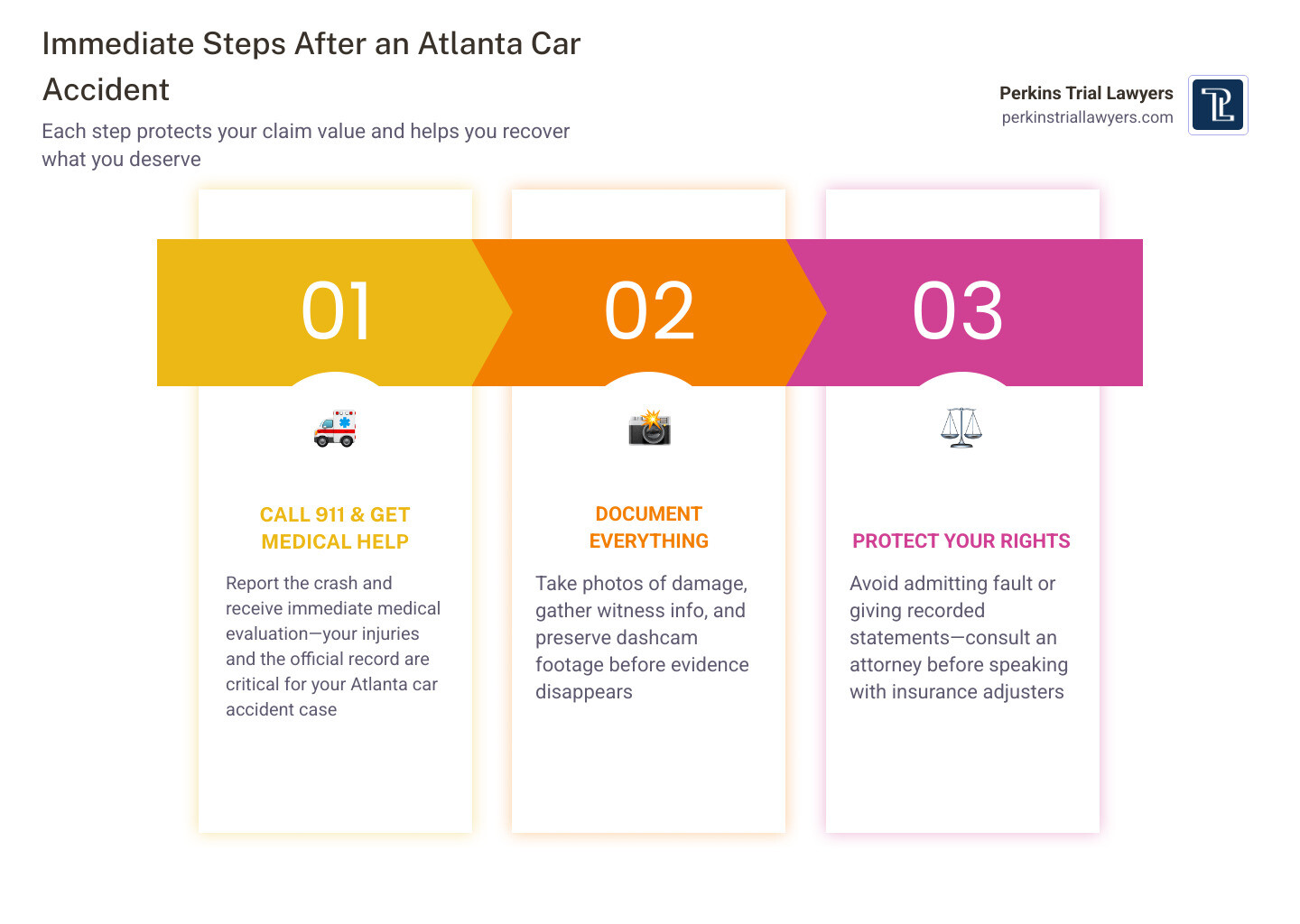
1. Dial 911 Immediately
Even if the other driver begs you not to call the police, you must report the accident. A formal law enforcement presence is vital. When the Atlanta Police Department or responding county sheriff arrives, they will write an official accident report. This document acts as an objective log of the crash, listing the parties involved, insurance details, and often an initial determination of who violated traffic laws.
Once the report is ready, you can obtain a copy online through portal systems like buycrash.com or by visiting the Atlanta Police Department’s Central Records Unit.
2. Document the Scene Extensively
Physical evidence can wash away with the next rainstorm, and skid marks fade within days. Take your phone and capture:
- Clear photos of all vehicles from multiple angles (showing the point of impact and overall damage).
- Wide shots of the entire intersection or road layout.
- Close-ups of any road hazards, debris, traffic signals, or skid marks.
- Photos of your visible injuries (cuts, bruising, swelling).
3. Exchange Key Information
Gather the name, phone number, physical address, driver’s license number, and insurance policy details of the other driver. If there are bystanders who stopped to help, ask for their contact details as well. Witness statements are incredibly difficult for insurance companies to dispute later on.
4. Seek Immediate Medical Evaluation
This is the most common area where victims make costly mistakes. Even if you walked away from the collision feeling relatively fine, you must see a doctor within 24 to 48 hours. The shock of a crash floods your body with adrenaline and endorphins, which temporarily mask severe pain and inflammation. Delaying medical care creates a “gap in treatment” that insurance adjusters will use to argue that your injuries were either exaggerated or caused by an unrelated event after the wreck.
For a detailed roadmap on handling the immediate aftermath, read our guide on Atlanta Car Accident Claim Help.
How Georgia Laws Affect Your Atlanta Car Accident Case
To secure the compensation you deserve, you must navigate the specific statutes that govern personal injury claims in Georgia. These rules dictate who can recover damages, how much they can receive, and how long they have to act.
Modified Comparative Negligence (O.C.G.A. § 51-12-33)
Georgia operates under a modified comparative negligence system with a 50% bar. This means you can still recover compensation even if you were partially to blame for the accident, provided your share of the fault is less than 50%.
However, your financial recovery will be reduced by your exact percentage of fault. For example, if a jury determines your total damages are $100,000 but finds you were 20% responsible because you were traveling slightly over the speed limit, your final payout will be reduced to $80,000. If you are found 50% or more at fault, you are barred from recovering anything.
This rule makes fault allocation highly contested. To see how these rules play out in simulated courtroom environments, you can review this Georgia comparative negligence rules case study.
Mandatory Insurance Requirements
Under Georgia law, all drivers must carry a minimum amount of liability insurance to cover bodily injury and property damage they cause to others:
- $25,000 for bodily injury per person.
- $50,000 for bodily injury per accident (if multiple people are hurt).
- $25,000 for property damage.
Given the skyrocketing costs of modern emergency medical care, these minimum limits are often exhausted quickly in a severe crash. That is why identifying secondary coverage options, such as Uninsured/Underinsured Motorist (UM/UIM) policies or corporate umbrella coverage, is a critical step in building your claim.
The Statute of Limitations
In most personal injury claims, Georgia gives you exactly two years from the date of the crash to file a lawsuit. If you let this deadline pass without taking legal action, your right to seek compensation is lost forever.
It is important to note that claims involving government entities — such as a collision with a MARTA bus or a city-owned vehicle — have much tighter deadlines. These cases require you to file an ante-litem notice within six to twelve months, depending on the municipality. For professional help navigating these strict statutory timelines, consult a Car Accident Lawyer Georgia.
Evaluating the Value of Your Claim and Recoverable Damages
When evaluating an Atlanta car accident case, we look at two primary categories of compensatory damages: economic and non-economic.
Economic Damages (Objective Financial Losses)
These are the measurable, out-of-pocket expenses resulting from your accident. They are proven using invoices, receipts, medical records, and employment documentation:
- Medical Bills: Emergency room visits, diagnostic imaging (MRIs, X-rays), surgeries, physical therapy, prescription medications, and estimated future medical care.
- Lost Wages: The income you lost while recovering, calculated by your hourly rate or salary and the time missed.
- Loss of Earning Capacity: If your injuries prevent you from returning to your previous profession or working the same number of hours, you can recover the difference in your lifetime earning potential.
- Property Damage: The cost to repair or replace your vehicle and any personal items damaged in the crash.
Non-Economic Damages (Subjective Personal Losses)
These damages compensate you for the physical and emotional toll of the accident. Because they do not come with a price tag, proving them requires presenting a compelling narrative of how the injury altered your daily life:
- Pain and Suffering: The actual physical discomfort and pain caused by your injuries.
- Mental Anguish: Post-traumatic stress, anxiety, depression, and sleep disturbances following a violent wreck.
- Loss of Enjoyment of Life: The inability to participate in hobbies, sports, or family activities you once loved.
- Loss of Consortium: The negative impact of the injuries on your relationship with your spouse.
| Economic Damages (Receipt-Based) | Non-Economic Damages (Quality-of-Life Based) |
|---|---|
| Emergency Room & Hospital Bills | Physical Pain & Ongoing Discomfort |
| Physical Therapy & Rehabilitation | Emotional Distress & PTSD Symptoms |
| Documented Lost Wages | Loss of Ability to Enjoy Hobbies |
| Vehicle Repair or Replacement Costs | Impact on Spousal & Family Relationships |
To learn more about how these categories are calculated and maximized, explore our resource on Atlanta Car Crash Compensation.
Proving Fault and Overcoming Insurance Tactics
Insurance companies are in the business of minimizing payouts. To protect their profit margins, they employ highly trained adjusters whose primary goal is to find reasons to deny or devalue your claim.
To overcome these tactics, we build your case using concrete, undeniable evidence:
- Dashcam Footage: Video recordings provide an objective, real-time account of the collision.
- Black Box Data: Modern vehicles store Event Data Recorders (EDRs) that capture speed, braking, steering angles, and seatbelt usage in the seconds leading up to an impact.
- Accident Reconstruction: We work with forensic engineers who analyze skid marks, vehicle crush profiles, and road geometry to recreate the crash and establish clear liability.
Watch Out for These Insurance Adjuster Tactics
- The Quick Settlement Offer: Adjusters often call within days of a crash, offering a fast cash settlement. They do this before you know the full extent of your injuries, requiring you to sign away your right to sue for future medical costs.
- The Recorded Statement Trap: The adjuster will ask you to give a recorded statement “just to get your side of the story.” They will use carefully phrased questions to get you to admit fault or downplay your pain.
- Delaying the Claim: They may drag out the process, hoping you will grow financially desperate as medical bills pile up, making you more likely to accept a lowball offer.
The importance of holding insurance companies accountable and preserving your rights through trial is illustrated in the Georgia Court of Appeals decision Jason Thomas v. Accurate Steel Rule Cutting Die, which highlights how disputes over medical causation and trial errors must be rigorously litigated. For more strategies on beating the insurance company at their own game, read our Atlanta Car Accident Settlement Guide.
Uncovering Hidden Injuries in an Atlanta Car Accident Case
Some of the most dangerous injuries caused by car crashes do not show up immediately. Whiplash, internal bleeding, soft tissue tears, and traumatic brain injuries (TBIs) like concussions are notorious for having a delayed onset.
During a collision, your body is subjected to violent, unnatural forces. The sudden deceleration can stretch or tear muscles, ligaments, and tendons in your neck and back. Because these tissues have limited blood flow, inflammation builds slowly, meaning you might not feel severe pain until several days or even weeks after the wreck.
Furthermore, a TBI can occur even if your head never directly strikes the window or steering wheel. The rapid back-and-forth motion of your brain inside your skull can cause microscopic axonal shearing and chemical imbalances. Symptoms like memory lapses, irritability, light sensitivity, and chronic headaches may emerge gradually.
Establishing medical causation is critical in these cases. The defense will argue that any delay in diagnosing these conditions means they were caused by something else. This complex legal dynamic is explored in decisions like Natasha Pontoo v. Gregory Pinson, which emphasizes how intervening causes and gaps in immediate injury proof can derail a multi-car negligence claim. If you are dealing with delayed pain, speak with a dedicated Atlanta Car Injury Attorney to protect your health and your claim.
Common Causes of Collisions and Liability in an Atlanta Car Accident Case
Understanding why an accident occurred is the first step in proving negligence. In metro Atlanta, several recurring behaviors contribute to our high rate of traffic violence:
- Distracted Driving: Despite Georgia’s Hands-Free Law, motorists constantly look at their phones, leading to rear-end collisions and lane-departure wrecks.
- Speeding: Atlanta’s major corridors often turn into speedways, reducing a driver’s reaction time and dramatically increasing the force of an impact.
- Impaired Driving: Driving under the influence of drugs or alcohol remains a leading cause of catastrophic and fatal crashes.
These dangers are starkly illustrated by local tragedies. For instance, in 2024, DeKalb County suffered a heartbreaking series of fatal crashes involving Lakeside High School students, resulting in multiple student deaths. In one notable incident on Oak Grove Road, a Mazda SUV reached an astonishing 98 mph just one second before impact — exceeding the 35 mph speed limit by more than 60 mph.
The driver in that crash had a blood-alcohol concentration of .046, which is more than double the .02 legal limit for drivers under 21 in Georgia. This devastating case serves as a sober reminder of how quickly reckless decisions can destroy lives.
To analyze local crash trends and high-risk areas, you can explore the official GDOT Crash Data. Avoiding critical mistakes during the initial liability investigation is essential; learn more by reading about Atlanta Car Wreck Attorney Mistakes.
Frequently Asked Questions About Atlanta Auto Accidents
How long do I have to file a lawsuit in Georgia?
Under O.C.G.A. § 9-3-33, the statute of limitations for personal injury claims is generally two years from the date of the accident. However, there are exceptions. If the crash involves a city, county, or state government vehicle, you must file a formal notice of claim (ante-litem) within six to twelve months.
Failure to follow these strict procedural rules will result in your case being dismissed, as demonstrated in the appellate ruling Muhammad v. Clayton County, which underscores the fatal consequences of procedural errors and late filings in civil actions.
What should I avoid doing after a car accident?
- Do not admit fault: Avoid saying “I’m sorry” or making statements that could be interpreted as taking blame at the scene.
- Do not give a recorded statement: Politely decline to speak with the other driver’s insurance adjuster until you have consulted with legal counsel.
- Do not post on social media: Insurance defense attorneys will monitor your public profiles looking for photos or status updates to argue that your injuries are not as severe as you claim.
- Do not settle too early: Never sign a release or accept a settlement check until you have reached Maximum Medical Improvement (MMI) and fully understand your future medical needs.
When should I hire an attorney to handle my claim?
You should contact an attorney immediately if:
- You sustained moderate to severe injuries requiring hospital care or ongoing rehabilitation.
- The insurance company is disputing who was at fault for the crash.
- The accident involved a commercial truck, a rideshare vehicle, or a government entity.
- You are being offered a settlement that does not cover your outstanding medical bills and lost wages.
Most personal injury attorneys operate on a contingency fee basis, meaning there are no upfront costs, and you only pay if they successfully recover money for you. To understand why legal representation is so critical, read our detailed guide on Why You Need an Atlanta Car Crash Lawyer After a Wreck.
Secure Your Recovery with Dedicated Legal Representation
When you are recovering from a serious injury, you should focus on your physical healing, not fighting with insurance adjusters. The legal team at Perkins Trial Lawyers is committed to providing tireless advocacy against insurance companies to secure the maximum compensation you deserve.
We handle every step of your Atlanta car accident case — from securing police reports and analyzing electronic black box data to negotiating with aggressive insurance carriers and presenting your case to a jury if necessary.
If you or a loved one has been injured in a collision, do not settle for less than your claim is worth. Contact a dedicated Car Accident Attorney in Atlanta GA today for a free, no-obligation consultation, and let us fight for your recovery.