 Skip to content
When Every Dollar Counts: What to Know Before Hiring a Car Accident Lawyer in Fayetteville, Georgia
If you’re looking for a car accident lawyer in Fayetteville, Georgia, here’s what you need to know right now:
Quick answers for accident victims:
- Call 911 and get medical help first – even if you feel fine
- Don’t admit fault or give recorded statements to insurance adjusters
- You have 2 years to file a personal injury claim in Georgia
- Partial fault does not bar your claim – Georgia uses a 50% modified comparative fault rule
- A lawyer works on contingency – no fees unless you win
A car accident can flip your life upside down in seconds. Medical bills pile up. You miss work. And while you’re trying to heal, insurance adjusters are already working to pay you as little as possible.
This isn’t an exaggeration. Insurance companies are trained to minimize payouts – and they move fast. Studies show that accident victims who hire an attorney recover 3 to 5 times more in compensation than those who go it alone.
Fayetteville, Georgia – located just south of Atlanta – has busy roads like Highway 85 and Highway 54 that produce serious crashes every single day. As traffic in Fayette County continues to grow, so does the risk of severe collisions.
The stakes are high. The legal rules in Georgia are strict. And the window to act is limited.
This guide walks you through everything you need to know – from the scene of the crash to securing the compensation you deserve.
Similar topics to car accident lawyer fayetteville:
- Atlanta car wreck attorney
- Atlanta vehicle accident lawyer
- Car accident lawyers near me free consultation
Immediate Steps to Take After a Crash in Fayetteville, Georgia

The moments immediately following a car wreck are often chaotic and terrifying. Adrenaline is pumping, your body is in shock, and it is incredibly easy to make simple mistakes that can damage your future personal injury claim. Knowing exactly what to do can protect your health and preserve your legal rights.
To protect yourself financially and legally, you must avoid the typical traps that insurance companies rely on to deny claims. Taking the right steps from the very beginning ensures you build a solid foundation for your recovery. For a detailed breakdown of what to avoid, you can read about how to avoid common post-accident mistakes.
What to Do at the Scene of the Accident
First and foremost, check yourself and your passengers for injuries. If it is safe to do so, move your vehicle to the shoulder of the road to avoid secondary collisions, especially when dealing with high-speed highway accident hazards. Turn on your hazard lights immediately.
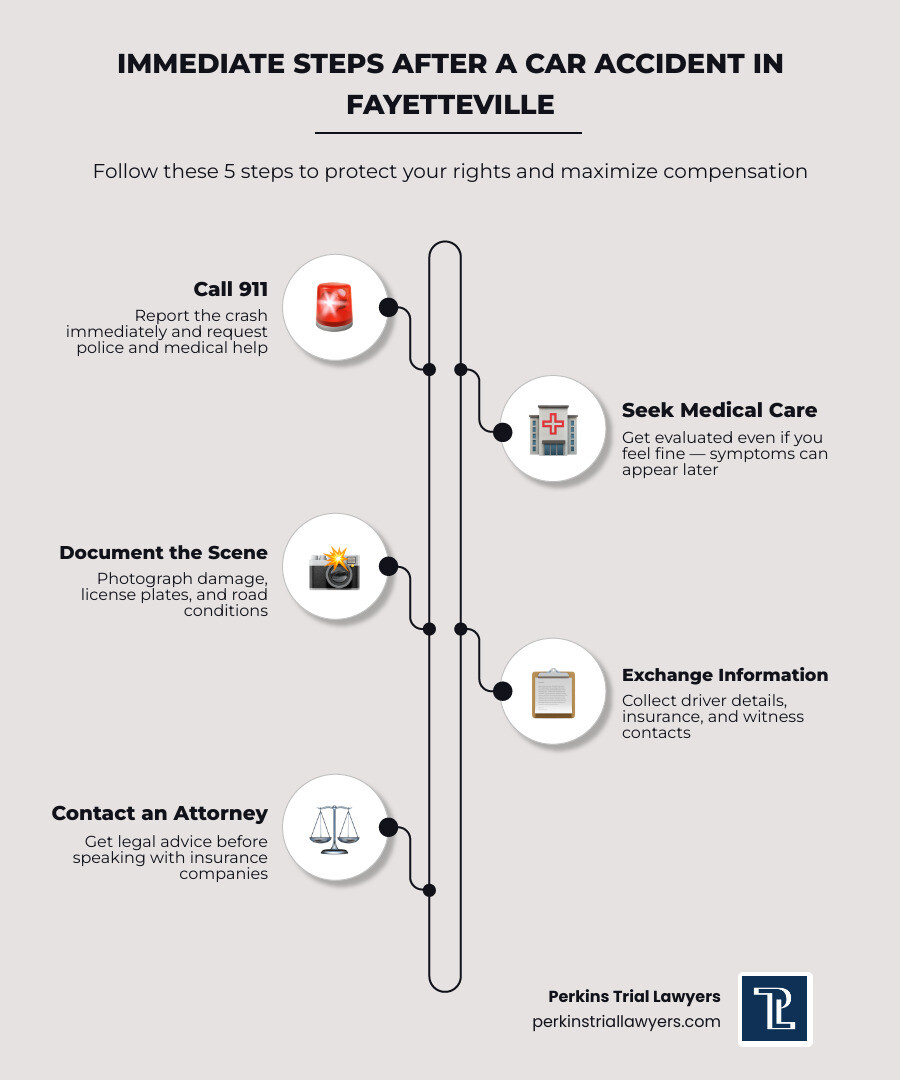
Once you are in a safe position, follow these steps:
- Call 911: Request both police officers and emergency medical services. A formal police report is one of the most critical pieces of evidence in any car accident claim.
- Exchange Information: Collect names, phone numbers, driver’s license numbers, and insurance policy details from all drivers involved. Keep the conversation polite but brief.
- Document the Scene: Use your phone to take extensive photos and videos. Capture the damage to all vehicles, the positioning of the cars, skid marks, traffic signs, weather conditions, and any visible injuries.
- Gather Witness Contacts: If anyone stopped to help or witnessed the crash, ask for their names and phone numbers. Their unbiased accounts can prove invaluable later.
- Watch Your Words: Do not apologize, say “I’m sorry,” or suggest that you might have been partially to blame. Even a polite comment can be twisted by insurance adjusters as an admission of fault.
Seeking Medical Attention and Documenting Injuries
Even if you believe your injuries are minor, you must be evaluated by a medical professional immediately. Adrenaline frequently masks severe pain and symptoms. Conditions like whiplash, internal bleeding, concussions, and soft tissue damage may not fully manifest until hours or even days after the collision.
Delaying medical care is a major red flag for insurance companies. They will argue that if you did not seek immediate care, your injuries were either not serious or were caused by an unrelated event after the accident. Visiting an emergency room, urgent care clinic, or your primary care physician establishes a direct, documented link between the wreck and your physical injuries.
| Injury Type | Common Symptoms | Typical Recovery Timeline |
|---|---|---|
| Whiplash & Soft Tissue Damage | Neck stiffness, headaches, shoulder pain, dizziness | 2 to 6 weeks (can become chronic) |
| Concussions & Traumatic Brain Injuries (TBI) | Confusion, memory loss, light sensitivity, nausea | 1 to 3 months (or permanent cognitive issues) |
| Bone Fractures & Breaks | Severe pain, swelling, inability to bear weight | 6 to 12 weeks (may require surgery/rehab) |
| Spinal Cord Damage & Herniated Discs | Numbness, tingling, loss of mobility, chronic back pain | Several months to permanent impairment |
How Georgia Laws Impact Your Fayetteville Car Accident Claim
The rules governing car accident claims are determined by state law. If you are injured in Fayetteville, Georgia, understanding the state’s specific legal environment is essential. A single detail regarding fault or filing deadlines can completely bar you from recovering compensation. For general Georgia roadway safety information, the Georgia Governor’s Office of Highway Safety provides public resources for drivers across the state.
Georgia’s 50% Bar Rule for Recovery
Georgia utilizes a modified comparative negligence system with a 50% bar. If you are injured in Fayetteville, GA, or the surrounding metro Atlanta area, you can pursue compensation if you are less than 50% responsible for the wreck.
Under this rule, your financial recovery is reduced proportionally by your percentage of fault. For example, if a jury determines your total damages are $100,000 but finds you 10% responsible for the crash, your final award will be reduced to $90,000. However, if you are found 50% or more at fault, you are legally barred from recovering any compensation whatsoever. Insurance adjusters know this rule well and will actively try to shift blame onto you to reduce or eliminate their payout.
Georgia’s Strict Two-Year Statute of Limitations
In Georgia, you have a relatively short window of time to take legal action. The statute of limitations for personal injury claims is generally two years from the date of the accident. If you fail to file a lawsuit within this two-year period, you lose your right to seek compensation forever.
Fayetteville, GA traffic can be incredibly congested, particularly around major intersections like Highway 85 and Highway 54, leading to complex multi-vehicle collisions. Because of the tight two-year deadline and the need to preserve fresh evidence, securing professional Georgia car accident representation as soon as possible is the best way to protect your claim.
How a Car Accident Lawyer Fayetteville Protects Your Rights
Many people wonder if they can handle a car accident claim on their own. While you are technically allowed to represent yourself, doing so places you at a massive disadvantage. Insurance companies employ teams of adjusters and corporate defense lawyers whose sole job is to protect their bottom line by paying you as little as possible.
When we represent you, we level the playing field. We handle all communications, gather the necessary evidence, calculate the true value of your physical and emotional damages, and negotiate aggressively on your behalf. Best of all, we handle personal injury cases on a contingency fee basis. This means you pay no upfront legal fees, and we only get paid if we successfully recover a settlement or jury verdict for you. To understand why this structure works in your favor, read more about the contingency fee benefits.
Navigating Complex Insurance Adjuster Tactics
Insurance adjusters often seem friendly and helpful immediately after a crash. Do not be fooled: they are looking for ways to devalue your claim. Common tactics include:
- The Lowball Offer: Offering a quick, small settlement within days of the crash before you even know the full extent of your injuries. Once you sign, you waive your right to ask for more money.
- Recorded Statements: Pressuring you to give a recorded statement, then twisting your words to imply you admitted fault or minimized your pain.
- Delaying the Claim: Dragging out the process to stress you out financially, hoping you will eventually accept a lower offer out of desperation.
- Unwarranted Denials: Denying liability entirely or claiming your injuries were pre-existing.
If you are facing an uncooperative insurer, learning about handling a denied insurance claim can give you the leverage you need to fight back.
When to Hire a Car Accident Lawyer Fayetteville
While minor fender-benders with no injuries can sometimes be resolved directly through insurance, you should contact a car accident lawyer in Fayetteville, Georgia immediately if your situation involves:
- Severe, life-altering, or permanent injuries
- Disputed liability (where the other driver claims you caused the crash)
- Multiple vehicles, commercial trucks, pedestrians, or motorcyclists
- An uninsured, underinsured, or hit-and-run driver
- The insurance company offering a settlement that does not cover your medical bills
If you are still unsure whether your situation warrants legal action, exploring why you need legal representation can clarify your options.
Proving Fault and Maximizing Your Compensation
Securing a fair settlement requires proving that the other driver’s negligence directly caused your injuries. Negligence means the driver failed to act with reasonable care, such as by speeding, driving distracted, running a red light, or driving under the influence.
Evidence Gathered by a Car Accident Lawyer Fayetteville
To build a strong case, we perform a comprehensive independent investigation of your crash. The evidence we collect includes:
- Event Data Recorders (Black Boxes): Many modern vehicles record pre-impact data, including speed, braking, and steering inputs.
- Cell Phone Records: Essential for proving the other driver was texting or distracted at the exact moment of the collision.
- Traffic and Security Camera Footage: Sourcing video from nearby businesses, highway cameras, or doorbell cameras.
- Police and Accident Reports: Analyzing the responding officer’s notes, citations issued, and diagram of the scene.
- Professional Witness Testimony: Collaborating with accident reconstructionists, medical professionals, and economic analysts to demonstrate how the crash occurred and how it will impact your life financially.
Types of Damages You Can Recover
A successful injury claim should cover both the tangible and intangible losses you have suffered. These damages are broadly categorized into:
Economic Damages: Real, measurable financial losses.
- Past, present, and future medical expenses (hospital stays, surgeries, physical therapy, medications)
- Lost wages and loss of future earning capacity if you can no longer work at the same capacity
- Property damage (vehicle repair or replacement costs, rental car fees)
Non-Economic Damages: Intangible losses that affect your quality of life.
- Physical pain and suffering
- Emotional distress, anxiety, and post-traumatic stress disorder (PTSD)
- Loss of consortium (impact on your relationship with your spouse)
- Loss of enjoyment of life
Punitive Damages: Awarded in rare cases involving extreme negligence, such as drunk driving or reckless street racing, to punish the offender and deter others.
To get a clearer picture of what your potential claim could be worth based on these categories, you can calculate your case value.
Frequently Asked Questions About Fayetteville Car Accidents
How long do I have to file a lawsuit after a Fayetteville car accident?
In Georgia, the statute of limitations for personal injury claims is two years from the date of the accident. If the accident resulted in a wrongful death, the family generally has two years from the date of death to file a claim. Exceptions exist for minors or cases involving incapacitated individuals, but it is always best to consult a lawyer immediately to avoid missing your deadline.
What if the other driver is uninsured or underinsured?
If the at-fault driver does not have insurance, or if their policy limits are too low to cover your damages, you can file a claim under your own Uninsured/Underinsured Motorist (UM/UIM) coverage. In Georgia, this coverage is highly recommended to protect you against the many motorists driving without adequate insurance on metro Atlanta roads.
Can I still recover compensation if I was partially at fault?
Yes, under Georgia’s modified comparative negligence law, you can still recover compensation as long as you are less than 50% responsible for the accident. However, your final compensation will be reduced by your percentage of fault. For example, if you are found 20% at fault, your recovery will be reduced by 20%.
Conclusion
If you have been injured in a car accident, do not settle for less than you deserve. Insurance companies are looking out for their profits, but Perkins Trial Lawyers is here to look out for you. We provide tireless advocacy against insurance companies to secure the maximum compensation possible for your medical bills, lost wages, and pain and suffering.
You do not have to navigate this stressful process alone. Learn how to get free legal advice today, or contact us directly to schedule a free consultation and take your first step toward recovery.
